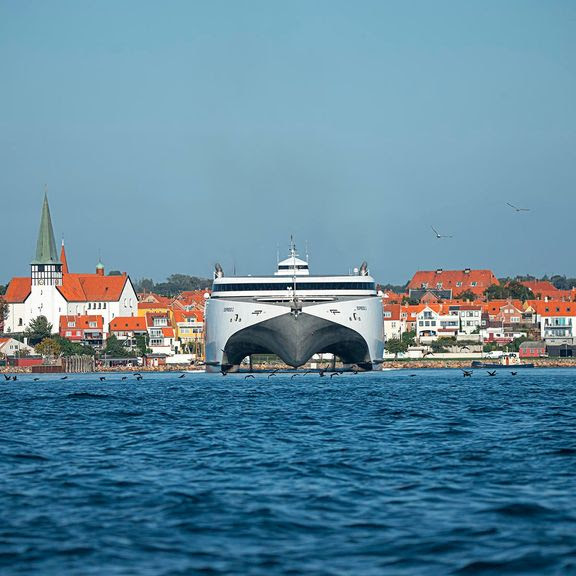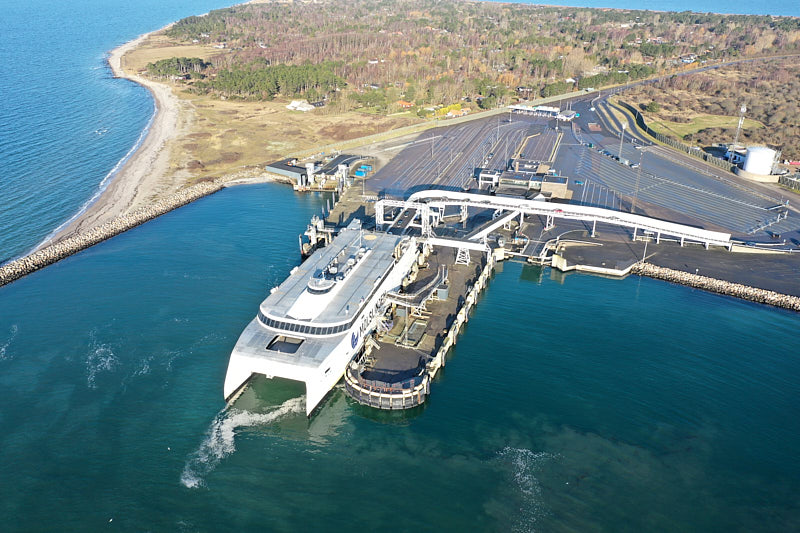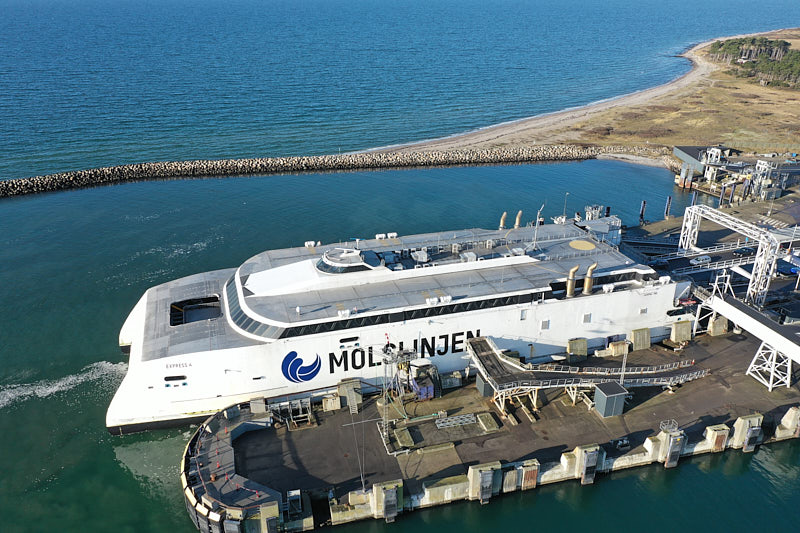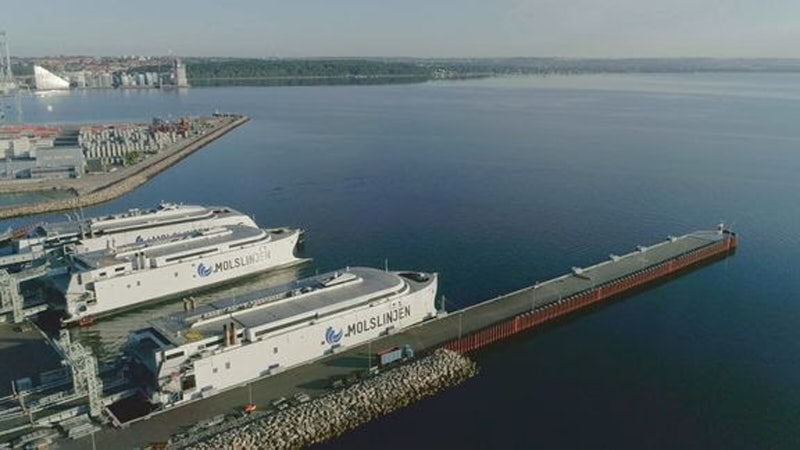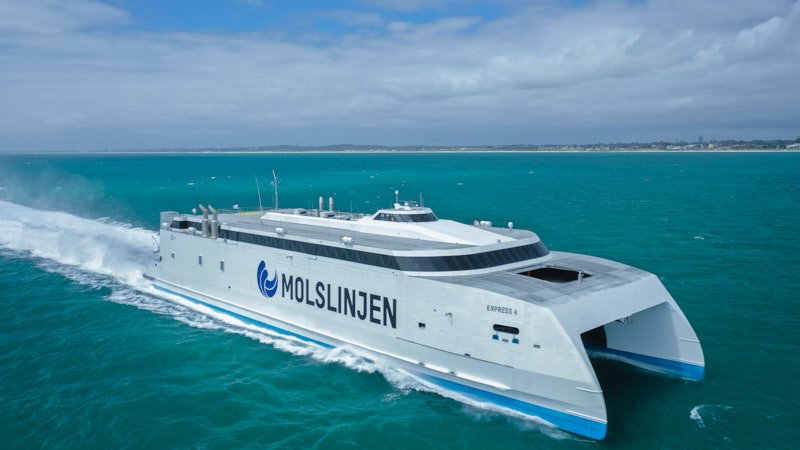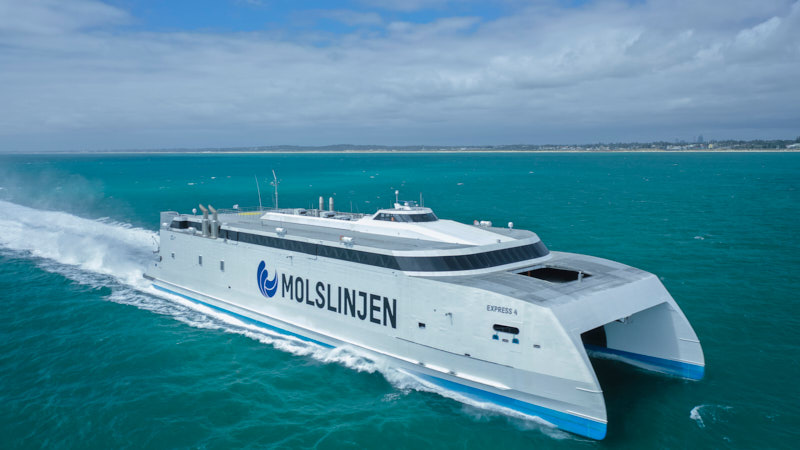

- From Easter 2023, a fast ferry will leave the Ystad-Bornholm route, as it will be replaced by newbuilding EXPRESS 5. This will allow a four-ferry operation on the Kattegat with more departures from both Aarhus and Ebeltoft.
- Four fast ferries the Kattegat has been Molslinjen’s plan since 2012, when the first large fast ferries were deployed. And from Easter 2023 the dream will come true.
- “Danes are increasingly staying at home and taking holidays domestically. Therefore, the private market is increasing right now, and we would like to support that growth by having four ferries in operation on the Kattegat”, says Molslinjen’s commercial director, Jesper Skovgaard.
- The new ferry on the Kattegat will either be EXPRESS 1 or the fast ferry MAX. The decision on which ferry will remain on Bornholm awaits the upcoming elections and a decision in the new Ministry of Transport.
- Ebeltoft departures will increase from 294 in 2022 to 656 in 2023 or 123% in the period March to October.
- At the same time, capacity is freed up to Aarhus, which will be expanded from 8,430 departures in 2022 to 8,628 departures in 2023, or an increase of 2.3%.
- That gives up to 32 daily departures between Jutland and Zealand.

- A future CO2 tax for Danish domestic ferries is set to cost Molslinjen approx. a quarter of a billion DKK per year.
- The bill will challenge the company’s ability to compete with the Great Belt Bridge on the important route over the Kattegat.
- The tax will be DKK1,125 per tonne of emitted CO2 by 2030.

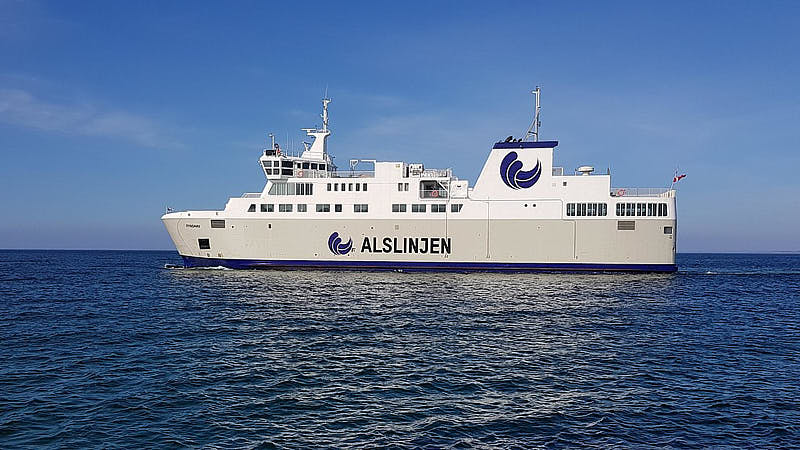
The Danish Ministry of Transport has announced that Molslinjen, after two tenders, will be awarded the next ten years for the ferry routes Alslinjen (Bøjden — Fynshav) and Samsølinjen (Kalundborg — Ballen)
Both routes will in future be operated by electric ferries powered by green electricity. The two ships will set completely new standards for electric ferries in Denmark.
NIB has signed a 7-year loan agreement with a EQT owned company to finance capital expenditures relating to electric ferries operated by Molslinjen A/S in Denmark and Torghatten AS in Norway.
The EUR 84.71 million loan, which is fully eligible to be funded by NIB Environmental Bond proceeds, will be key in realising EQT Infrastructure’s ferry capital expenditure programme during 2021-2026.
EQT Infrastructure is combining the two leading ferry companies, Molslinjen and Torghatten, under one common holding vehicle to establish a pan-Nordic floating bridge and island-to-mainland transportation infrastructure champion. The combined entity will become the leading maritime transportation company located in one of the most attractive and creditworthy regions, with a strong and resilient financial profile underpinned by robust cash flow visibility and a highly diversified route and contract portfolio.

Norway’s investment bank ‘DNB Markets’ said in a LinkedIn post that it acted as Debt Advisor in the NOK 14.3 billion Sustainability-Linked Joint Refinancing of Torghatten and Molslinjen on behalf of EQT Infrastructure.
EQT Infrastructure is combining the two leading ferry companies, Molslinjen and Torghatten, under one common holding vehicle to establish a pan-Nordic “floating bridge” and “island-to-mainland” transportation infrastructure champion.
“The combined entity will become the leading maritime transportation company located in one of the most attractive and creditworthy regions, with a strong and resilient financial profile underpinned by robust cash flow visibility and a highly diversified route and contract portfolio,” says DNB Markets.
The Kattegat’s three fast ferries have been busy like never before in the autumn holidays.
A new record has been set.
- Pax: 143,331 (117,689 passengers in the same period 2020, and in 2019 the figure was the previous record of 132,264 passengers)
- Cars: 47,271 (38,546 cars in 2020. In 2019, the number of cars was 42,031)

Molslinjen’s brand new electric ferry GROTTE was put into operation on October 1st on the route between Esbjerg and Fanø. ‘
GROTTE was design by OSK Group and built at Hvide Sande Shipyard.
It was built according to exactly the same design as the two current ferries, FENJA and MENJA, which for many years have shown their efficiency in the short Danish domestic route between Esbjerg and Nordby on the island of Fanø.
The ferries FENJA and MENJA have just switched to fossil-free biofuel. The three ferries together will reduce emissions by up to 96 percent.
Following the approval of the EU competition authorities, EQT Infrastructure is now the formal owner of Molslinjen.
- Danish Sampension will be a new minority investor in Molslinjen
- Experienced industry experts join the company’s board
- The new chairman of the board of Molslinjen will be Niels Smedegaard. (ex CEO DFDS)
- Merete Eldrup will also be part of the new board (ex CEO of TV 2 Denmark)
“We look forward to the collaboration with many new competencies in the new Board of Directors, and we are pleased that with the combination of EQT Infrastructure and Danish pension funds we get a strong starting point for an exciting future for Molslinjen”, says Carsten Jensen, CEO of Molslinjen.

The new port terminal at Østhavnen in Aarhus has been taken into service on Wednesday 11 November 2020.
“It is the culmination of a huge construction project,” says Molslinjen’s CEO, Carsten Jensen.