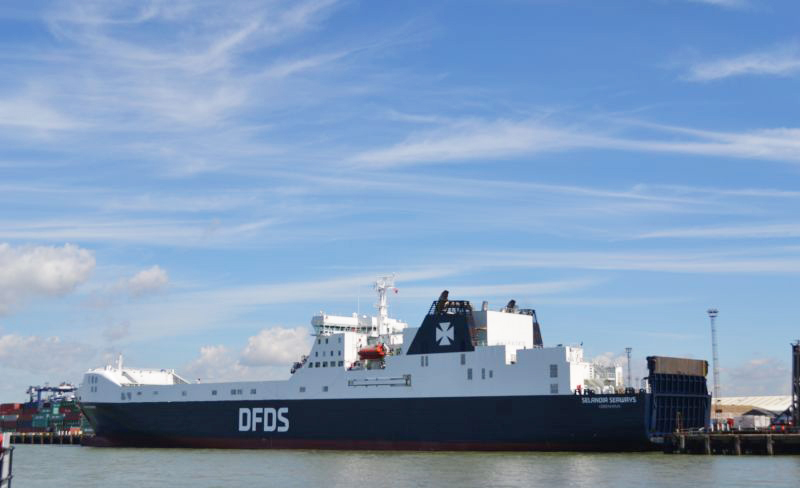
The Port of Felixstowe and DFDS have agreed to increase ro-ro capacity at the UK port by over 40% through investment in a new linkspan, tractor units and additional trailer parking facilities.
Cross-Channel Firms Challenge UK Brexit Ferry Decisions
The CEOs of Eurotunnel and Port of Calais have objected to the emergency contracts awarded by the UK government to Brittany Ferries, DFDS and Seaborne Freight to provide additional ro-ro capacity in the event of a ‘no-deal’ Brexit, threatening to take legal action.
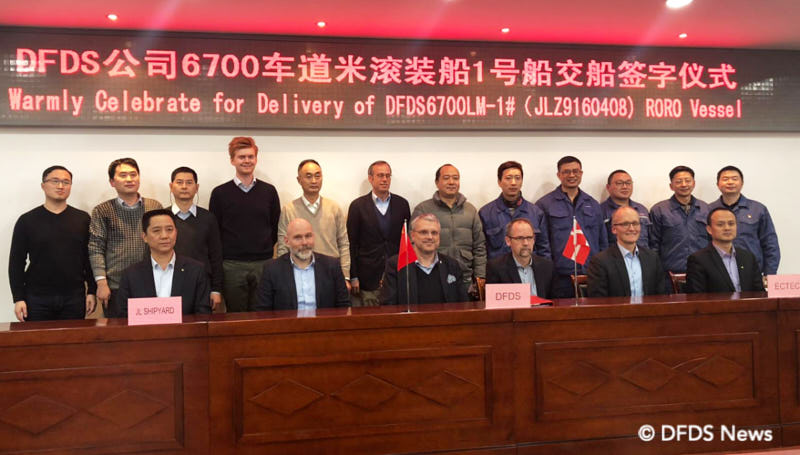
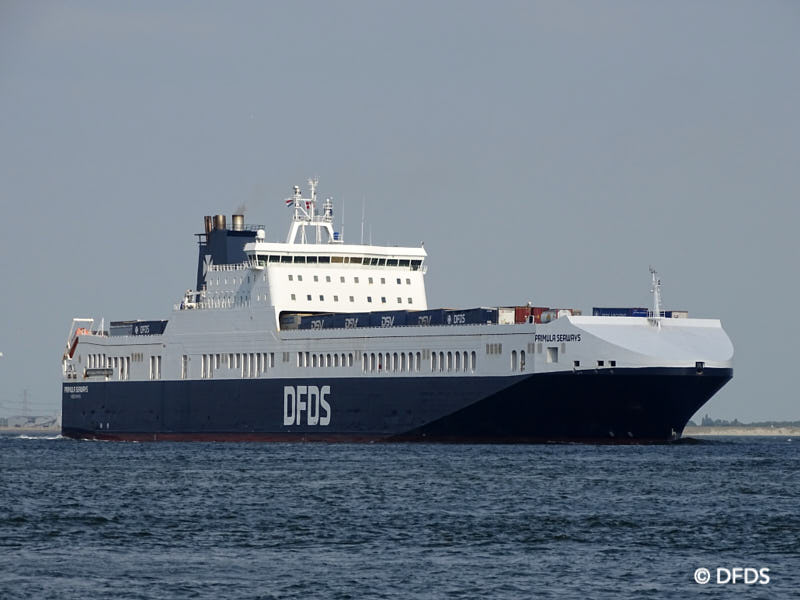
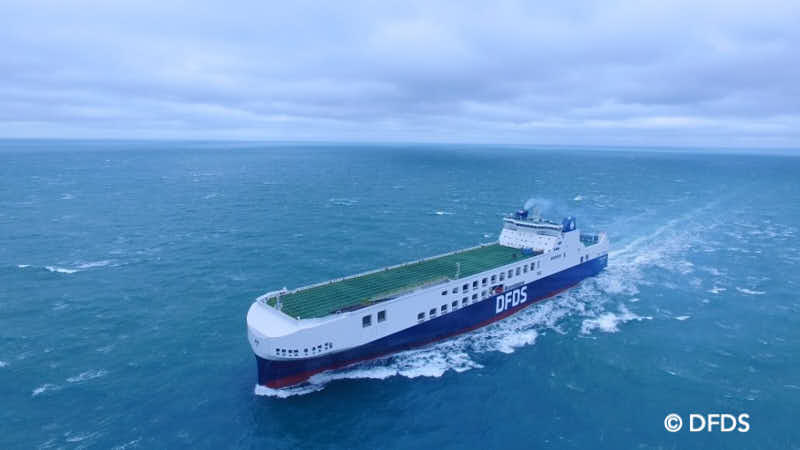
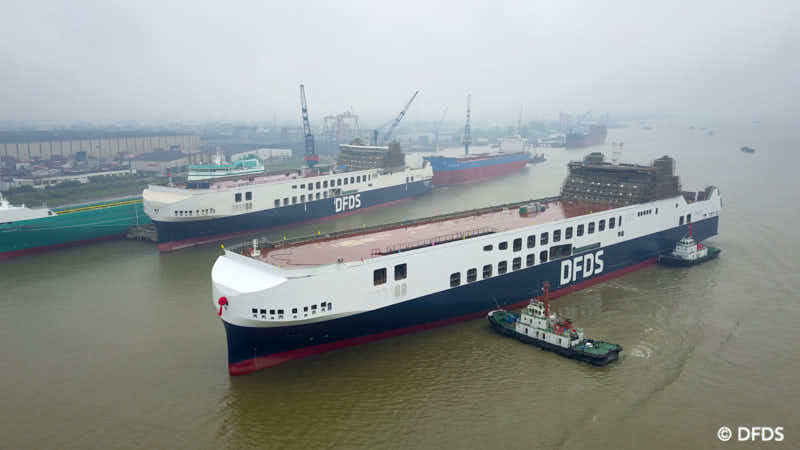
DFDS has released this aerial photo of the first Chinese ro-ro undergoing sea trials.
She and her sister are to be used on the Turkish/Mediterranean routes.
DFDS has given more details about the deal with the British Government in case of a hard Brexit.
DFDS agreed to provide additional capacity on Immingham – Cuxhaven, Immingham – Rotterdam, and Felixstowe – Rotterdam.
DFDS and Ekol Logistics, a leading Turkish transport company in the market between Turkey and Europe, have agreed just before Christmas to significantly expand their cooperation.
The agreement covers sea transport of trailers between Istanbul and Trieste. DFDS expects it to increase volumes of freight units in the Mediterranean by almost 30 %.
To accommodate those extra volumes, DFDS will:
1) expand terminal capacities. DFDS has signed a contract for the use of a recently built ro-ro terminal in Yalova, southeast of Istanbul.
2) increase ships capacity by adding more tonnage. This means the two new 450-trailer freight ferries will not be put on Ghent-Gothenburg, but on the Med route.
The recently delivered ro-ro ALF POLLAK has been put on the former U.N. Ro-Ro line too, chartered by DFDS instead of the previously announced CLdN.
Since the acquisition of U.N. Ro-Ro in 2018, DFDS has already invested in the lengthening of ships
China’s mega project, the New Silk Road, is to intensify international trade between Asia and Europe in the long term through a stronger infrastructure. The project also offers new opportunities for the Port of Cuxhaven. Due to the increasing demand in the United Kingdom for goods from China, DFDS has now established the last link of the transport chain between Great Britain and China via Cuxhaven. DFDS organises and carries out the onward road transport to the Cuxport terminal of goods arriving from China in Hamburg by rail, as well as the following sea transport from Cuxhaven to Immingham.
DFDS Extends Vlaardingen Terminal By 92,000 m2
650 trailers. This is the extra number of trailers, which DFDS will be able to accommodate at the Vlaardingen terminal when it adds the recently acquired Rotterdam Bulk Terminal’s 92,000 m2 to the current space.
The acquisition has been negotiated since 2016 and became reality on Monday 12 November when SVP Kell Robdrup signed the contract that moves the ownership to DFDS.
The work to remove the current structures and buildings have started and the terminal expects to starts using a part of the new area in April 2019. The rest will be taken in use during May 2020.
Photo below: Kell Robdrup and Hans Nagtegaal (Director Containers Port of Rotterdam) sign the sale and purchase agreement.
“Stop Trying To Delay Environmental Rules,” Says CEO DFDS
Shipowners around the world need to stop trying to delay environmental regulation and become more engaged with the sustainable developments in society according to Niels Smedegaard, Chief Executive of Danish shipowner DFDS.
The hotels and restaurants of Calais are dreaming about the return of the tax-free era, once the Brexit is a fact.
After the duty-free was abolished in 1997, Calais lost 40% of its tourist traffic. The city was used to have a lot of British day-trippers.
When Brexit was announced in April 2017, an association has been created under the name “Yes to Duty Free.” Some of its members include ferry companies DFDS and P&O, Eurotunnel and SEPD (Société d’exploitation des ports du Detroit).
REGINA SEAWAYS had an engine fire, as reported last week. Its cause is still being investigated. The company is getting ready for the ferry’s repair work and is looking for a substitution to compensate the drop in freight capacity.