

DFDS Q1, 2026: Key Figures, Info And Outlook

By 2026 Newsletter week 19
  • Revenue: DKK 7.4bn (-2%)
  • EBIT: DKK 33m (up DKK 150m; underlying +DKK 262m)
  • EBITDA: DKK 799m (+7%)
  • Adjusted free cash flow: DKK 300m (+22%)
  • CO₂e emissions (own fleet): +2.9%
  • Ferry Division improved, driven by Mediterranean freight
  • Logistics Division strengthened by Continent and Nordic units
  • Five of six turning point actions delivered earnings improvements
  • Oil price volatility from Iran/Gulf tensions creates cost risk; no volume impact yet
  • Financial leverage improved to 3.9x (target <4.0x in 2026)
  • 2026 outlook unchanged: revenue flat; EBIT DKK 1.0–1.4bn
  • Adjusted free cash flow outlook upgraded to above DKK 250m

Click on cover to access the document

DFDS Acquires RoPax Ferry STENA VINGA

By 2026 Newsletter week 19

DFDS has acquired the RoPax ferry STENA VINGA from Stena Line.

The vessel is currently chartered by DFDS and has operated on the Jersey service since its launch in March 2025.

STENA VINGA serves routes between Jersey, the UK and France, carrying both passengers and freight.

DFDS says the acquisition strengthens fleet resilience and supports its long-term commitment to Jersey.

The 125m ferry was built in 2005. It can carry up to 400 passengers, 200 cars and offers 1,500 lane metres of freight capacity.

Onboard facilities include 40 cabins, a restaurant, duty-free shop, cinema and recliner lounge.

The vessel will be reflagged under the UK flag.

DFDS plans to recruit across all ranks, creating around 70 new positions, including cadets and apprentices.

STENA VINGA will be renamed to align with DFDS’ existing fleet. Further details will follow.

The acquisition is expected to be completed in November 2026.

DFDS Raises 2026 EBIT Outlook

By 2026 Newsletter week 16

DFDS has upgraded its 2026 EBIT guidance following stronger-than-expected progress in the first quarter.

The company now expects EBIT of DKK 1.0-1.4 billion, up from the previous outlook of DKK 0.8-1.1 billion.

According to DFDS, five of the six operational turning points supporting the earnings plan performed ahead of expectations in Q1. The largest contribution came from the Mediterranean ferry network, while the sixth turning point was in line with expectations.

Further improvements are anticipated during the coming quarters.

DFDS also noted that the sharp rise in oil prices, together with a wider spread between high- and low-sulphur fuel, had a negative impact in March. Based on current market levels, this effect is expected to turn positive in Q2.

DFDS March Volumes Show Continued Good Momentum

By 2026 Newsletter week 16
  • DFDS reported total March 2026 freight volumes of 3.9 million lane metres, up 4.2% year-on-year.
  • Adjusted for route changes, freight growth was 3.0%.
  • North Sea volumes increased, driven mainly by stronger traffic between the Continent and the UK.
  • Channel volumes were above 2025 levels, supported by higher Dover Strait traffic and the ramp-up of Jersey services.
  • Baltic Sea volumes also increased, while Strait of Gibraltar traffic was above last year.
  • Mediterranean volumes were lower overall, although utilisation improved following capacity reductions on one main route.
  • Over the last twelve months, total freight volumes rose 0.6% to 41.8 million lane metres.
  • March passenger numbers, adjusted for route changes, increased 11.3% to 261,000.
  • Passenger growth was mainly driven by higher volumes on Dover Strait routes.
  • Over the last twelve months, total passengers fell 19.5% to 5.1 million, or 11.8% lower adjusted for route changes.

DFDS Expands Rosslare–Dunkerque Capacity With Third Vessel

By 2026 Newsletter week 14

From September, DFDS will increase capacity on the Rosslare–Dunkerque route by adding a third vessel and offering seven weekly roundtrips.

The additional RoPax, —OPTIMA SEAWAYS—, will join ATHENA SEAWAYS and VICTORIA SEAWAYS, which already serve the route.

DFDS said growing demand for direct links between Ireland and continental Europe is driving the need for extra capacity.

The route has previously operated as a three-ship service at various times.

DFDS to Upgrade Karlshamn–Klaipeda Service with CIUDAD DE VALENCIA

By 2026 Newsletter week 14

From mid-September 2026, DFDS will strengthen its Karlshamn–Klaipeda service with the chartered CIUDAD DE VALENCIA.

Adding the modern Visentini RoPax will bring a major increase in passenger capacity and extra freight space, supporting further growth on the Baltic route.

Built in 2020, CIUDAD DE VALENCIA can carry up to 950 passengers and offers 2,562 lane metres. Capacity includes space for 250 cars.

Compared with the vessel it replaces (OPTIMA SEAWAYS), passenger capacity will almost triple.

DFDS currently operates two RoPax ferries on the Karlshamn–Klaipeda route. It also runs four other ferries on Baltic Sea routes linking Germany and Sweden, Sweden and Estonia, and Denmark and Lithuania.

DFDS CEO Steps Down, Interim CEO Appointed

By 2026 Newsletter week 13
  • Torben Carlsen to step down as CEO on 17 April 2026
  • CFO Karen Dyrskjøt Boesen appointed Interim CEO from 18 April
  • Incoming CEO Michael Hansen to join on 1 July 2026

The succession process, launched in November 2025, is being accelerated as DFDS reports improving financial performance into early 2026.

DFDS February: Solid Freight Volumes

By 2026 Newsletter week 11

DFDS reported solid freight performance in February 2026, while passenger numbers fell due to weather disruptions and fewer sailings.

Freight

  • Total freight volumes reached 3.5m lane metres, +3.0% vs February 2025 (+1.6% adjusted for route changes).
  • North Sea: Volumes above 2025, driven by stronger flows between the Continent and the UK.
  • Mediterranean: Volumes higher on most routes despite capacity reductions on one route.
  • Channel: Volumes above 2025 thanks to new Jersey services; Dover Strait remained almost level year-on-year.
  • Baltic Sea and Strait of Gibraltar: Both reported higher volumes, despite weather-related sailing cancellations in the Strait.

For the last twelve months, transported freight reached 41.6m lane metres, +0.6% year-on-year (–1.3% adjusted for route changes).

Passengers

  • Passenger numbers in February 2026 fell 23.3% to 181,000 (adjusted for route changes).
  • The decline reflects unfavourable weather across northern and southern Europe and fewer departures on some routes.

For the last twelve months, passenger numbers decreased to 5.1m from 6.6m in 2025–24 (–5.8% adjusted for route changes).

Increasing Competition and Tonnage Deployment Between Grimaldi and DFDS

By 2026 Newsletter week 08

The competitive landscape between the shipping companies DFDS and Grimaldi Euromed on the Motorways of the Sea connecting the Turkish market with Central Europe via the port of Trieste is heating up again.

The Danish shipping company announced the deployment of the chartered-in RoRo vessel HAFNIA, adding approximately 3,300 linear metres of garage capacity to the market. “We offer the highest frequency and largest RoRo cargo capacity on the Turkey–Europe trade, with 14 weekly departures, in addition to the Egypt–Italy service,” commented Lars Hoffmann of DFDS.

A few days later, Grimaldi publicly announced that eight weekly departures had been restored on the Trieste–Patras–Ambarli–Gemport line, with a total capacity of approximately 4,000 RoRo units per week.

Furthermore, another development has been announced: “We are ready to deploy our fifth vessel, EUROCARGO BARI, on the line, aiming to reach a total frequency of ten weekly departures and a capacity of over 4,500 rolling units per week,” Grimaldi said.

Photo Lars Hoffmann on Linkedin

DFDS December 2025: Freight Volumes End the Year on a Firmer Note

By 2026 Newsletter week 03

Ferry – freight:

  • Total volumes0m lane metres were 1.2% above 2024 and 0.4% lower adjusted for route changes. The full-year growth rates were -0.1% and -1.8%, respectively.
  • North Sea volumes were above 2024 driven by higher volumes on most routes. Mediterranean volumes were as expected below 2024 due to capacity reductions.
  • Channel volumes were above 2024 driven by the new Jersey volumes as the total Dover Strait volumes were on level with 2024.
  • Baltic Sea volumes were just below 2024.
  • Strait of Gibraltar volumes were above 2024.

In 2025, the total transported freight lane metres decreased 0.1% to 41.5m from 41.5m in 2024 and decreased 1.8% adjusted for route changes.

Ferry – passenger:

  • The December decrease was mainly due to lower volumes on Strait of Gibraltar.
  • The number of cars in December was on level with 2024 adjusted for route changes.

In 2025, the total number of passengers decreased 21.1% to 5.2m compared to 6.6m in 2024. The decrease was 4.4% adjusted for route changes.

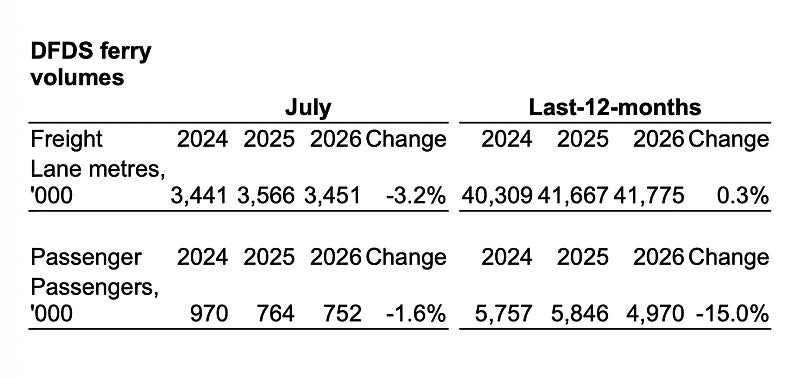
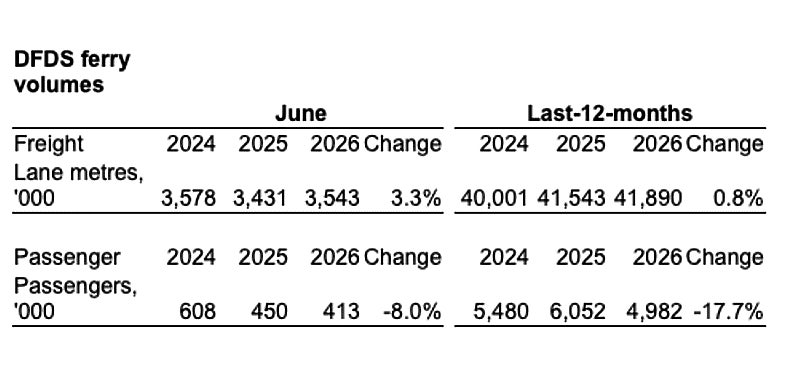
Source: click on table below to access the DFDS website