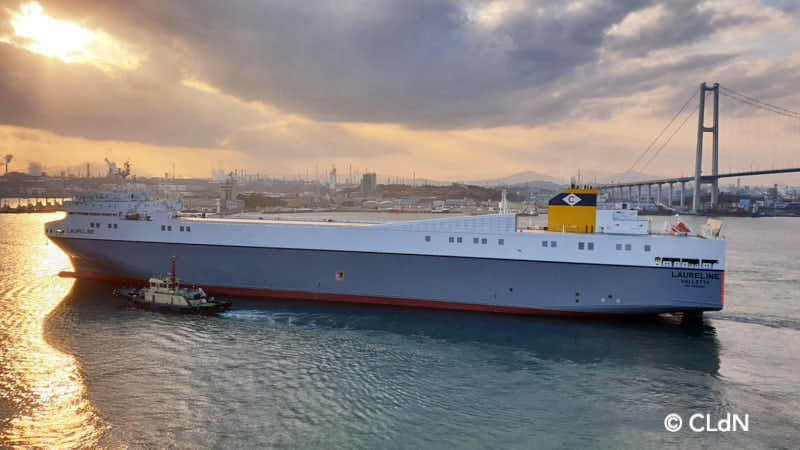

Versatility the Watchword for New CLdN Ro-Ro Series
CLdN, one of the leading lights in the European ro-ro freight business is powering ahead with fleet investment as part of an integrated transport chain, writes David Tinsley in The Motor Ship.


Versatility the Watchword for New CLdN Ro-Ro Series
CLdN, one of the leading lights in the European ro-ro freight business is powering ahead with fleet investment as part of an integrated transport chain, writes David Tinsley in The Motor Ship.

New DFDS Mega Freight Ferries n° 3 and 4 to be Deployed on Belgium – Sweden
The DFDS freight website now shows that the 3rd Chinese mega roro, Hollandia Seaways, will start to operate on Ghent – Gothenburg next week. She arrived in Sweden after the long delivery trip, which included berthing trials in Vlaardingen and Immingham.
DFDS expects in Q2, 2020 to replace the three freight ferries currently deployed on Gothenburg – Zeebrugge with the 4th 6,700 lane metre mega freight ferry. The ferries that are replaced are expected to be deployed elsewhere in DFDS’ European route network.
The first two units, Ephesus Seaways and Troy Seaways (photo), are in service in the Mediterranean Sea.
DFDS & CLdN: Space Charter Agreements on Gothenburg – Zeebrugge
In June 2019, DFDS added the freight ferry route between Gothenburg and Zeebrugge to its portfolio.
DFDS currently deploys three freight ferries, offering five weekly departures in each direction: Magnolia Seaways, Belgia Seaways and Gothia Seaways.
In order to optimise capacity utilisation, DFDS has entered into two mutual space charter agreements with CLdN that also operates a freight ferry route between Gothenburg and Zeebrugge.
The space charter agreements entail that capacity is shared between route operators while all commercial activities remain entirely under the control of each operator.
“We are very pleased to announce our new space charter agreements. The flexibility of the agreements entails that we reduce the environmental footprint while offering a total of ten weekly departures in each direction on our two routes between Sweden and Belgium to support trade and the growth of our customers”, says Peder Gellert Pedersen, Executive Vice President, DFDS Group, and Head of Ferry Division.
The space charter agreements are expected to start on 1 January 2020. When the agreements are fully implemented, DFDS and CLdN are each expected to deploy one freight ferry on their respective routes between Gothenburg and Zeebrugge.
HERMINE is yet another newbuilding for CLdN. She started to operate last week from Zeebrugge to the UK. She’s the last unit of a 5,400 lane meter quartet of Hyundai Mipo built roro ships, including LAURELINE, YSALINE and SIXTINE. Before, two larger 8,000 lane meter roro’s were delivered, the CELINE and DELPHINE.
Previously, the order for two vessels at the Uljanik Yard have been cancelled because of the financial problems of the yard.
Instead, in July 2019 CLdN placed an order for an additional two roro’s at Hyundai Mipo. The major difference will be the fact that they will use LNG as fuel.
The two roro’s will have a 320m3 capacity C-type fuel tank, located under the main deck.
The 4+2 delivered roro ships are LNG-ready.
Four more ships will be ordered, as part of a twelve-ship expansion plan.
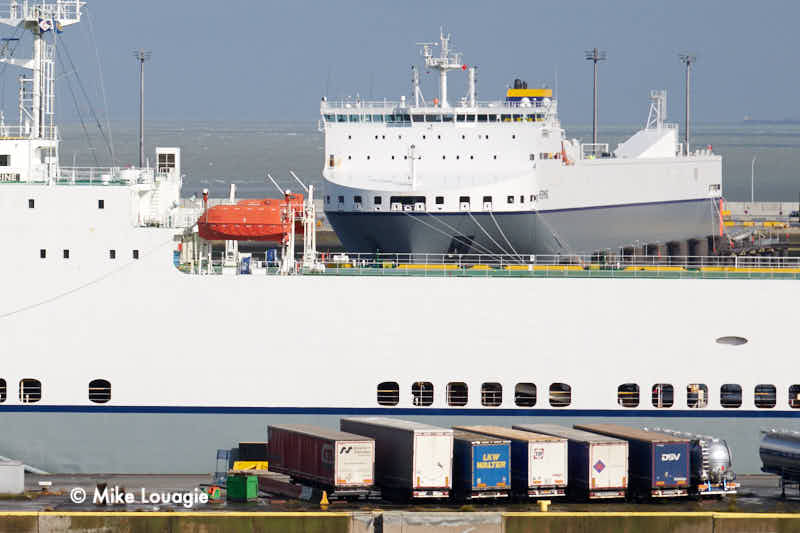
The Spanish Port of Santander closes the first half year with an increase in total traffic of 9.6% and 6.2 million tons of cargo.
It is the best half year of the last five years and represents a clear recovery of merchandise traffic since the drop experienced in 2016.
On the ferry side, the line from CLdN has driven the growth of the Margen Norte dock. In addition, ro-ro cargo moved by Brittany Ferries has increased by 8.8%.
Through its hub in Zeebrugge, CLdN links Santander with Dublin, Purfleet, Killingholme, Esbjerg and Göteborg.
Brittany Ferries has direct ro-pax connections between Santander and Cork, Plymouth and Portsmouth.
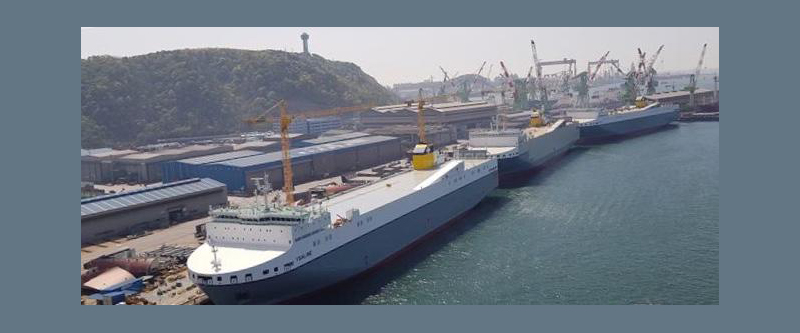
CLdN continues to work on its future, with in this picture three new ships under construction at Hyundai in Ulsan. Photo courtesy CLdN.
UK: The Brittannia Dock will become CLdN’s UK hub, in order to create further options from/to London (Purfleet) & Killingholme.
Non-UK: Albert II Dock becomes the main hub in Zeebrugge for CLdN’s non-UK related services, allowing efficient through shipments and attractive leadtimes between Santander, Göteborg, Esbjerg, Hirtshals & Dublin.
As from 26 February, CLdN increased the number of sailings on Rotterdam – Dublin from three to four in each direction, whilst improving the spread of the sailings and increasing capacity, at a time when Brexit uncertainty is a major feature in clients planning.
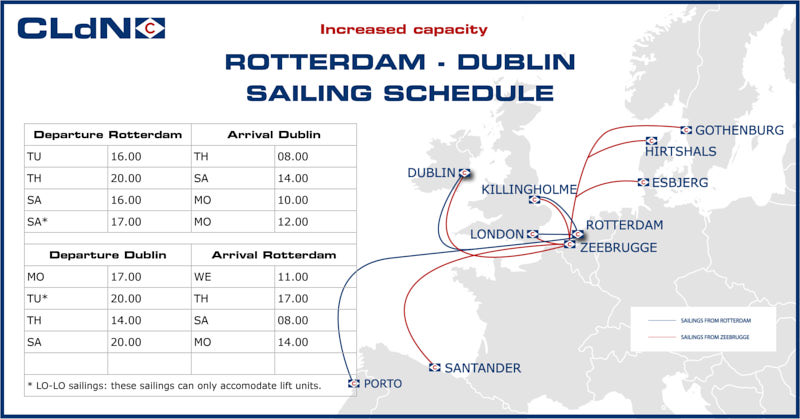
Three of the sailings will be ro-ro vessels, departing from Rotterdam on a Tuesday, Thursday and Saturday and from Dublin Thursday, Saturday and Monday.
In addition one Lo-Lo vessel will sail ex Rotterdam on Saturday and ex Dublin on Tuesday.
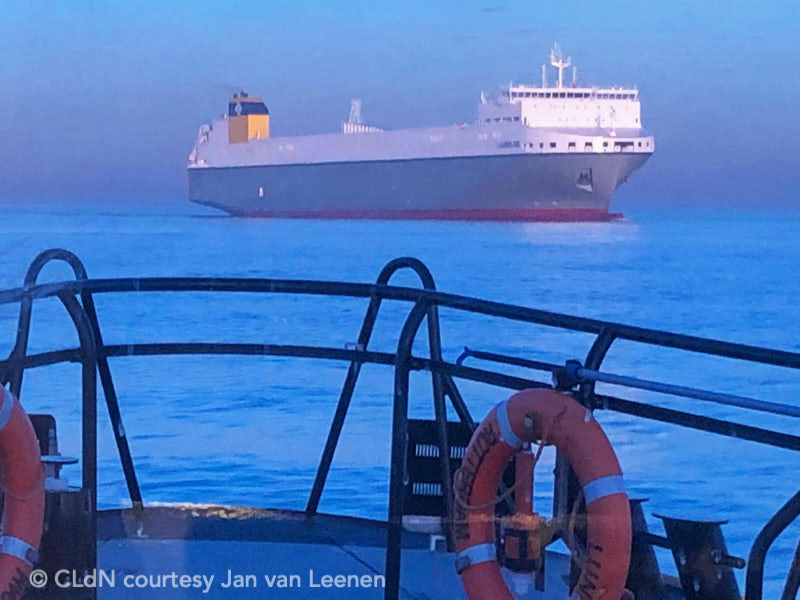
The photo (courtesy Jan van Leenen, C.Ro Ports) shows the latest addition to the fleet, the LAURELINE. After her delivery trip from Korea she arrived in Rotterdam.
CLdN has made a direct pitch to the British Government in a bid to win contracts for spill-over freight in the event of a no-deal Brexit.
Speaking directly to Chris Grayling, the British Government’s Secretary of State for Transport and Nusrat Ghani, the Shipping Minister, Phil Pannett, a CLdN representative in the United Kingdom told the ministers that there was no need for money, but that the ferry operator was set to deploy four new ferries in the coming months.
Luxemburg-registered CLdN decided to cancel the first of two 5,500 lane meter ro-ro vessels from Uljanik. The Croatian yard is experiencing a lot of difficulties and failed to meet the terms of the contract. The ships were originally planned for 2018.
In the meanwhile, Uljanik received a number of bids from potential investors.
CLdN’s First Of Four New Class Ro-Ro’s Has Been Delivered
CLdN’s new ro-ro LAURELINE is on her way to Europe. She has been successfully delivered on 11 January in Ulsan, Korea.
She is one of the first of the four new 5,000 lane meter class ships CLdN ordered.