
Ferguson Marine Engineering directors have served notice of their intent to go into administration.
The business has been involved in a long-running dispute with the Scottish government over the construction of two ferries for CalMac.
Ferguson Marine Engineering directors have served notice of their intent to go into administration.
The business has been involved in a long-running dispute with the Scottish government over the construction of two ferries for CalMac.
The rural municipality of Saaremaa decided that it will start negotiations with the company Kihnu Veeteed regarding the relaunching of the Montu-Ventspils ferry route between Estonia and Latvia.
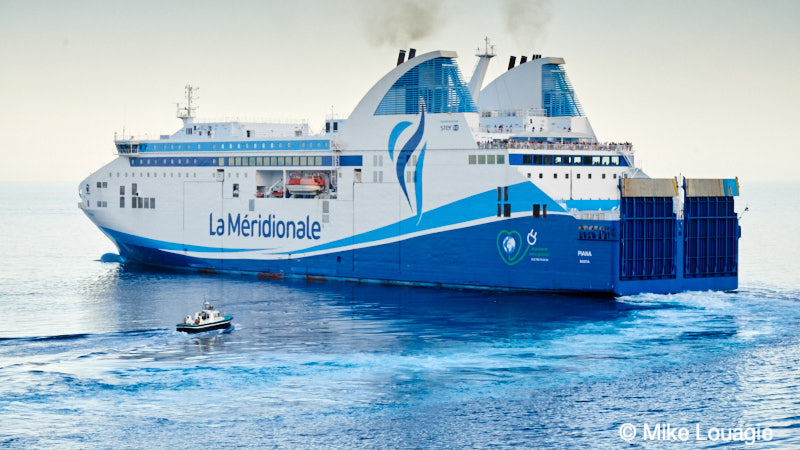
PIANA On Charter To Corsica Linea
La Méridionale’s Ro-Pax PIANA will leave the Bastia route and serve the Marseille – Porto Vecchio run for Corsica Linea, instead of PAGLIA ORBA. The latter will sail on the Marseille – Ajaccio route.
This charter of PIANA is from October 2019 to February 2020.
E-Ferry ELLEN Is Operational
E-ferry ELLEN made her first commercial trip connecting the ports of Søby and Fynshav in Denmark.
She can carry 30 cars and 200 pax. The Leclanché power pack has a capacity of 4.3MWh.
Ulstein Verft Delivered COLOR HYBRID, The World’s Largest Plug-In Hybrid Newbuilt Ro-Pax
On 1 August, the world’s largest plug-in hybrid vessel, COLOR HYBRID, was delivered from Ulstein Verft to Color Line. With all its innovative and new environmentally friendly solutions, the ship is an important milestone project for both Ulstein, Color Line and the suppliers.
Over 70% of the suppliers are from the maritime cluster in Norway.
COLOR HYBRID introduces new solutions to reduce noise and emissions. The vessel is a plug-in hybrid, where the five-megawatt batteries can be charged with environmentally friendly power from shore power in Sandefjord. The vessel will go silently in and out of the fjord of Sandefjord, without emissions. With a battery pack of 4.7 MWh, the ‘COLOR HYBRID is able to travel 12 nautical miles only on battery power.
The battery pack weighs 65 tons and can be recharged in one hour. The ship also has a heat reservoir of five megawatts which utilizes heat from both the wake and the exhaust for heating. This, together with an optimal hull construction, helps to make the vessel energy efficient and environmentally friendly.
Measuring 160 m in length and 27.1 m in the beam, the vessel has a capacity of carrying 2,000 passengers and 500 cars.
As from 16 August she will operate on Sandefjord (Norway) – Strømstad (Sweden). The crossing time is 2h30.
Remark: Recently Fincantieri redelivered the Grimaldi ferries CRUISE ROMA and CRUISE BARCELONA after lengthening. They have been equipped with large Corvus battery packs (5.5MWh), which are being charged at sea, and used in port for a better environment for the locals.
These two Italian ships can probably claim the title of ‘largest battery packs on a ferry’. The two ferries are also huge, with a gross tonnage of 63,000 and a length of 254m.
Bad Start For Ro-Pax OLYMPUS Of Sea Speed Ferries
The Port Authority of Santorini decided to impose sanctions to the damaged ro-pax OLYMPUS of Sea Speed Ferries.
These sanctions came as a result of the inspection carried out – on August 2, 2019 – which identified significant deficiencies in the area of the SOLAS, LOAD LINES, MLC 2006, MARPOL & ISM CODE.
On the morning of 1 August, OLYMPUS hit the reef called Skala Panagias, which lies between Thirassia and Aspronisi, resulting in a few meters crack in her double bottom. On the same day, a floating barrier was installed around her, as well as two absorbent pads.
However, fuel contaminants and slag were found inside the dam, resulting in the installation of a second dam.
On 3 August, the tug CHRISTOS XXVIII of the Spanopoulos Group arrived in Santorini, in order to remove the vessel. But there are some temporary repairs in progress that have to be completed first. The ship is still moored on the spot.
Scandlines Is Planning Next Steps For Emission-Free Ferry Traffic
“Full battery operation on Puttgarden-Rødby is possible if the ports can be efficiently connected to the power grid, and if the electricity becomes cheaper,” said Scandlines CEO Søren Poulsgaard Jensen to Dr. Bernd Buchholz, Minister of Economy, Transport, Labor, Technology and Tourism of Schleswig-Holstein.
“We plan to upgrade two more main engines from our ferries and replace them with battery packs that are loaded with land-based electricity during the less than 15-minute port time. But for this purpose, the capacity of the power grid in the port of Puttgarden must first be extended by an additional ten-kilometer cable from the center of the island of Fehmarn, and an on-site energy storage system must be built. Due to the currently high price difference between power produced onboard and the electricity purchased from the grid, the running costs are currently too high and thus not competitive. Therefore, we welcome the current efforts of the federal government to reduce the EEG surcharge for shore power as a first step,” said Søren Poulsgaard Jensen.
For the conversion of the ferries and the shore-side infrastructure Scandlines expects investments of approximately 100 million euros.
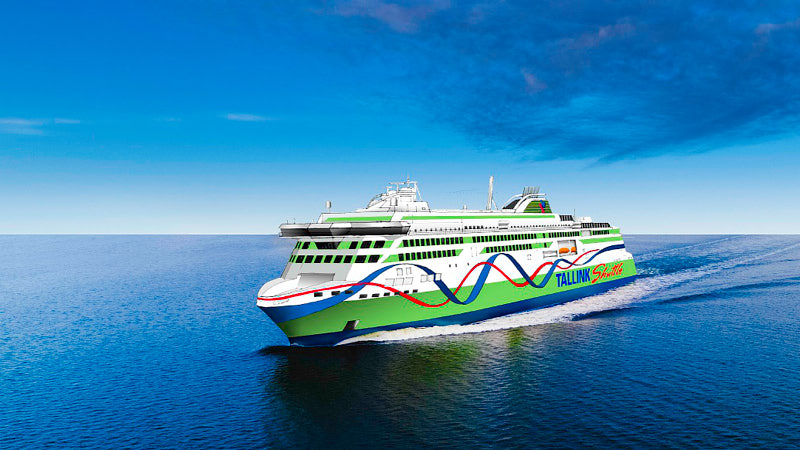
Tallink Grupp Launches Name Search For New Shuttle Vessel
Tallink Grupp has launched an international name search for its new shuttle vessel, the construction of which is due to kick off at the Rauma shipyard in Finland early next year (2020).
The shuttle vessel, which will be similar to the group’s newest vessel Megastar, operating on the Tallinn-Helsinki route since January 2017, will be completed by the end of 2021 and delivered to Tallink Grupp in January 2022. The new vessel will then start operating on the Tallinn-Helsinki route, providing conveniently frequent departures between the twin capitals of Estonia and Finland.
Names for the new vessel can be proposed by filling in a form on Tallink Grupp’s website www.tallink.com/competition . The competition is open for entries until 31 August 2019 and the winning name will be selected by the company’s Management Board by the end of September this year.
Finnlines Calculated Passenger-Specific Route CO2 Emissions
“Finnlines’ vessels are an eco-friendly choice for passengers,” says the company, now that shipping is coming under attack in the media.
Passenger-specific carbon-dioxide figures for 2018 have been calculated on Finnlines’ passenger routes, Naantali–Kapellskär, Malmö–Travemünde and Helsinki–Travemünde. The figures will be updated on a yearly basis and this will be the base for future calculations.
In 2018, CO2 emissions per passenger on routes:
Differences are due to passenger numbers and, for example, weather conditions and route choices.
Tallink Grupp Sees More Passengers On Nearly All Routes in Q2
Q2 main figures:
+0.8% Passengers (2.7 million)
+0.3% Revenue (EUR 256.1 million)
+16.5% EBITDA (EUR 50.7 million)
-2.6% Net Profit (EUR 14.0 million)
The Group’s revenue and operating result were impacted by the following operational factors:
During the first 6 months of 2019 the Group carried 1.2% less passengers and saw a decrease of 1% of revenue.
Unaudited EBITDA for the first 6 months was EUR 54.5 million (EUR 47.7 million) and unaudited net loss was EUR 10.4 million (EUR 4.3 million, 6 months 2018 net loss).
The financial result of the first 6 months of 2019 was impacted by the planned dockings of seven ships in Q1.

July Was A Record Month For Wasaline
The strategy of adding more departures for the summer season has proven a success.
The number of departures in July 2019 has increased by 30% compared to July 2018.
The total number of passengers in July was 46,073 which is an increase with almost 2,000 passengers.
Cars, caravans and campers also increased.
As a result of above figures, the overall turnover has grown with 7,1% compared to July last year.
Despite faster crossings, Wasaline has managed to keep the fuel consumption on a lower level, thanks to the continuous optimisation of fuel consumption.
