Hydrogen manufactured by community-owned wind turbines has been proposed for Scotland’s west coast ferries. The Scottish government has awarded funding for a feasibility study.
The project’s partners include CMAL.
Partners are Ferguson Marine shipyard, Siemens Gamesa Renewable Energy and Point and Sandwick Trust, operators of the community-owned Beinn Ghrideag Wind Farm on the Isle of Lewis. The latter is leading the project.
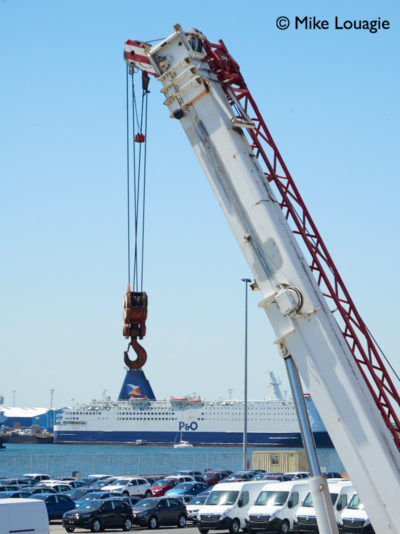
Photo: Mike Louagie
CLdN’s second newbuilt ro-ro, DELPHINE, has reached Zeebrugge on Sunday February 17. She is a sister to the 7,800 lane metre CELINE.
- DFDS have hired Michelin grade chef Søren Westh as a consultant for the Marco Polo restaurants on Copenhagen – Oslo. Westh has experience from both Noma (Copenhagen) and the legendary El Bulli restaurant in Barcelona.
The Scandlines hybrid ferry PRINSESSE BENEDIKTE uses engine waste heat to cool down the batteries. Behind the innovative system is the start-up company Cool4Sea, which used the ferry as a test lab, with the support of the EU.
The particularity of the system is that it tolerates inclinations of up to 45°, ideal for maritime use. Normally the process should not be subject to movement and vibration.
The advantage is obvious: waste heat means no fuel has to be used for air conditioning, thus saving money.
Cool4Sea expects to have the system available on the market as from 2020.[/vc_columnScandlines, hybrid_text]
Photo: Scandlines/Jukka Huotari
In 2017, Helsinki grew to become the busiest passenger port in Europe and possibly the entire world with 12.3 million passengers. Passenger numbers continued to increase on the Helsinki-Tallinn route in particular, reflecting the development of Helsinki and Tallinn into ‘twin cities’ with close economic and social ties.
A new video has been produced. One part shows the terminal where ADELTE has installed a new Seaport Passenger Boarding Bridge.
Photo: Port of Helsinki
Full-year and Q4 results for Viking Line
Viking Line’s full-year results deteriorated slightly, but the 4th quarter operating income improved significantly.
Full year key figures:
Consolidated sales €522.7 million (+0.6%)
Operating income €10.0 million (down from €13.7 million).
Passenger-related revenue €476.4 million (+0.8%)
Cargo-related revenue €43.8 million (-1.1%)
Bunker expenses increased by 18.3%, mainly because of high-speed craft VIKING FSTR.
Cargo units went slightly down. Full year results 127,668 (131,918)
Cars went up. Full year results 762,253 (682,194)
Passengers went up. Full year results 6,881,149 (6,502,191).
The increasing cargo traffic entailed higher capacity utilisation on the route’s ferries despite a minor decline in the number of cars. Capacity was increased by expanding the timetable of HAMLET by 5 hours per day since December 1, 2017.
Some figures:
- Number of departures: 12,300 (status quo)
- Freight units: 109,500 (+5%)
- Goods in tonnes: 1,252,000 tons (+4%)
- Cars: 265,000 (-2%)
- Passengers 1.44 million (-4%)
”Our freight customers appreciate the precision and reliability we offer, and they have welcomed the increased flexibility brought about by our capacity expansion and more daily departures,” said Johan Röstin, CEO of HH Ferries AB.
Photo: HH Ferries
Norwegian-headquartered TTS Group ASA has entered into a sales agreement with MacGregor, a subsidiary of Cargotec Oyj listed on Nasdaq Helsinki Stock Exchange in Finland.
The agreement implies a takeover by MacGregor of all TTS’ assets except for TTS Group ASA and its Syncrolift business.
Both companies are global providers of handling solutions and access systems and services for the marine and offshore industries. TTS has approximately 930 employees, while MacGregor activities counts approximately 2,000 employees.
TTS, proposed to be renamed Nekkar, will build its future operation around Business Unit Shipyard Solutions with its Syncrolift brand, and additionally seek new investment opportunities.
The transaction is subject to approvals from relevant competition authorities.
Red Funnel places £10m ro-ro ship order from UK yard
Red Funnel, the Isle of Wight ferry operator, has placed a £10 million order for a new ro-ro freight ferry from UK shipbuilder Cammell Laird.
The new ship is designed to provide additional year-round freight capacity for Red Funnel’s Southampton-East Cowes route, which currently handles 53% of all freight movements across the Solent.
Some particulars:
- Length 74m
- Capacity 265 lane metres freight and 12 pax
- Hull shape designed to reduce wash (sensitive operation area)
- Meeting the latest Tier III emission regulations
- Rolls Royce azimuth thrusters
- Crossing time of 1 hour
- Delivery spring 2019
Photo: Red Funnel
Two new ro-pax ferries have been ordered on February 12 for delivery in Q1 and Q3 2021 respectively.
The ships are designed to each carry 4,500 lane metres of freight and passenger vehicles, as well as 600 passengers (with up to 690 berths/250 cabins available).
The two ships will be built by Guangzhou Shipyard International Co, Ltd. at their Nansha Yard in China.
Both ships are planned to be deployed on one of the routes connecting Lithuania (Klaipeda) with either Sweden (Karlshamn) or Germany (Kiel).
The deployment in 2021 is planned to be a catalyst for a reallocation of ships in the Baltic route network ultimately increasing the network’s total freight capacity by around 30%.
DFDS opts for scrubber technology.
The ships will have a 1C ice class.
The investment in the two ships totals around DKK 1.8bn
MSC Group and Onorato Armatori signed a contract with Guangzhou Shipyard International Co., Ltd (GSI) and China Shipbuilding Trading Co., Ltd (CSTC) for 4 large ro-pax ferries, with an option for another two + two.
GNV, an MSC Group company, will receive the delivery of the first and third vessel.
Onorato Armatori (Moby, Tirrenia..) will receive the second and fourth.
Additionally, the two companies will hold options for an additional two vessels each. The first vessel will come into service in 2020.
What do we know about these ferries?
- Ro-pax ferry described by the companies as cruise ferry.
- Passenger capacity of 2,500, with 534 cabins available.
- Lane meter capacity of 3,765. (in combination with pax capacity quite impressive)
- LNG-ready engines.
- Designed by OSK-Shiptech.
- First ready end of 2020.
Photo MSC Group
The official signing ceremony, which took place on February 11 at CSSC headquarters in Beijing, was attended by Mr Dong Qiang, chairman of CSSC, Mr Pierfrancesco Vago on behalf of MSC Group, Mr Achille Onorato of Onorato Armatori and ship owner, Mr Matteo Catani, CEO of GNV, Mr Han Guangde, chairman of GSI, as well as Mr LI Hongtao, general manager of CSTC.