- Wasaline is making organizational changes to emphasize its role as a forerunner in maritime sustainability.
- Catarina Fant has been appointed as Director, Brand, Communications and Sustainability. In her new role she will also oversee strategic investments and establish contacts with partners and financiers in sustainability-related projects.
- Responsibility for marketing duties will be shifted from Fant to Marketing Manager Markku Ikonen. He reports to Head of Sales and Business Development Niina Aitamurto. Niina will lead the updated sales and marketing organization as well as the Growth Team, a cross-functional unit that is responsible for driving company growth.
- By making these changes, Wasaline responds to the growing demand in the market and stays one step ahead.
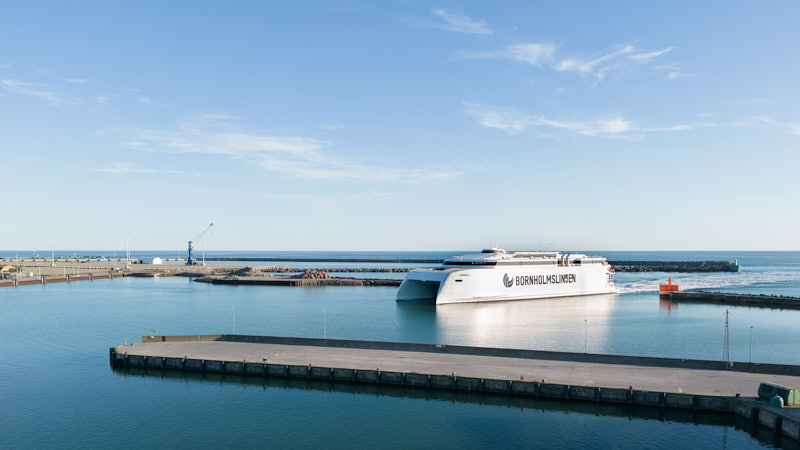
Molslinjen launched a calculator on their website, where motorists can get an estimate of how much they can save in terms of money and kilometres.
We did the test and imagined a journey from Kolding to Helsingør.
The answer was “We can’t help you save money, but you can save 21 km behind the wheel and enjoy a break on board Molslinjen.”
So, in this case it was cheaper to drive via the island of Fyn.
Godby Shipping is a proud sponsor of the non-profit project of building the sailing vessel EMELIA in Mariehamn. She will be over 25 meters long with two masts and eight sails and is planned to be ready for sailing during summer 2026.
The project will secure that the tradition of building and sailing traditional vessels is carried on to future generations. The original EMELIA was built in 1889-1890.
More info www.emelia.ax
Or in English “Boost for Gaelic language from CMAL”
- Caledonian Maritime Assets Ltd (CMAL) has released the third iteration of its Gaelic Language Plan, designed to enhance the status of the language.
- The plan sets out CMAL’s commitments to promote its use through a range of actions and initiatives, including bilingual signage at harbours and other properties; bilingual names for all ferries; Gaelic translation of communications hosted on its website and across social media. A number of employees are currently learning Gaelic.
- Incat Tasmania has handed over its latest building project, the 76m high speed passenger catamaran EL DORADO EXPRESS to South Korea.
- Reflecting the exacting requirements of her owners the bespoke new ferry, Incat Hull 099, is predominately a passenger craft with ramp and cargo space forward.
- She will operate for Daezer Ferry on the crossing between Pohang and Ulleung, an island 117 nautical miles off the eastern coast of South Korea supporting the needs of local residents and providing a service for tourists to the Islands.
- More photos on website Incat.
AI can offer several benefits to the ferry industry by enhancing efficiency, safety, and customer experience. Here are some ways AI can help the ferry industry:
- Intelligent Fleet Management: AI can optimize ferry operations by analyzing data on weather conditions, passenger demand, traffic patterns, and other factors. It can help schedule ferries more efficiently, reducing waiting times and improving overall fleet management.
- Predictive Maintenance: AI algorithms can monitor various components of ferries in real-time, analyzing sensor data to predict maintenance requirements. By detecting potential issues in advance, ferry operators can perform proactive maintenance, minimizing downtime and reducing costs.
- Enhanced Safety Measures: AI can contribute to improving safety in the ferry industry. Computer vision technologies can be employed to monitor passenger behavior, identify potential security threats, and detect abnormal activities. AI can also aid in monitoring weather conditions and predicting potential hazards to ensure safe operations.
- Intelligent Customer Service: AI-powered chatbots or virtual assistants can provide instant assistance to passengers, addressing their queries about schedules, ticketing, facilities, and more. Natural Language Processing (NLP) algorithms enable chatbots to understand and respond to passenger inquiries, improving customer experience and reducing the workload on customer service personnel.
- Automated Ticketing and Boarding: AI can streamline the ticketing and boarding processes by automating ticket validation, facial recognition-based identification, and automated passenger counting. This reduces queues and simplifies the passenger experience, leading to faster and more efficient boarding procedures.
- Route Optimization: AI algorithms can analyze historical data and real-time information to optimize ferry routes. By considering factors like passenger demand, traffic conditions, and fuel consumption, AI can suggest the most efficient routes, reducing travel time, and optimizing fuel usage.
- Environmental Impact Reduction: AI can aid in reducing the environmental impact of ferry operations. By optimizing routes, fuel consumption can be minimized, leading to lower carbon emissions. AI algorithms can also analyze data on energy usage to identify areas where energy efficiency can be improved.
Overall, AI can help the ferry industry by optimizing operations, improving safety, enhancing customer experience, and reducing costs. By leveraging AI technologies, ferry operators can achieve increased efficiency, sustainability, and profitability.
- At the Cemre shipyard in Turkey, all the steel plates for Scandlines’ new zero direct emission freight ferry PR24 (Puttgarden-Rødby 2024) have now been cut.
- All 36 sections are expected to be welded together and placed on the slipway by the end of June 2023.
- The ferry will enter service on the Fehmarn Belt in 2024 under the Danish flag and with dual crew.
- When the PR24 enters service on the Fehmarn Belt in just over a year’s time, it will sail under the Danish flag and with dual crew, which is the optimum operational solution for Scandlines.
- Preparations are also ongoing in Scandlines’ simulator in Puttgarden. A digital twin of the PR24 will be installed in the first quarter of 2024, so that the crew will have enough time to practice navigation of the PR24 before it goes into service.
- The ferry terminals in Puttgarden and Rødby must also be prepared for the use of the PR24 and the increased traffic volume, especially within freight. Scandlines has therefore carried out a comprehensive traffic study in cooperation with the construction consultancy Sweco, which forms the basis for the new terminal infrastructure. The new infrastructure will increase the capacity of the terminal areas and enable the automation of check-in as well as the use of the new freight ferry PR24.
Source: Scandlines press room
Soon the shipping companies will also have to pay for their carbon dioxide emissions. Viking Line lacks alternatives to fossil fuels and describes emissions trading as a direct tax in the short term. It is expected to cost the shipping company around 25 million euros per year.
Source: https://svenska.yle.fi
In Norway, the Eide Knudsen family in Bergen will become a new co-owner of the ferry company Fjord Line, writes Finansavisen. The brothers Tom and Iwan Eide Knudsen become owners of Fjord Line together with Frode Teigen and Johan H. Andresen.
Gotlandsbolaget closed 2022 with a strong negative operating result, above all due to extreme fuel prices. One of the measures taken to stop an escalating continued loss, was that Destination Gotland adjusted the ticket prices. The operating profit for the first quarter of 2023 is, as expected, negative due to the low season, but stabilized fuel prices and the effect of the decisions taken at the end of 2022 lead to an improvement compared to the same period in 2022.
The stabilized fuel prices have meant that Destination Gotland has been able to lower its ticket prices from April and forwards.
Quarter January-March 2023
Revenues and costs during the quarter are lower than the previous year mainly as a result of items relating to Stockholms Reparationsvarv and Hansa Destinations being included, as well as for the four product tankers that were sold in autumn 2022.
Adjusted operating profit amounted to SEK -62.9 million (-98.5), corresponding to SEK -25.2 (-39.4) per share. The improvement is due to the previous year’s result being burdened by a negative result for Hansa Destinations, as well as adjusted prices in Gotlandstrafiken and the fact that the price of fuel has stabilised.
Revenues and results are normally low during the first quarter as a result of the low season for Gotland’s hospitality industry, which also historically means a negative result.
Net sales losses on the sale of the vessels VALENTINE and HSC GOTLANDIA amounted to SEK -30.5 million.
The complete interim report for the period January to March 2023 is available here in Swedish.
Baleària‘s CAP DE BARBARIA, the first electric ferry in Spain, started sailing between Ibiza and Formentera.
With a capacity for 390 passengers and 14 trucks, it makes four daily departures in each direction.
The ferry was designed by Oliver Design and built by Astilleros Armón Vigo.