

Port of Helsinki: Growth in 2024

By | 2025 Newsletter week 15 | No Comments
  • Passenger traffic grew by 5%, with full ferry capacity reinstated on both Tallinn and Stockholm routes by autumn.
  • Cargo traffic showed a positive trend after a quiet spring – strong year-end growth in unitised traffic strengthened the port’s role as a key general cargo hub for Finland.
  • The Port and City of Helsinki progressed joint projects that will see South Harbour repurposed mainly for city residents in the early 2030s.
  • Solid financial performance:
    • Turnover: €99.6M
    • Operating profit: €9.5M
    • Net profit: €7.5M
  • Sustainability in focus:
    • Port operations’ CO₂ emissions: –2.5%
    • Overall port area emissions: –3.3%
    • Wider adoption of onshore power contributing to cleaner air.

The 2024 Annual Report – including full sustainability results – is now available on the Port of Helsinki website, or click here below.

https://www.portofhelsinki.fi/en/about-us/port-of-helsinki/port-of-helsinki-annual-report-2024/

Digital Disruption at the Terminal: What Ferry Ports Can Learn from MSC in Miami

By | 2025 Newsletter week 15 | No Comments

MSC Cruises has just opened the world’s largest cruise terminal in PortMiami, with a capacity for 36,000 passengers per day —but it’s the digital infrastructure that sets it apart. For ferry terminals looking to modernise, this is a glimpse into the future.

At the heart of MSC’s innovation is a fully biometric passenger journey—from app-based check-in and facial recognition kiosks to automated boarding gates. Passengers can scan their passport, look into a camera, and breeze through security in minutes—no paper, no queues.

Why it matters for ferry ports:

  • Biometric processing can significantly reduce embarkation time and staff load.
  • App-based check-in streamlines the journey long before passengers reach the terminal.
  • Automated boarding improves flow and security.

Even in smaller terminals, these tools can make a big impact—especially on high-frequency routes or during peak travel seasons.

Bottom line?

MSC is showing what’s possible when digital meets operational efficiency. Ferry terminals don’t need to copy the scale, but adopting smart, passenger-centric technology is now more accessible—and more necessary—than ever.

DIGITAL

By | 2025 Newsletter week 15 | No Comments

Telenor Maritime and Quvia Partner to Revolutionise Maritime Connectivity with AI Integration

Telenor Maritime and Quvia have announced a collaboration to enhance AI-driven connectivity for the cruise and ferry industry. They plan to launch a Proof of Concept integrating Quvia’s AI-powered network management solution, Grid, into Telenor Maritime’s Connectivity Platform. This initiative aims to optimize network performance and bandwidth usage, ensuring a high-quality digital experience for passengers and crew. Kjetil Kjellstadli, Chief Product Officer at Telenor Maritime, emphasized AI’s role in improving service efficiency, while Benny Retnamony, CEO of Quvia, highlighted the potential for smarter, adaptive networks at sea. This partnership aligns with Telenor Maritime’s strategy to expand its Connectivity Platform’s capabilities and supports Quvia’s mission to transform maritime connectivity.

Fincantieri and Accenture Launch Fincantieri Ingenium to Drive Maritime Digital Transformation

By | 2025 Newsletter week 15 | No Comments

Fincantieri and Accenture have launched Fincantieri Ingenium, a new joint venture aimed at accelerating digital transformation in shipbuilding and port logistics. Owned 70% by Fincantieri NexTech and 30% by Accenture, the venture combines Fincantieri’s naval engineering expertise with Accenture’s digital and AI capabilities.

Fincantieri Ingenium will focus on next-generation technologies for the cruise, defence, and port sectors. A key initiative is Navis Sapiens, a digital ecosystem designed to enhance operational efficiency and lifecycle management for ships and ports, with the first implementation expected by the end of 2025.

The venture also aims to improve sea-to-shore data exchange, boost the competitiveness of Italian ports, and support sustainability through energy optimisation.

IMAGE CARDS

By | 2025 Newsletter week 15 | No Comments

Baleària will begin operating the Tarifa-Tangier Ville route in the second week of May. The shipping company, which will launch tickets next week, will initially operate four daily services from each port, with departures gradually increasing as the summer season progresses, from early morning until late evening. Last December, Baleària was awarded this new route, which expands its presence in the Strait of Gibraltar and represents its fourth service between Spain and Morocco.

New Safety Brochure: “E-cars on Board – A Safe Passage”

By | 2025 Newsletter week 15 | No Comments

Interferry has released a new brochure addressing one of today’s most discussed maritime topics: the safety of battery electric vehicles (BEVs) on ro-pax ferries.

Drawing on recent research and findings from EU-funded projects such as Lash Fire, the brochure provides clear and accessible guidance for ferry operators, passengers, and stakeholders.

Core message: BEVs do not present a greater fire risk than conventional internal combustion engine vehicles.

Presented in a Q&A format, the publication:

  • Explains why BEV fires are statistically less frequent
  • Clarifies common misconceptions around fire causes, intensity, extinguishing methods, and fume toxicity
  • Details safe storage practices and the safety of on-board charging

“As electric vehicle numbers rise globally, so do questions about their impact on ferry safety. With the travel season approaching, it’s more important than ever for operators to provide passengers with clear and accurate information. This brochure is a practical tool to support that.”

Johan Roos, Director of Regulatory Affairs at Interferry


The brochure is free to download and share—membership not required.
Ferry operators are encouraged to make it accessible to passengers to support informed, confident travel.

Download the brochure and print instructions (ZIP, 1.2 MB): https://interferry.com/e-cars-on-board-brochure/

FINANCE

By | 2025 Newsletter week 14 | No Comments

AS Tallink Grupp: Outlook Optimistic After Though Q1

Q1, 2025

-12% passengers (970,359)

-32% cargo units (57,830)

-11% passenger vehicles (135,829)

  • Q1 passenger numbers reflect the state of the economies in Tallink’s core markets with low consumer confidence.
  • Four vessels were out of service.
  • A large-scale dry-docking had an impact on passenger numbers.
  • A significant factor was also the timing of Easter, which fell in March last year and resulted in tens of thousands more passengers during the same period.

SHIPS

By | 2025 Newsletter week 14 | No Comments

Christmas 2029: Two New Interislander Ferries for New Zealand

Big news from Minister Winston Peters: New Zealand is set to welcome two new state-of-the-art Interislander ferries by Christmas 2029, offering a crucial upgrade to Cook Strait transport – for both passengers and freight.

This is a politically sensitive project, following the cancellation of the iReX programme and the decision to build two new ferries at Hyundai Mipo Dockyard.

Key takeaways of the new project:

  • RoPax train ferries, 200m LOA, 28m wide (longer and wider than current fleet, but smaller than iRex)
  • Capacity for 1,500 passengers, 2,400 lane metres of RoRo deck, and 40 rail wagons
  • Cost-effective infrastructure: existing terminals will be reused wherever possible, with smarter upgrades in Picton and Wellington
  • A focus on affordability, reliability, and simplicity – a more pragmatic approach compared to the cancelled iReX project
  • The road and rail marshalling yards will be modestly modified, not completely rebuilt as previously planned
  • The terminal buildings in both Wellington and Picton will remain as they are today

Quotes

“While some may regret the absence of a Taj Mahal in Picton and the Sydney Opera House in Wellington, the people paying their taxes will not.”

Minister Winston Peters

 Next steps: the Ferry Holdings Ltd board will shortlist shipyards to compete on price and quality, with a ferry contract awarded later this year. Ferry Holdings will also work with Port Marlborough, CentrePort and KiwiRail to finalise the scope, progress engineering, strengthen the delivery programme and agree co-funding terms.

Speech delivered by Minister for Rail Winston Peters in the Legislative Council Chamber, Parliament, to media at the announcement of the decision on the future of the interisland ferries: https://www.beehive.govt.nz/speech/rail-ferries-and-straightforward-infrastructure

Disappointment for BC Ferries: 4, not 5 ships

By | 2025 Newsletter week 14 | No Comments

The BC Ferry Commission has approved the procurement of four new vessels—not the five BC Ferries had proposed.

That missing ship could mean longer waits, fewer sailings, and rising fare pressures in the years ahead.

“We’re disappointed,” said CEO Nicolas Jimenez. “We had a cost-effective plan to build capacity and resilience now. This decision risks missing a crucial opportunity to meet growing demand affordably.”

BC Ferries warns that the current shipbuilding conditions won’t last, and delaying the fifth vessel will likely cost more—financially and in service reliability.

The company now shifts focus to delivering four vessels while reassessing how to serve a growing population with mounting expectations.

Commissioner Eva Hage authorised the replacement of the ferry fleet’s four oldest major vessels: QUEEN OF ALBERNI, QUEEN OF NEW WESTMINSTER, QUEEN OF COQUITLAM and QUEEN OF COWICHAN.

BC Ferries is currently in the middle of a transparent, competitive global procurement process to select the highest quality, most affordable bid for the shipyard that will build the New Major Vessels. This process is expected to complete by early summer.

Stena Line Unveils Fuel-Efficient Concept Ship ‘STENA FUTURO’

By | 2025 Newsletter week 14 | No Comments

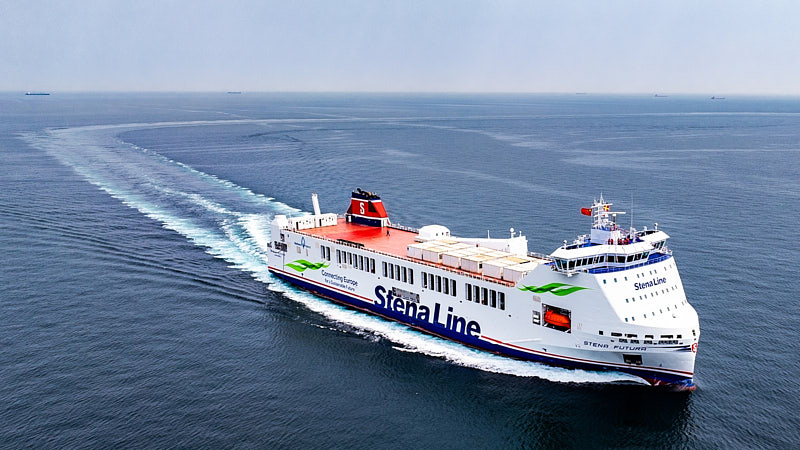
Stena Line has introduced STENA FUTURO, a next-generation RoRo concept ship designed to significantly cut fuel consumption and emissions. With a 240-metre length, it is tailored for transporting semi-trailers and cars.

Thanks to optimised hull design, streamlined structure, and hybrid propulsion, STENA FUTURO is expected to reduce energy use by over 20%. It will feature battery support, low-fuel engines compatible with various fuels, solar panels, and an air lubrication system to minimise water resistance. A waste heat recovery system will reuse exhaust energy.

Notably, the design includes four 40-metre wing sails, which recent tests showed could provide up to 15% additional fuel savings.

Stena Line aims to cut CO₂ emissions by 30% by 2030, and STENA FUTURO marks a significant step in its sustainability journey.