Fred. Olsen Express Says Goodbye to the BONANZA EXPRESS

By 2020 Newsletter week 50

Fred. Olsen Express officially announced the sale of its Incat-built BONANZA EXPRESS (1999).

Fred. Olsen Express’ fleet manager, Juan Ignacio Liaño, said in a Spanish release that the vessel has been sold to a European operator. After a refit it will go to Malta, mid-December.

This milestone is part of the continuous commitment made by the shipping company to improve the fleet. This year it incorporated the new BAJAMAR EXPRESS trimaran.

BAÑADEROS EXPRESS is scheduled for the summer of 2021.

Last minute news / to be confirmed: rumour has it that the new owner and ferry operator could be Ponte Ferries Ltd., a company registered in Malta on 20 October 2020.

The World’s Largest Electric Ferry Delivered

By 2020 Newsletter week 50

BASTØ ELECTRIC was delivered from Sefine Shipyard to BastøFosen on 7 December 2020. This marks a new era for Norway’s busiest ferry route Moss-Horten. When Bastø Electric enters operation in early 2021, it will be the starting point for electric operation, which will significantly reduce the route’s environmental footprint.

Following BASTØ ELECTRIC two of the existing ferries will be converted to electric drive before summer 2022.

High voltage charging systems are being built in Moss and Horten, capable of charging with a power of up to 9000 kW. The ferry has a large 4000 kWh battery system, enabling all electric operation. In addition, the ferry has diesel generators with sufficient capacity to maintain normal operation in case of failure of shore power.

BASTØ ELECTRIC is the world’s largest all electric ferry, with a length of about 145 m and capable of carrying 200 cars and 600 passengers.

SOLUTIONS FOR THE INDUSTRY

By 2020 Newsletter week 50

Moormaster Nxg Vital for ASKO’s Autonomous, Zero-Emission Roro Fleet and A Profitable Way to Sustainability for The Industry At Large

ASKO Maritime – the shipping arm of Norway’s largest grocery wholesaler – is doing something revolutionary in the history of shipping. Its fleet of vessels, planned to start operation early 2022, are designed to be both fully electric and autonomous. It means there will be no captain and no crew on board as the ships operate their route across the Oslo Fjord.

But of course, autonomous operations require many innovations. A key component in ASKO’s plan is a system that can automatically moor ships in port. The autonomous vessels could use their thrusters to stay in position, but this would increase energy consumption and reduce battery life. Therefore, ASKO Maritime has selected Cavotec’s next generation vacuum mooring technology, MoorMaster NxG, to moor the vessel within 30 seconds from arriving at berth.

In the words of ASKO Maritime’s CEO, Kai Just Olsen, MoorMaster NxG is “modern technology for a futuristic fleet”. We have used every minute of data from 20 years’ service to re-design MoorMaster from the ground up, to deliver easier installation and smarter operations – all in a sleeker footprint which requires 40% less depth on the quay. Now it is easy to integrate transformative MoorMaster technology at operational ferry and cargo berths across the world.

Nowhere does MoorMaster automated mooring add more value than at ferry and roro terminals with more than one call per day. By mooring in seconds, the terminal frees up valuable minutes that can be used to load more cargo or shorten turnarounds. Every minute saved in port also lets the vessels cruise slower to its next port, saving fuel and the environment.


The time savings also have a positive impact on health and safety. The fast mooring allows the vessels’ engines to be shut off faster, thereby reducing harmful emissions for port employees and nearby communities. Port accidents are also more common in compressed loading windows where stress causes mistakes. With automated mooring, ships’ crews and quayside personnel can focus on value-added activities, such as loading and unloading cargo.

It all comes down to profitable sustainability. Typically, sustainability benefits are viewed as a drag on financial results. But with automated vacuum mooring, ports and shipping companies become more profitable and at the same time contribute to a greener, less polluted world.

There is no doubt the shipping industry will embrace new, safer, more sustainable mooring practices as the rate of innovation picks up throughout the maritime supply chains. ASKO Maritime needed to adopt automated mooring for their fleet of the future.  In other ports, automated mooring can be considered a “nice to have”. Nice for the people not putting their lives on the line, nice for the environment, and nice for the company’s bottom line.

Article by Nicklas Vedin, Product Manager, Cavotec MoorMaster

FERRY PORTS

By 2020 Newsletter week 50

Stena Line Connects to Shore Power in Kiel

The new shore power facility in Kiel, inaugurated on 9 December, means that Stena Line now has the possibility to connect 14 vessels at seven terminals with onshore electricity during port stay.

The new connection in Kiel will reduce the CO2 emissions from the two vessels STENA SCANDINAVICA and STENA GERMANICA with 2,700 tonnes per year.

In total Stena Line reduce its CO2 emissions with shore power with 13,000 tonnes per year.

Covid-19 Made Algérie Ferries Lose Billions

By 2020 Newsletter week 50

General Director of the ENTMV, Guerairia Ahcene, said that the company has lost 9 billion Algerian dinars (DZD)(=EUR 57 million), due to the corona pandemic.

He said that the company is struggling to pay its employees, because of the operational stop.

Although the company is receiving its newbuilt ferry in January, the general director already knows that the summer fleet capacity is too small. He calls for more new tonnage, and new ports of call.

SHORT NEWS

By 2020 Newsletter week 50

The Trinidad and Tobago’s government newbuilding HSC A.P.T. JAMES made a short stop in Malta while en route to Trinidad. She was built at the Austal Vietnam Shipyards and delivered on November 5, 2020. She will continue her long journey making another stop to Algeciras before crossing the Atlantic Ocean.

In Trinidad, she will replace the HSC JEAN DE LA VALETTE of Virtu Ferries, which was chartered by the government of Trinidad in May 2019 in order to serve the local line and which will return to the Mediterranean service on the Valletta-Augusta or Catania line.

Hurtigruten Group has appointed Hedda Felin CEO of Hurtigruten Norway – where she will take the helm of Hurtigruten’s iconic coastal Norway operations. (press release)

The Tunisian Minister of Transport and Logistics, Moez Chakchouk, announced that he is finalising a study which would enable the national ferry company CTN to acquire new ships in 2022.

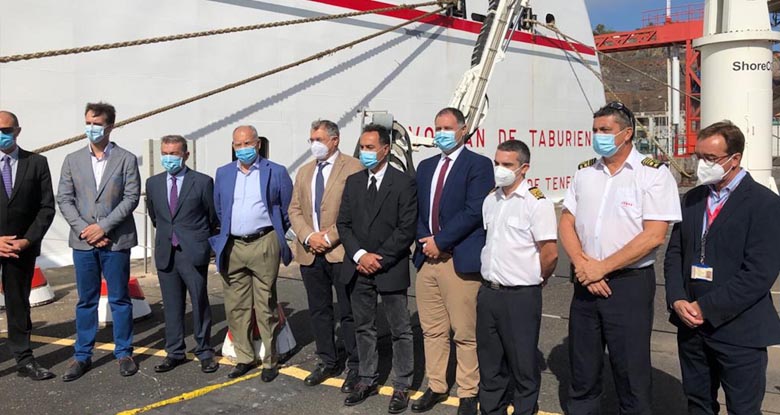
The VOLCÁN DE TABURIENTE, from Naviera Armas, is the first vessel to have been connected to shore power in the port of San Sebastián de La Gomera.

PHOTOS OF THE WEEK

By 2020 Newsletter week 50

Dwarfed

Roro MISIDA looks very small when passing THIALF and SLEIPNIR in Rozenburg, Rotterdam. The latter is Worlds’ biggest semi-submersible crane vessel, powered by LNG.

MISIDA is currently being chartered by Sea-Cargo.

FERRY SHIPPING

By 2020 Newsletter week 49

The Return of RoRo Shipbuilding in Flensburg

Flensburger Schiffbaugesellschaft (FSG) has received its first order since the restart under the direction of Tennor Holding.

IVP Ship Invest – a company of Tennor founder Lars Windhorst – is ordering a 32,770 GT, 210m long RoRo (option for a second ship) with a 4000+ lane metre capacity.

The double order is worth €140m and the first ship is planned for an April 2022 delivery.

Moby Approached Its Ad Hoc Bondholder Group with a Draft Restructuring Proposal

By 2020 Newsletter week 49

Moby has approached its ad hoc bondholder group with a draft restructuring proposal consisting of new money from a third-party fund and two alternative forms of recovery.

That’s what the news provider Reorg revealed, mentioning sources familiar with the matter.

“Under the draft plan, the creditors may be able to choose between a 30% recovery, and a smaller cash recovery which would, however, also consist in the future proceeds deriving from potential asset sales” the sources said. The proposal is not official yet and may still change.

The size and type of the new money remains unclear.

Funds Clessidra and Europa Investimenti have submitted two non-binding proposals to the Italian shipping group, but Moby seems to be more inclined to select the proposal by Europa Investimenti.

Creditors are discussing the draft proposal and have not told Moby whether they would like to continue negotiations on these grounds, sources said.

The deadline for the Onorato-controlled group to present its restructuring plan is 28 December 2020.