

Small Norwegian double ender car ferry GOMA (1968) has been sold after more than half a century of fjord crossings.
New name: POLAR LADY
New owner POLAR ATLANTIC AS, Sentrum 2, 8150 Ornes, Norway.
Small Norwegian double ender car ferry GOMA (1968) has been sold after more than half a century of fjord crossings.
New name: POLAR LADY
New owner POLAR ATLANTIC AS, Sentrum 2, 8150 Ornes, Norway.
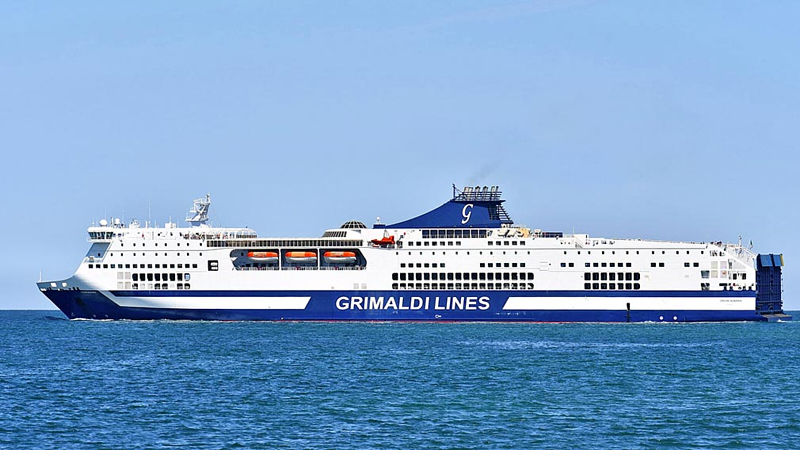
Grandi Navi Veloci obtained the RINA “biosafe ship” notation for two vessels of its fleet: RHAPSODY and GNV ALLEGRA.
Biosafe Ship is a new goal-based notation, based on many different systems, components and operative procedures to control and prevent possible onboard infection outbreak. In response to the Covid-19 pandemic, RINA has further strengthened its commitment towards a biosafe shipping by developing dedicated services for the infection prevention and control that is the first additional class notation devoted to this particular matter.
The red and white catamaran SKÅNE JET of the shipping company FRS Baltic moored in Sassnitz on September 2.
On September 17, the former Fjordline catamaran will start to operate between Sassnitz / Germany and Ystad / Sweden.
The short crossing time of only 2.5 hours will allow Germans to go on a day trip to Sweden with FRS Baltic.
Quote from Senator Claire Chandler, addressing the Australian Senate on the replacement plan for the Bass Strait ferries – Tuesday, 25 August 2020
Some Indications on the Next Tender for the Maritime Continuity in Italy
Italy’s transport ministry officially announced a public consultation among the ferry companies which will last until next September 24, in order to understand which are the operators’ intentions about the maritime continuity with the main islands (Sardinia, Sicily and Tremiti).
The former scheme, through which Rome paid Compagnia Italiana di Navigazione (Moby group) EUR 72 million per year since mid-2012, expired on July 18 but was postponed until February 28, 2021.
First indications reported by the Transport ministry in a purpose-built paper suggest that different tenders might be launched for some specific routes or market areas and that more than one company could operate with public subsidies on the same link. In case of high prices there might be some sort of subsidies directly addressed to the final users, thus introducing the model existing in Spain.
As of today the following routes are those included for the full year in the public subsidies scheme in Italy: Cagliari-Palermo, Napoli-Cagliari, Civitavecchia-Cagliari-Arbatax, Genova-Olbia-Arbatax and Termoli-Tremiti (served with ro-pax ships) and Ravenna-Brindisi-Catania and Livorno-Cagliari (with ro-ro cargo vessels).
The three maritime links Napoli-Palermo, Genova-Porto Torres and Civitavecchia-Olbia are included in the scheme from October to May and operated without subsidies during the summer season.
The Napoli-Palermo is likely to be cancelled as publicly supported line while for all the other routes analyses by the Minister are still underway.
To minimize the negative effects caused by the coronavirus situation, Viking Line will reorganize the land-based organization by adapting staff resources to the weaker demand and begin cooperation negotiations. The negotiations will affect all of the company’s land-based staff of about 570 people in Finland, Sweden, Estonia and Åland.
Tallink Grupp suspends the Turku-Tallinn route, which was temporarily launched in early July and which it originally planned to continue to operate throughout the coming autumn-winter season on weekends.
The route had proved extremely popular among the company’s customers during the summer period after travel restrictions were lifted between the two neighbouring countries.
„As a direct result of significant information noise and mixed messages circulating in the Finnish media, the ticket sales have significantly reduced as passengers are confused about the travel advice and nervous about a possibility of a quarantine. This has resulted in great numbers of customers cancelling their trips and requesting refunds instead,” Paavo Nõgene, CEO of Tallink Grupp commented.
“The tourism sector will be under significant pressure until at least until next summer. Decisive action by our governments is vital and requires swift action for the survival of our sector in this pandemic situation,” Nõgene said.
COVID-19 had a significant impact on first quarter results (April-May-June)
At the outset of the pandemic, ferry traffic dropped dramatically and was down 75 to 80% across the system in a matter of days. With the easing of travel restrictions, traffic at the end of June partially recovered and was down approximately 35% compared to this period last year.
BC Ferries is one of the entities included in the federal government’s transit funding of $540 million in response to the impact of COVID-19. This transit funding is to be matched equally by the Province for a total funding envelope of CAD 1.08 billion.
Tallink CEO: Finland Quarantine on Estonians Would Knock Out Tourist Sector
The coronavirus infection rate in Estonia increasing to a point where Finland would impose a quarantine requirement would be the worst possible scenario for Estonian tourism, CEO of Tallink Grupp Paavo Nõgene told ERR on Monday.