
Moby Going On Serving Routes Until End of February

By 2020 Newsletter week 50

After some alarms raised over the maritime continuity in Italy during the last weeks, eventually Tirrenia Cin will go on serving the subsidised routes with the Tremoli, Sicily and Sardinia islands until the end of February.

The decision came after a meeting where the Italian transport ministry made sure that the condition and the financial resources for Moby group will be granted in change for the service offered.

The public contract for the subsidized maritime links between Italy mainland and the islands expired last July but was postponed until 28 February 2021.

The Italian financial newspaper IlSole24Ore also revealed that Moby selected the investment funds Arrow Capital and Europa Investimenti as preferred financial partner for setting up a debt restructuring and turnaround plan to be submitted to bondholders and banks before 28 December 2020, which is the expiring date decided by the Court of Milan.

Three-Year Charter Contract for New RoRo LIEKUT

By 2020 Newsletter week 50

The Flensburg newbuilt LIEKUT finally found a home to operate. The roro vessel will join the SeaRoad fleet for three years, as from March 2021.

She will replace SEAROAD TAMAR on the Bass Strait (Tasmania-Australia) until SeaRoad’s new vessel is constructed.

SeaRoad’s new permanent vessel is scheduled to come online in the second half of 2023.

Ferry Shipping News asked if a ship had already been ordered. “It’s still being negotiated with shipyards,” said the SeaRoad spokesperson.

LIEKUT’s ship owners, Siem, will complete modifications in Poland prior to her delivery, including strengthening decks, installing barriers and drainage, and modifying the stern ramp to suit LIEKUT’s new home port of Devonport.

DFDS ‘Ark’ Fleet Reshuffle

By 2020 Newsletter week 50
  • ARK FUTURA will leave the Ark (*) cooperation during December 2020, and this has triggered a reshuffle in the fleet.
  • MAGNOLIA SEAWAYS and FINLANDIA SEAWAYS will join the Ark fleet.
  • FINLANDIA SEAWAYS will be reflagged from the Lithuanian flag to the Danish flag from January 2021.
  • MAGNOLIA SEAWAYS will enter the Ark fleet in 2022.
  • ARK FUTURA becomes FUTURA SEAWAYS
  • The seven ships that will be part of the Ark cooperation are thus ARK DANIA, ARK GERMANIA, SUECIA SEAWAYS, MAGNOLIA SEAWAYS, BRITANNIA SEAWAYS, FINLANDIA SEAWAYS.

(*) The ARK Project is a Danish–German collaboration that ensures Danish and German military access to, and availability of, capacity for maritime transport in accordance with the nations’ own obligations to NATO.

Fred. Olsen Express Says Goodbye to the BONANZA EXPRESS

By 2020 Newsletter week 50

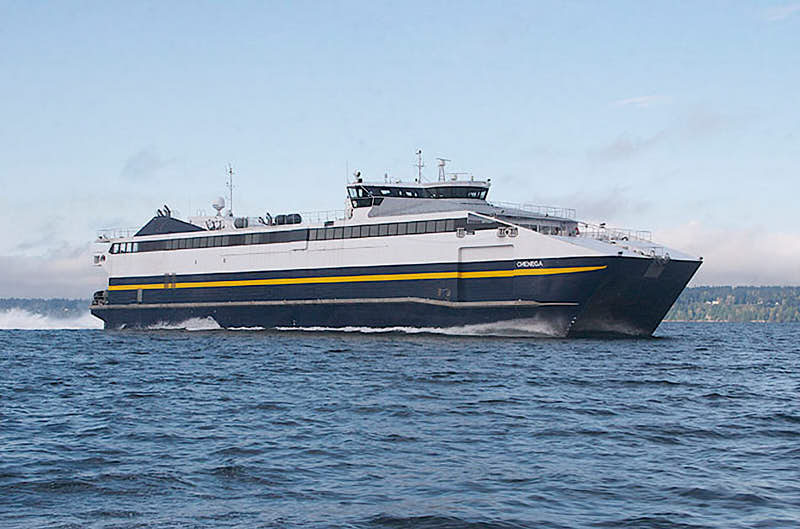
Fred. Olsen Express officially announced the sale of its Incat-built BONANZA EXPRESS (1999).

Fred. Olsen Express’ fleet manager, Juan Ignacio Liaño, said in a Spanish release that the vessel has been sold to a European operator. After a refit it will go to Malta, mid-December.

This milestone is part of the continuous commitment made by the shipping company to improve the fleet. This year it incorporated the new BAJAMAR EXPRESS trimaran.

BAÑADEROS EXPRESS is scheduled for the summer of 2021.

Last minute news / to be confirmed: rumour has it that the new owner and ferry operator could be Ponte Ferries Ltd., a company registered in Malta on 20 October 2020.

The World’s Largest Electric Ferry Delivered

By 2020 Newsletter week 50

BASTØ ELECTRIC was delivered from Sefine Shipyard to BastøFosen on 7 December 2020. This marks a new era for Norway’s busiest ferry route Moss-Horten. When Bastø Electric enters operation in early 2021, it will be the starting point for electric operation, which will significantly reduce the route’s environmental footprint.

Following BASTØ ELECTRIC two of the existing ferries will be converted to electric drive before summer 2022.

High voltage charging systems are being built in Moss and Horten, capable of charging with a power of up to 9000 kW. The ferry has a large 4000 kWh battery system, enabling all electric operation. In addition, the ferry has diesel generators with sufficient capacity to maintain normal operation in case of failure of shore power.

BASTØ ELECTRIC is the world’s largest all electric ferry, with a length of about 145 m and capable of carrying 200 cars and 600 passengers.

SOLUTIONS FOR THE INDUSTRY

By 2020 Newsletter week 50

Moormaster Nxg Vital for ASKO’s Autonomous, Zero-Emission Roro Fleet and A Profitable Way to Sustainability for The Industry At Large

ASKO Maritime – the shipping arm of Norway’s largest grocery wholesaler – is doing something revolutionary in the history of shipping. Its fleet of vessels, planned to start operation early 2022, are designed to be both fully electric and autonomous. It means there will be no captain and no crew on board as the ships operate their route across the Oslo Fjord.

But of course, autonomous operations require many innovations. A key component in ASKO’s plan is a system that can automatically moor ships in port. The autonomous vessels could use their thrusters to stay in position, but this would increase energy consumption and reduce battery life. Therefore, ASKO Maritime has selected Cavotec’s next generation vacuum mooring technology, MoorMaster NxG, to moor the vessel within 30 seconds from arriving at berth.

In the words of ASKO Maritime’s CEO, Kai Just Olsen, MoorMaster NxG is “modern technology for a futuristic fleet”. We have used every minute of data from 20 years’ service to re-design MoorMaster from the ground up, to deliver easier installation and smarter operations – all in a sleeker footprint which requires 40% less depth on the quay. Now it is easy to integrate transformative MoorMaster technology at operational ferry and cargo berths across the world.

Nowhere does MoorMaster automated mooring add more value than at ferry and roro terminals with more than one call per day. By mooring in seconds, the terminal frees up valuable minutes that can be used to load more cargo or shorten turnarounds. Every minute saved in port also lets the vessels cruise slower to its next port, saving fuel and the environment.

The time savings also have a positive impact on health and safety. The fast mooring allows the vessels’ engines to be shut off faster, thereby reducing harmful emissions for port employees and nearby communities. Port accidents are also more common in compressed loading windows where stress causes mistakes. With automated mooring, ships’ crews and quayside personnel can focus on value-added activities, such as loading and unloading cargo.

It all comes down to profitable sustainability. Typically, sustainability benefits are viewed as a drag on financial results. But with automated vacuum mooring, ports and shipping companies become more profitable and at the same time contribute to a greener, less polluted world.

There is no doubt the shipping industry will embrace new, safer, more sustainable mooring practices as the rate of innovation picks up throughout the maritime supply chains. ASKO Maritime needed to adopt automated mooring for their fleet of the future.  In other ports, automated mooring can be considered a “nice to have”. Nice for the people not putting their lives on the line, nice for the environment, and nice for the company’s bottom line.

Article by Nicklas Vedin, Product Manager, Cavotec MoorMaster

FERRY PORTS

By 2020 Newsletter week 50

Stena Line Connects to Shore Power in Kiel

The new shore power facility in Kiel, inaugurated on 9 December, means that Stena Line now has the possibility to connect 14 vessels at seven terminals with onshore electricity during port stay.

The new connection in Kiel will reduce the COemissions from the two vessels STENA SCANDINAVICA and STENA GERMANICA with 2,700 tonnes per year.

In total Stena Line reduce its COemissions with shore power with 13,000 tonnes per year.

Covid-19 Made Algérie Ferries Lose Billions

By 2020 Newsletter week 50

General Director of the ENTMV, Guerairia Ahcene, said that the company has lost 9 billion Algerian dinars (DZD)(=EUR 57 million), due to the corona pandemic.

He said that the company is struggling to pay its employees, because of the operational stop.

Although the company is receiving its newbuilt ferry in January, the general director already knows that the summer fleet capacity is too small. He calls for more new tonnage, and new ports of call.