
SNCM is dead but its ghost continues to haunt the public authorities… and Corsica Ferries

By 2021 Newsletter week 46

The Corsica executive council has decided not to include the fine of EUR 86.3 million in the 2021 supplementary budget of the Collectivité de Corse (CDC).

At the end of September, the CDC had been definitively ordered by the Council of State to pay EUR 86.3 million to Corsica Ferries, in compensation for the damage linked to the illegal subsidies of its former competitor SNCM, between 2007 and 2013.

CDC refuses to pay and wants the French State to take its responsibilities. To be continued…

Six companies selected to design a zero-emission fast ferry

By 2021 Newsletter week 46

Six companies have received a contract to develop a high-speed zero-emission fast ferry: Eker Design, ESNA, LMG Marin, SES-X, Transportutvikling and Umoe.

The contract was signed on 5 November 2021 by the director for transport in Trøndelag (Norway).

In May 2023, the design part of the project will be completed. The goal is then to have developed a zero-emission fast ferry with a minimum of 30% lower energy consumption compared to today’s vessels.

The project is supported by Klimasats, a support scheme under the Norwegian Environment Agency for reducing greenhouse gas emissions.

Is the DFDS – P&O Ferries capacity sharing agreement distorting competition?

By 2021 Newsletter week 46

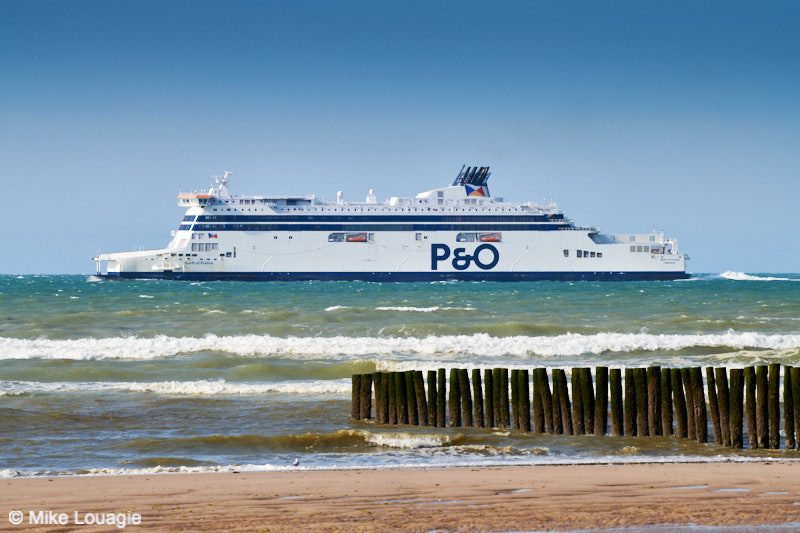
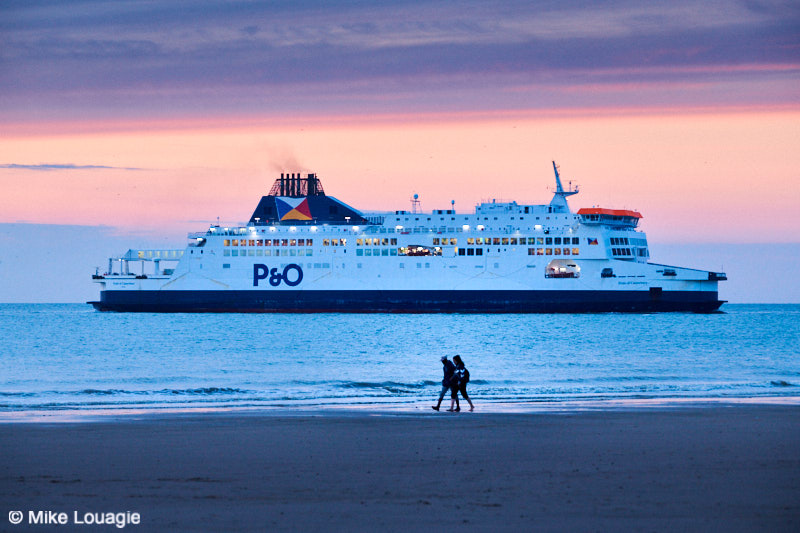
United Kingdom’s CMA (Competition and Markets Authority) is investigating whether a capacity sharing agreement between P&O Ferries and DFDS, on the Dover-Calais route has potential to prevent, restrict or distort competition within the UK.

The investigation has been launched on 11 November 2021.

The P&O and DFDS freight space agreement commenced on 7 November. Drivers are allowed to embark on the next available ferry, either from DFDS or P&O.

If going with DFDS or P&O, truck drivers have a ferry every 37 minutes.

Competitor Irish Ferries will have a departure every 2 ½ hours, once the second ship enters the route. [FSN Week 45]

Another competitor is GetLink, the ‘tunnel’.

Back in 2013, the UK Competition Commission ruled that Eurotunnel, which leased the three MyFerryLink vessels to the SCOP, could no longer operate ferry services from Dover.

Reason: the proportion of the cross-Channel market that Eurotunnel held as a result.

In 2015 Eurotunnel sold ropax ferries RODIN and BERLIOZ to DFDS.

Name swap at Destination Gotland

By 2021 Newsletter week 46

From week 47 to week 49, the LNG RoPax VISBORG will embark on a planned shipyard visit in Landskrona.

In connection with this, the ship will also change its name to VISBY. (Destination Gotland’s newest ships are always named VISBY and GOTLAND.

The older VISBY will have its new name in January 2022: VISBORG. She is actually on a charter to DFDS for the France-Ireland service.

Seajets’s Aqua Star will enter service from February 2022

By 2021 Newsletter week 46

Towards a new career within the Hellenic Coastal Shipping is heading the Seajets’ AQUA STAR (former AZORES EXPRESS).

The ship is currently at Chalkis Shipyards undergoing some interior refit and she is expected to connect the port of Volos with Skiathos-Skopelos-Alonissos at the end of February 2022.

Seajets is investing in that line following its success on the Thessaloniki-Sporades-Evia line with HSC SUPERRUNNER JET last summer.

photo: Kostas Papadopoulos

Ignazio Messina’s deep-sea RoRo network now includes Koper in the North Adriatic

By 2021 Newsletter week 46

Ignazio Messina & c. added the Slovenian port of Koper to its network of routes between Mediterranean basin, Africa and Middle East.

“We are excited to announce that Ignazio Messina & C. has set up a new weekly service, which will connect Koper with East and South Africa, Persian Gulf and India. Vessels can accept various roro and project cargoes” is written in a statement from the Slovenian port authority.

The local agent in Koper is Neptune International Shipping d.o.o.

More specifically Ferry Shipping News understands that Neptune’s vessel will transport cargo from and to Koper for Messina. The cargo will be transshipped in the Egyptian port of Alexandria for further sailing to and from the Indian Ocean

New train/ropax ferry IGINIA delivered to RFI for the Strait of Messina

By 2021 Newsletter week 46

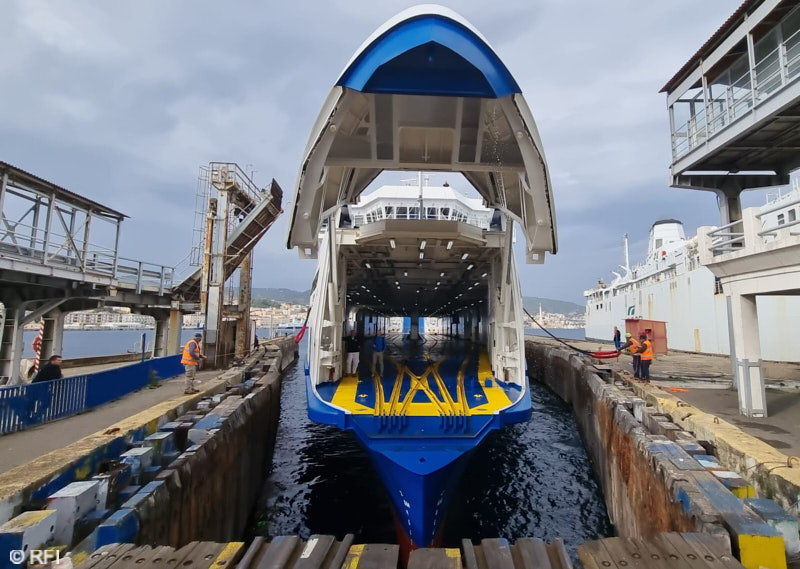
The new ropax ferry ordered by Rete Ferroviaria Italia (RFI) and built in Genoa at San Giorgio del Porto and T. Mariotti shipyards has been successfully delivered in the port of Messina.

The ferry, suitable for the transportation of railway carriages, wagons, passengers, and vehicles, will soon enter service in the Strait of Messina.

The hull of the new unit (equipped with engines, generators, propulsion machinery and systems) was built in Porto Nogaro by Cimar shipyard and then towed to Genoa.

This new ship is LNG-ready.

A tender for the construction of a sister unit was launched last August and is expected to be awarded before the end of this year.

Scandlines orders zero-emission freight ferry for the Puttgarden-Rødby route

By 2021 Newsletter week 45

An emission-free freight ferry will be built for Scandlines

  • Design and builders: LMG Marin and Cemre Shipyard
  • The ferry will enter service in 2024
  • Route Puttgarden-Rødby
  • Capacity: 66 freight units (+23% compared to the ships it will replace, HOLGER DANSKE and KRONPRINS FREDERIK).
  • Crossing time 1 hour, if fully electric
  • Crossing time 45 min. if hybrid
  • The ferry can also be used as backup ferry for one the four current double-ended ferries
  • Berth 3 in Rødby and Berth 1 in Puttgarden must be rebuilt to also load lorries on the upper deck.
  • A new lorry storage area will be established in the terminal of Puttgarden.
  • The ferry will initially exclusively charge in Rødby. Already in 2019, Scandlines invested in a 50 kV / 25 MW power cable to Færgevej in Rødbyhavn. This cable will now be extended to the ferry berths, where a transformer and charging station will be installed. In the longer run, the plan is to also be able to charge in Puttgarden when a good solution has been found for the purchase of green energy.
  • The modular construction of the vessel makes it possible to later adjust the vessel in order to also carry cars.
  • Length: 147.4 m
  • number of passengers: 140
  • Service speed: 18 knots

Finnlines’ financial review January–September 2021: result on the upturn during Q3

By 2021 Newsletter week 45

January–September 2021

+17% Revenue EUR 425.9 million (EUR 363.1 million in 2020).

+27% Result EUR 69.0 million (EUR 54.2 million)

EBITDA EUR 121.2 (107.2) million

Cargo units 583,000 (536,000 in 2020)

Cars 124,000 (102,000)

Tons of freight not possible to measure in units 1,041,000 (811,000)

Passengers and truck drivers 439,000 (390,000)

  • An upward trend continued during Q3 when cargo volumes increased nearly on all routes.
  • The automotive industry suffered from shortage of components and the summer stoppage was longer than anticipated. However, as the Finnlines fleet consists of vessels in different sizes, capacity could be moved from routes with temporarily declining demand to others where larger capacity was needed.
  • When travel restrictions were gradually eased, recreational travel recovered although passenger numbers remained far below the normal level.
  • To reach the ambitious goal of becoming carbon neutral, it may be necessary to modify existing ships with new tanks and engines so that they can run on new types of fuel. However, at current rates of production, zero-carbon fuels are not commercially available at the scale needed for the global fleet. Today, Finnlines concentrates on new battery technology, hydrodynamic design in vessels, air lubrication systems and solar panels on its newbuilds. Several existing ships will be equipped to use onshore power where available. Moreover, gradual transition to carbon-free and renewable fuels is being investigated.
  • The construction of three hybrid ro-ro vessels and two state-of-the-art ro-pax vessels is proceeding.
  • Energy efficiency is the best way to reduce the emissions and reach immediate results.