

ESPO Regrets Postponement of IMO Net-Zero Framework

By | 2025 Newsletter week 43 | No Comments

The European Sea Ports Organisation (ESPO) has expressed serious concern over the International Maritime Organisation’s decision to postpone adoption of the Net-Zero Framework (NZF) by one year. The delay, agreed at the MEPC meeting in London, risks slowing global climate ambition and the pace of maritime decarbonisation.

The NZF was intended to set a global regulatory framework for shipping emissions, including a fuel standard and carbon pricing mechanism. ESPO called the postponement a missed opportunity, warning it could prolong regulatory fragmentation and undermine the momentum for a unified global approach.

ESPO urges the European Commission to maintain progress through tax incentives for clean fuels, subsidies, and ETS revenues directed towards onshore power supply and clean fuel infrastructure.

“The postponement should not lead to a cancellation of ambition,” ESPO stated, calling on governments, industry, and civil society to stay engaged in developing a credible and ambitious global framework for shipping’s energy transition.

ESPO Welcomes Continuation of CEF Programme

By | 2025 Newsletter week 43 | No Comments

The European Sea Ports Organisation (ESPO) welcomes the European Commission’s decision to continue the Connecting Europe Facility (CEF), ensuring continued EU funding for developing and upgrading Europe’s transport and energy networks.

ESPO highlights the geostrategic role of ports as multimodal hubs supporting trade, energy, military mobility, and industrial activity. Secretary General Isabelle Ryckbost stressed the need for investment support to help ports deliver on public-interest projects that may not yield immediate returns.

The proposed €81.4 billion CEF budget is seen as a positive step, though ESPO considers it a minimum to achieve Europe’s strategic goals in competitiveness, resilience, and decarbonisation.

The ESPO position can be found here

ESPO Welcomes Outcome of EU–UK Summit

By | 2025 Newsletter week 22 | No Comments
  • The European Sea Ports Organisation (ESPO) welcomes the results of the first EU–UK Summit, held on 19 May in London, as a key step towards restoring stronger trade relations.
  • ESPO applauds plans to ease controls on animals, plants, and related products, viewing this as a boost for agri-food trade and food security.
  • The organisation supports aligning the EU and UK Emissions Trading Systems but stresses the need for coordination with IMO’s global efforts to avoid market distortion in maritime transport.
  • Enhanced cooperation on maritime safety and security is welcomed, including collaboration on the ISPS Code, cybersecurity, and responses to shadow fleet activity.
  • ESPO calls for rapid implementation to deliver legal certainty, rebuild trust, and enable deeper EU–UK cooperation.
  • The ESPO Statement can be read here.

ORGANISATIONS

By | 2025 Newsletter week 17 | No Comments

ESPO Welcomes EP’s Budget Committee’s Plea for Greater Funding for Transport, Energy and Dual-Use Infrastructure Within the Next MFF

The European Sea Ports Organisation (ESPO) welcomes the report of the European Parliament’s Budget Committee voted on 23 April, titled “On a revamped long-term budget for the Union in a changing world,” by co-rapporteurs Siegfried Mureşan (EPP) and Carla Tavares (S&D). The compromise amendments and the full report can be found here.

The report stresses the need for the next Multiannual Financial Framework (MFF) to allocate significantly greater funding to energy and transport, in line with the objective of achieving climate neutrality by 2050. This requires the decarbonisation of the economy through the deployment of clean technologies and the enhancement of energy and transport infrastructure.

The Budget MEPS are also asking support for military mobility in the future EU budget, to enhance infrastructure for dual-use—both military and civilian— to strengthen the Union’s defence capabilities.

The Budget Committee finally underlines the importance of ensuring that the MFF is adequately resourced and sustainably financed and recognises that budgetary needs post-2027 will be significantly higher than the amounts allocated in the 2021–2027 MFF.

In the Media

By | 2024 Newsletter week 43 | No Comments

“The Transport Network Must Be Developed Across Europe”

Isabelle Ryckbost, Secretary General of the European Sea Ports Organisation (ESPO), expressed concern over the EU Commission’s potential restructuring of its budget framework, which could shift EU funding control to individual member states. She fears this could undermine a European approach to transport policy, as countries might prioritise local projects, like roads, over critical cross-border infrastructure, such as ports or rail connections.

Despite the EU’s existing guidelines for the trans-European transport network (TEN-T), Ryckbost stresses that coordinated European investment is essential for an integrated transport network, ensuring optimal connections that serve the entire EU, not just individual countries.

While she acknowledges the need to streamline EU programmes, she highlights the importance of the Connecting Europe Facility (CEF), which funds key infrastructure projects. Ryckbost believes this targeted approach must continue to ensure the development of essential transport links, like hinterland connections for major ports, which benefit all of Europe.

Source: DVZ

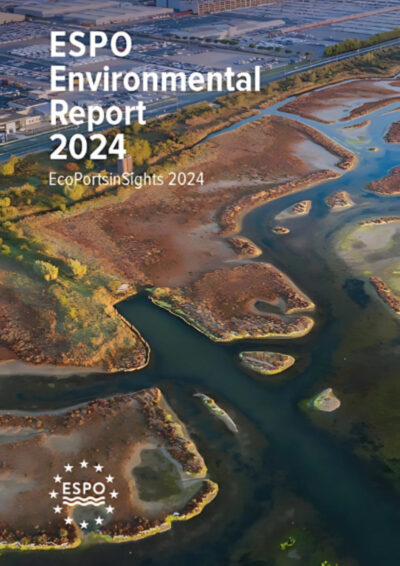
ESPO’s Environmental Report 2024: Climate change more than ever a priority for Europe’s ports

By | 2024 Newsletter week 43 | No Comments

One of the main features of this report remains the Top 10 of environmental priorities, a list which sheds light on the environmental challenges faced by European ports. This ranking provides both ESPO and European policymakers with the critical insights needed to make well-informed decisions. For the third consecutive year, climate change maintains its position as the foremost environmental concern for European ports.

Apart from climate change, other key priorities in the sector shifted, with energy efficiency taking the second position and air quality moving to third, compared to the 2023 report.

Together, these three form a trio of critical environmental concerns for ports in the region.

Climate change adaptation is increasingly important, with 64% of ports reporting climate-related operational challenges, an increase from 47% last year. Additionally, 73% of ports are working to enhance the resilience of existing infrastructure, while 86% are integrating climate adaptation into new projects.

Notably, water-related port development has maintained its position from last year’s report, continuing to rank among the Top 10 priorities for the second consecutive year.

Click here to see the report

AFIR and FuelEU Maritime: ESPO calls for cooperation and flexibility in the roll-out of onshore power supply to ensure smooth implementation of the legislation

By | 2023 Newsletter week 27 | No Comments

On Monday 10 July, the European Parliament will discuss in Strasbourg the final agreement on both the Regulation on the deployment of Alternative Fuel Infrastructure (‘AFIR’) – which sets the framework for the deployment of onshore power supply (OPS) in ports – and the Regulation on the use of renewable and low-carbon fuels in maritime transport and amending Directive 2009/16/EC (‘FuelEU Maritime’) – which regulates the use of OPS by ships in EU ports. Both agreements will be voted on Wednesday 12 July. Once the Council has then formalised its agreement with the text, both AFIR and FuelEU Maritime are expected to enter into force shortly after.

The European Sea Ports Organisation (ESPO) welcomes the final agreements, allowing ports, terminals and shipping lines to prepare for their implementation.

“The final adoption of the AFIR allows ports and all port stakeholders who are to play a role in the deployment of OPS to effectively prepare for compliance with the new rules. The development and use of new fuels and energy solutions, such as onshore power supply, is the most important pillar of greening the shipping sector. For ESPO, it is important that for the first time, the strict framework for deployment of OPS is accompanied by an obligation to use the infrastructure. The emissions at berth will only go down if the OPS installations are properly used. We now have to take the legislation to the quay and sit together with all relevant stakeholders including shipping lines and terminal operators to make quick progress ahead of 2030.”, says ESPO Secretary General Isabelle Ryckbost.

To assist their members in the process of deploying and using OPS in Europe’s ports, ESPO has already been organising different workshops. During these workshops different challenges relating to deployment and use of OPS have already been identified.

Continue to read on the ESPO website

Passenger ports in Europe stress that more time is needed to set up the Entry Exit System (EES) without endangering smooth maritime passenger traffic

By | 2023 Newsletter week 24 | No Comments

ESPO finds that many of the necessary conditions for the entry into operation of the Entry/Exit System (EES), are not yet met. The level of implementation in most countries is behind schedule, insufficient information is available regarding the deployment of physical infrastructure and new operational procedures, and not enough funding has been provided.

Read more on the ESPO Website.

ETS Shipping (2): Europe’s ports call for early and robust action to prevent evasion

By | 2023 Newsletter week 16 | No Comments

ESPO welcomes the inclusion of maritime in the EU ETS1 as part of decarbonising shipping. Europe’s ports have consistently called for an ambitious maritime EU ETS that makes the green transition of maritime possible, whilst protecting the competitiveness of European ports.

Whilst ESPO welcomes that a price tag is being put on the emissions produced by ships, the geographical scope of the EU ETS Maritime agreement could still lead to evasive port calls where shipping companies can avoid paying into the ETS by adding a call to a port outside the EU, or by reconfiguring their routes.

ESPO welcomes the agreement on FuelEU Maritime to reduce emissions from shipping during navigation and at berth

By | 2023 Newsletter week 12 | No Comments

“We are pleased that for the first time there is an agreement on the greening ambitions for shipping, both during navigation and at berth. The requirements for ships when to use of electricity at berth, will hopefully break the chicken and egg discussion,” says ESPO’s Secretary General Isabelle Ryckbost.

“We hope however that the flexibility given to shipping lines to decide their own greening path, will also be mirrored in the upcoming agreement on AFIR (*). There is no time and no money to lose, for shipping lines nor for ports. Reducing emissions, fast and efficient, should be the main ambition. We hope the AFIR is also giving some flexibility to ports to prioritise investments in onshore power in ports where it makes the most sense.”

(*) AFIR Alternative Fuels Infrastructure Regulation