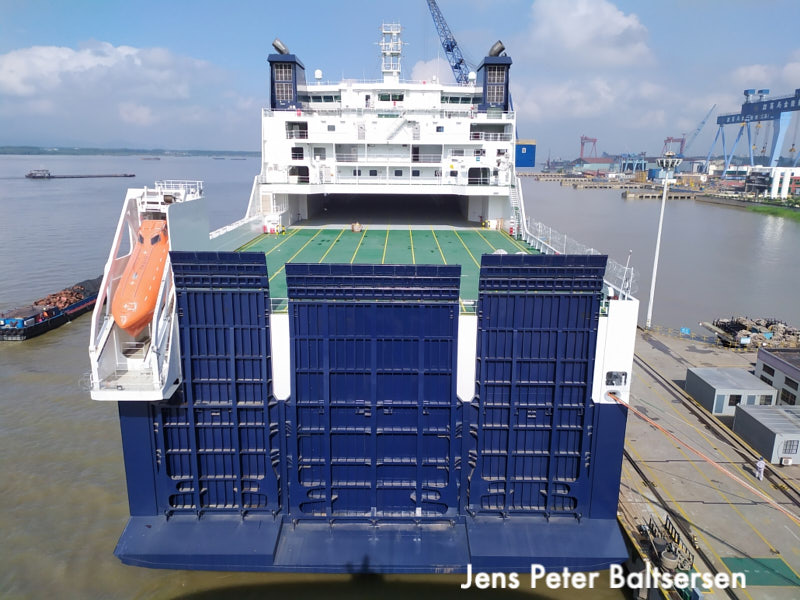
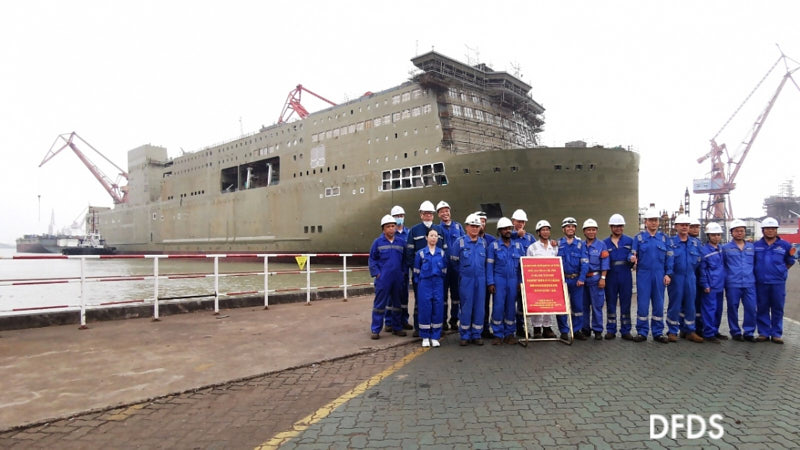
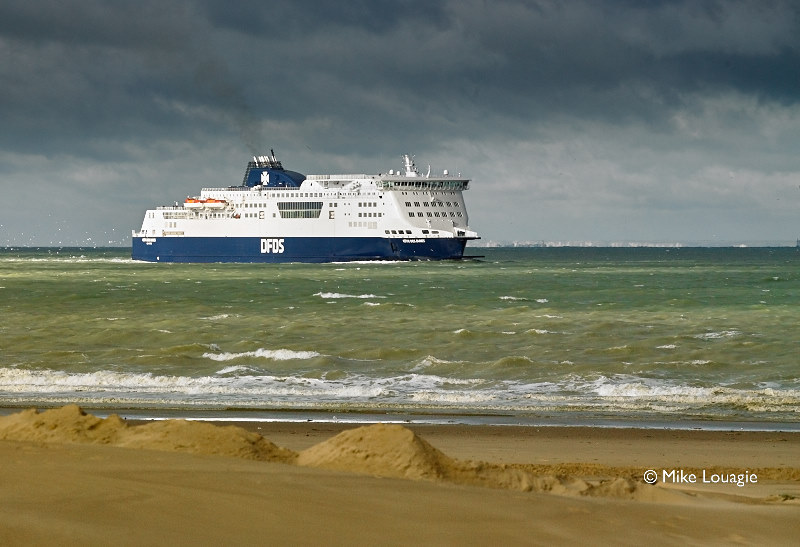
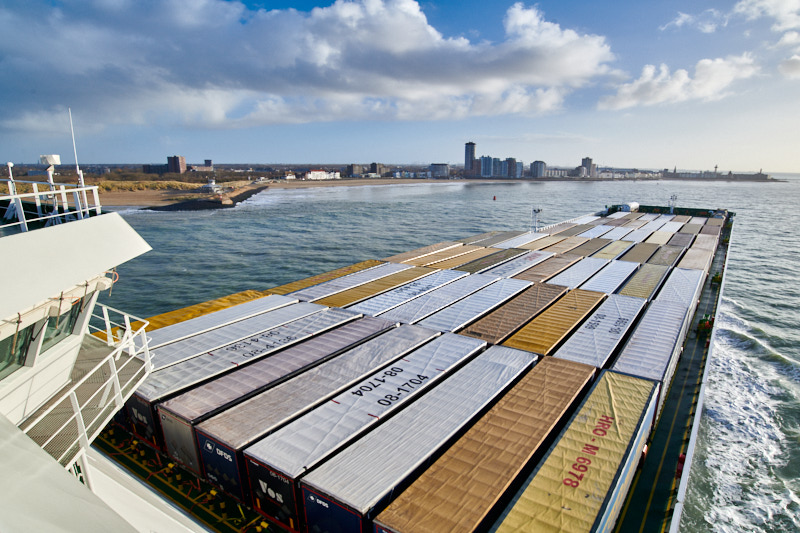
The first of two 4,500 lane metre DFDS ropax ferries was launched at Guangzhou Shipbuilding International in China. They are both set to operate on the Baltic routes.
DFDS Q2: Pickup in Demand Faster than Expected
Q2 2020
- Revenue down 34% to DKK 2.8bn
- EBITDA down 49% to DKK 507m
- Rebound in freight volumes at end of Q2 and in July, better than expected
- Passenger activities cause most of profit decrease
- Encouraging pickup in passenger demand for reopened routes
- Outlook improved: EBITDA of DKK 2.2-2.5bn now expected for 2020 (previously: likely to be reduced towards DKK 2bn)
”Our outlook is improved. Freight volumes have picked up and the demand for ferry travel is encouraging on our reopened passenger routes. It is uncertain whether the pickup in demand is sustainable and we therefore remain alert,” says Torben Carlsen, CEO.
After having to lay up several ships, Godby Shipping announced new charters and deployments:
MISIDA to P&O Ferries, for Dublin-Liverpool, July-September
MIDAS to Wagenborg, for a new liner service Riga-Oxelösund. The main cargo is prefabricated construction elements for the Swedish building sector. (read Wagenborg’s press release)
MISANA and MISIDA have been chartered to Norwegian operator Sea-Cargo for delivery in August and October 2020. The contract is valid until end 2021 with options for Sea-Cargo to extend after that. The ships will be employed in Sea-Cargo liner service between Norway and continental Europe.
MISTRAL will start a new traffic in August. The charterer has asked to remain unnamed for the moment.
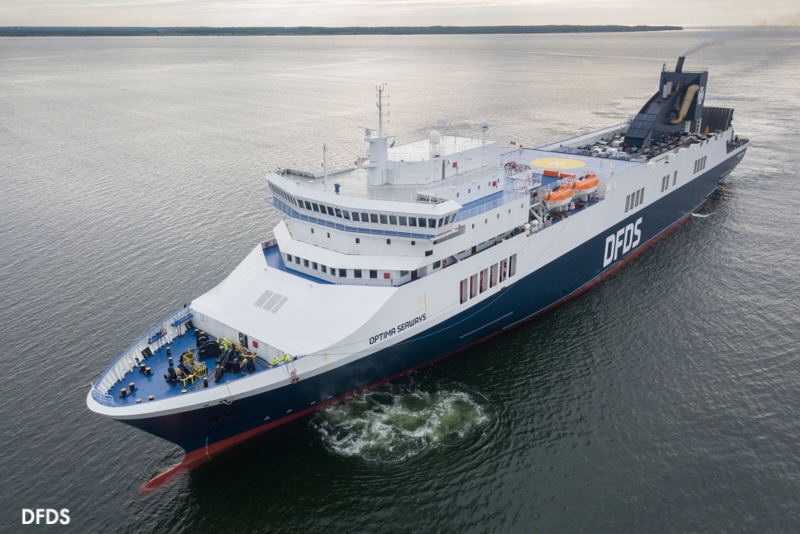
After her charter with Brittany Ferries the newly returned SIRENA SEAWAYS embarked on her first sailing on her new route between Paldiski – Kapellskär taking over from OPTIMA SEAWAYS that was repositioned to Klaipėda-Karlshamn.
SAILOR’s charter agreement will soon expire, as she goes to Tallink.
PATRIA SEAWAYS takes over SAILOR‘s schedule for the Paldiski-Hanko and Paldiski- Kapellskär routes, starting from Week 28.
Rene Pärt, Baltic Sales & Partnership Manager, says, “We are establishing ourselves in the Northern Baltic Sea region by changing both of our vessels in Estonia with bigger and better ones to continue servicing our wide customer base on Paldiski-Kapellskär.”
“The new setup provides more flexible tonnage opportunities for our freight customers on the Klaipėda-Karlshamn route and with PATRIA and SIRENA sailing from Paldiski, they will ensure an efficient mix of passenger and freight capacity in the Northern Baltic”.
(Source: DFDS News)
The first sailing from Amsterdam will be on 15 July and the first sailing from Newcastle on 16 July 2020.
Kasper Moos, VP & Head of Passenger said, “we have been busy making several changes onboard to ensure passengers can relax and enjoy socially distanced travel. Our capacity will be reduced tremendously to guarantee social distancing onboard.”
DFDS Adapts To Post Covid-19 Market Conditions
The new initiatives include:
Industry sales of large freight customer solutions, involving both ferry and logistics operations, will be combined in one unit. The unit will be part of the Logistics Division Overlapping functions will be streamlined.
Freight and logistics operations will be adapted to new market conditions, including optimisation of port terminal and haulage operations
Passenger concepts have been aligned to changes in travel market dynamics (mainly transportation and holiday travel).
Onboard concepts and offerings have been simplified.
A range of improvement and efficiency projects will simplify and focus business support functions. This includes a reshaped and integrated IT and digital organisation as well as a downsizing of various functions.
These initiatives are expected to generate annual cost savings of up to DKK 250m. In 2020, a positive financial impact of DKK 50-75m is expected.
The adaptation to the new market conditions will lead to around 650 employees leaving DFDS in the coming months, 200 of whom are employed in Denmark. DFDS currently employs around 8,600 people.
A one-off redundancy cost of around DKK 100m is expected in 2020 and will be recorded under Special items


DFDS: Current Situation
Freight volumes in Q2 have in most areas been above expectations and of the 12 freight carrying ferries laid up in March/April, five have now been redeployed.
One of the passenger routes, Oslo-Frederikshavn-Copenhagen, reopened on 25 June following the opening of borders between Denmark and Norway.
The reopening of the second passenger route, Amsterdam-Newcastle, and the non-essential travel on the English Channel is contingent on an easing of UK and EU travel restrictions.

DFDS: Outlook 2020
On 7 May 2020, the outlook for EBITDA before special items was reduced towards DKK 2bn.
Uncertainty remains exceptionally high, particularly for passenger travel, and this may still cause the outlook and its assumptions to change significantly in the second half of the year.
Therefore, the 2020 outlook for EBITDA before special items is maintained at this point in time.

When DFDS resumes sailings on the Oslo – Copenhagen ferry route from 25 June, a new ferry route between Frederikshavn and Oslo will open at the same time.
It will not be possible for passengers to travel between Copenhagen and Frederikshavn only. That’s why DFDS calls it two separate routes.
The target group for the new route is in the first place passengers travelling with their own car for transport purposes (not mini cruise). Onboard facilities and experiences will be adapted to this target group. The route between Copenhagen and Oslo will also focus more on transporting passengers when it resumes service.
“We look forward to welcoming passengers travelling between Denmark and Norway for holidays in summer houses and hotels or other purposes. The new route will also contribute to tourism and trade in and around Frederikshavn and Oslo. We also look forward to welcoming freight customers on the route,” says Torben Carlsen, CEO of DFDS.

Safety Measures By DFDS
DFDS has created an easy-to-understand webpage about the Covid-19 prevention measures.

Danish Companies Join Forces On An Ambitious Sustainable Fuel Project
DFDS has together with Copenhagen Airports, A.P. Moller – Maersk, DSV Panalpina, SAS and Ørsted formed the first partnership of its kind to develop an industrial-scale production of sustainable fuels for road, maritime and air transport.
The joint vision is to establish one of the world’s largest electrolyser and sustainable fuel production facilities
When fully scaled-up by 2030, the project could deliver more than 250,000 tonnes of sustainable fuel for busses, trucks, maritime vessels, and airplanes every year. Production would potentially be based on a total electrolyser capacity of 1.3 gigawatts, which would likely make it one of the world’s largest facilities of its kind. The production from the fully scaled facility can reduce annual carbon emissions by 850,000 tonnes.

‘Illegal’ £35m State Aid For Ferries Faces Legal Challenge (writes The Telegraph)
CLdN is seeking a judicial review of Transport Secretary Grant Shapps’ decision to hand the £35 million to passenger operators Brittany Ferries, DFDS, Eurotunnel, P&O, Seatruck and Stena.