Unity Line and Polska Żegluga Bałtycka (PŻB – Polferries brand) submitted an application to the Polish Office of Competition and Consumer Protection (UOKiK) to create a joint venture.
The aim is to obtain financing for new ro-pax ferries.
Unity Line and Polska Żegluga Bałtycka (PŻB – Polferries brand) submitted an application to the Polish Office of Competition and Consumer Protection (UOKiK) to create a joint venture.
The aim is to obtain financing for new ro-pax ferries.
780,000 passengers during a normal summer
240,000 passengers were expected in 2020
???,000 passengers after UK Quarantine restrictions for people coming from France
Quarantine restrictions on those holidaying with Brittany Ferries in Normandy and Brittany will heap more pain on an already terrible summer season for the company and its passengers.
“This announcement is dreadful news for Brittany Ferries,” said Christophe Mathieu CEO Brittany Ferries. “It threatens what little remains of an already disastrous summer season. Our only hope is that holiday makers visiting our French destinations follow the stoicism of those who have travelled with us to Spain over the last fortnight. Despite quarantine restrictions on their return to the UK, only around one in five of those who booked have cancelled or changed their travel plans. Of course, what this will mean for future bookings remains to be seen.”
Brittany Ferries says it is lobbying French government at the highest levels to avoid the implementation of reciprocal quarantine measures. In a normal year the company carries about 2.6 million customers, of which 85 percent are British. Any move that might dissuade more Brits to cancel their travel plans would hurt Brittany Ferries and the regions it serves, particularly the tourism sector in Brittany and Normandy.
Ropax SICILIA has been refitted and re-engined at the WestSea Viana Yard in Portugal.
Baleària decided already in 2012 to make LNG its main fuel.
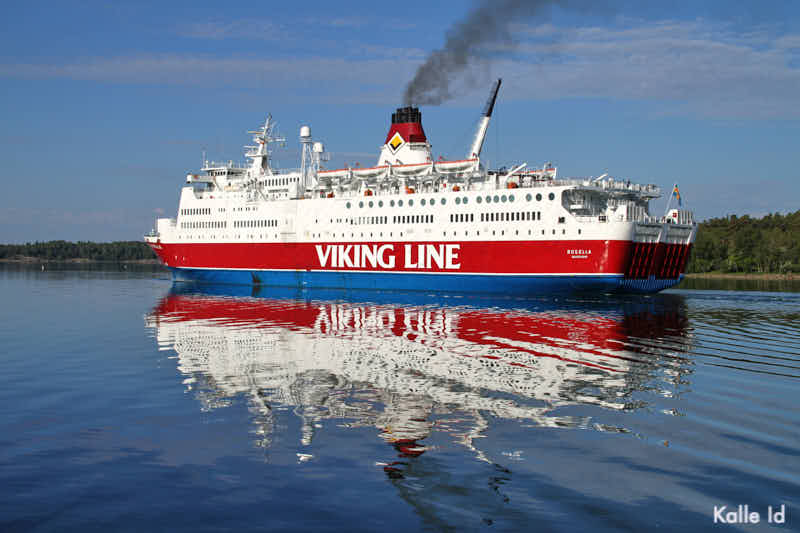
Sharp Deterioration In Viking Line’s Results Due To The Impact Of COVID-19
Sales
The ongoing COVID-19 pandemic has caused a serious deterioration in the Group’s operating conditions. Viking Line reacted quickly to the crisis and adjusted operations to the changed market. Salary and other employment benefit expenses decreased during the second quarter. A large percentage of the staff in Finland was furloughed. In Sweden and Estonia, government-funded furloughs were also made use of.
During the period March 19-June 18, the group received aid from Finland’s National Emergency Supply Agency for cargo traffic to ensure the security of supply for four of the Group’s vessels serving the Turku – Långnäs – Stockholm, Mariehamn – Kapellskär and Helsinki – Tallinn routes.
The Group’s three other vessels were not in service at times during the period March – June. Although cargo traffic generated revenue to cover variable costs and a small percentage of fixed costs for each vessel during the second quarter, it did not generate positive operating income for the vessels in service that received aid
Revised Outlook
Change in prospects: The impact of COVID-19 pandemic has continued to cause a deterioration in the Group’s consolidated results and financial position during the peak season as well. Results for Q3, when the most of the Group’s income for the year is generated, will be significantly worse than in previous years due to the COVID-19 pandemic. The earnings outlook for the financial year 2020 has therefore been revised. Income for the full financial year will be negative.
With more new vessels added, and new route contracts, the ferry division of Fjord1 has done a good job with a revenue increase of 14%.
The tourism division (fjord sightseeing etc) was of course affected by the absence of foreign travellers.
Highlights
Ferry Division Q2
+14% Revenue NOK 698 million (612)
+17% EBITDA NOK 227 million (194)
+15% EBIT NOK 112 million (97)
Fjord1 now has 5 “electric” routes
Renewal programme comprising 25 vessels coming to an end
Gianluigi Aponte’s Italian holding Marinvest revealed in its last yearly financial report that both Grandi Navi Veloci and SNAV are back in profit, after some years in red.
In 2019, the Genoa-based ferry company GNV closed with a net profit of almost EUR 1 million, while the previous year the loss amounted to EUR 13.4 million.
Following the outbreak of Covid-19, the results were heavily impacted in the first half of this year and GNV asked for a new EUR 25 million bank loan in line with the “Decreto Liquidità” law approved by the Italian Government (in order to make it possible for the companies to overcome those challenging months).
The Aponte family also injected EUR 17 million in the company, as a potential capital increase for the future if needed.
Also, the Marinvest-controlled ferry company SNAV, today mainly focused on the lines in the Gulf of Naples, between Naples and the Aeolian islands and between Ancona and the Croatian port of Split, last year closed with a profit of almost EUR 1.5 million, coming from a red of almost EUR 550k in 2018.
Peel Ports: The Wheels Are Set in Motion for New Roro Service
Find out how Peel Ports, alongside its strategic partners, worked together to open up new trade opportunities and provide a flexible and adaptable supply chain for the end customer.
In June 2020, Peel Ports introduced a new call at the Port of Liverpool, opening the first pure RoRo service with CLdN in a triangular route between Santander (ES), Liverpool (UK) and Dublin (IE).
An electricity consumption of around 200,000 fewer kilowatt-hours in the first half of 2020, compared to the same period in 2019, speaks its own clear language. The Port of Hirtshals’ installation of the digital registration and invoicing system ProPower has, in addition to significantly reducing the consumption of the vessels in the port, also meant a reduction in the port’s total electricity consumption of 10%.