Viking Line, Another Six Months with the Pandemic

By | 2021 Newsletter week 34 | No Comments

Half-year Financial Report January–June 2021 (compared to January–June 2020)

  • Sales EUR 71.5 million (97.5)
  • Passenger-related revenue decreased 34.1% to EUR 50.1 million (76.0), while cargo revenue was EUR 20.4 million (20.7)
  • Other operating revenue EUR 33.6 million (16.1)
  • Operating income EUR 4.5 million (-27.4)
  • Net financial items EUR -2.4 million (-2.1)
  • Income before taxes EUR 2.2 million (-29.5)
  • Income after taxes EUR 2.7 million (-23.7)

Key Figures H1

Passengers 538,348 (998,483)

Market share pax 32.1% (27.0%)

Cargo units 65,214 (62,409)

Market share cargo 16.8% (17.1%)

Market share pax cars 31.4% (24.1%)

Outlook

  • The outlook for the financial year 2021 is better than the outcome for 2020.
  • Improved demand starting late in Q2, 2021 together with one-off items in the form of the sale of MARIELLA and the anticipated redemption of Viking Line’s terminal buildings including fixtures and fittings with the City of Turku will boost income.
  • Uncertainty about how authority requirements, State aid, the impact of vaccination programmes and related restrictions on passenger traffic as well as market demand will affect Viking Line’s operations, results and financial position for the full-year 2021, but on the whole the Board of Directors believes operating income will be positive.

Second quarter 2021 (compared to second quarter 2020)

  • Sales amounted to EUR 46.9 million (22.6)
  • Operating income EUR 12.2 million (-5.9)
  • Covid-19 continues to dominate the company’s operations and results, but at the end of Q2 Viking Line saw increased demand for services between Åland, Finland and Sweden.
  • Traffic between Finland and Estonia has been greatly affected by restrictions.
  • Results for the second quarter were dominated by Viking Line’s public service obligations (*) and cargo transports, but an increase in demand in the passenger sector was also discernible at the end of the period.

(*) During H1, the Group received aid for its public service obligations from Traficom for the Group’s vessels on the Turku–Mariehamn/Långnäs–Stockholm, Mariehamn-Kapellskär and Helsinki–Tallinn routes. It also received aid from the Development and Management Centre of Finland’s Centres for Economic Development, Transport and the Environment (known as ELY centres) and from Finland’s Local Employment and Economic Development Offices. The aid is recognized as State aid under other operating revenue.

NGOs Urge Greece and Bangladesh to Stop Illegal Beaching of Ferry

By | 2021 Newsletter week 34 | No Comments

The ropax PRINCE(SS) (IMO 7347548) illegally departed from Katakolon, Greece, in July and arrived on 22 August in Chattogram, Bangladesh, where she is about to be beached. Despite the fact that competent authorities were alerted that the ship was heading for scrap already in May, the unit was allowed to leave European territorial waters. Before its departure, the new owners changed the flag of the vessel from Cyprus to Togo, and then from Togo to Comoros, in what is a typical preparatory step prior substandard breaking.

Irish Continental Group H1 Results: Increase in RoRo Revenue versus Challenging Pandemic and Customs Distortion

By | 2021 Newsletter week 34 | No Comments

Key highlights in H1, 2021

  • Group revenue generated totalling €141.6 million, €10.8 million more than HY 2020
  • RoRo freight travel patterns affected by new customs requirements following the exit of the UK from the EU.
  • EBIT generated was a loss of €10.3 million, €0.8 million worse than HY 2020.
  • EBITDA generated of €12.7 million, €2.7 million more than HY 2020.
  • Gross cash balances of €131.1 million (31 December 2020: €150.4 million).
  • Net debt at €112.1 million, €23.6 million higher than at the beginning of the year.
  • No interim dividend declared (2020: nil).
  • Commencement of a new ferry service between Dover (UK) and Calais (France) on 29 June. Second ship to be added in September.
  • Further investment in environmentally friendly port equipment at Dublin Ferryport Terminals and increased capacity from 2022.

Commenting on the results, Chairman John B. McGuckian noted;

  • Covid-19 pandemic continued to create an exceptionally challenging trading environment for the Group.
  • The Group welcomes the introduction of the EU Digital Covid Certificate and the easing of restrictions on non-essential passenger travel, however, the timing of its introduction limits the benefits for the key summer season.
  • On 31 December 2020, the UK and EU ended the post Brexit transition period. While trade flows have decreased between Ireland and Britain, our flexible fleet has allowed us to adjust capacity on our direct continental RoRo and container shipping services. While this has led to a reduction in RoRo volumes, the change in yield mix has resulted in increased RoRo revenues. This increase in revenue is particularly encouraging as it is against the backdrop of both the Covid-19 pandemic and the introduction of customs requirements on the Irish Sea.
  • Still of concern to the Group is the lack of implementation of appropriate checks on goods arriving into Northern Ireland from Britain, which are required under the Northern Ireland Protocol. To the extent that goods are destined for the Republic of Ireland, this is causing a distortion in the level playing field as goods that arrive directly into the Republic of Ireland ports from Britain are being checked on arrival.

Some figures for ICG subsidiary Irish Ferries

-47.3% Car volumes (‘000) 29.8 (56.6)

-43.2% Passenger volumes (‘000) 132.8 (233.9)

-15.2% RoRo freight volumes (‘000) 126.7 (149.4)

GNV and Tirrenia Cin Sumbitted Offers for Maritime Continuity between Genoa and Porto Torres

By | 2021 Newsletter week 34 | No Comments

Grandi Navi Veloci and Compagnia Italiana di Navigazione (Moby’s subsidiary operating as Tirrenia) are the two ferry companies which applied for the maritime continuity during the low season between the ports of Genoa and Porto Torres, in Sardinia.

Invitalia, the public body which launched the tender for the Italian transport ministry, last June excluded this same two companies which now applied again for this tender which is worth EUR 25.8 million for the period 2021 – 2026.

The selected company will have to cover the route Genoa – Porto Torres from October to May with daily maritime services.

Ro-pax units to be deployed on this line must be aged up to 20 years, with 750 passengers and 1,000 lane meters capacity.

Grimaldi Group will be active on the same routes with no public subsidies.

Grandi Navi Veloci is Considering Adding Ciudadella as a Port of Call

By | 2021 Newsletter week 34 | No Comments

Spanish sources revealed that GNV might add a port call in Menorca to its network of routes linking Barcelona and Valencia to the Balearic islands.

Ferry Baleares reported that in case the new rotation should be Barcelona – Palma – Ciutadella – Palma – Barcelona.

The Genoa-based ferry company officially denied that its services to Ibiza and Mallorca could change in the near future but also added that they “always look at interesting opportunities to open new markets”.

As from last July 6, Grandi Navi Veloci started a regular network of maritime services between Spain mainland and Balearic islands where are deployed the ro-pax ships GNV BRIDGE (linking Barcellona – Palma – Ibiza) and GNV SEALAND (Valencia – Palma – Ibiza).

Viking Line Invests in Fleet Management System Sertica

By | 2021 Newsletter week 34 | No Comments

Viking Line has invested in Fleet Management System SERTICA, which will be implemented on their 6 existing vessels and the newbuild VIKING GLORY.

Jonas Rosenqvist, Technical Superintendent at Viking Line tells, “We are looking forward to start using SERTICA. I believe the app will have great impact on our daily work as it supports us both in maintenance and in relation to inspections. In the end, this means improved safety and comfort to our passengers.”

The fleet management system includes maintenance, procurement, safety and apps.

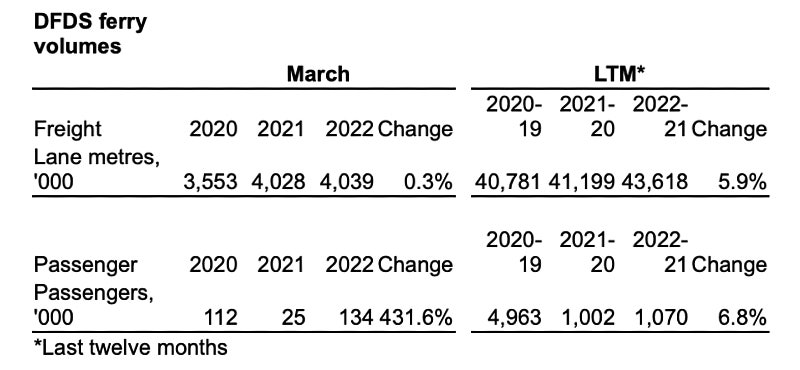
DFDS Q2: Solid Growth in Freight Volumes – Strong Performance Mediterranean

By | 2021 Newsletter week 33 | No Comments

Key figures:

  • Revenue 4,213 DKK m (2,798 in Q2, 2020 and 4,241 in Q2, 2019)
  • EBITDA before special items 897 DKK m (507 in Q2, 2020 and 989 in Q2, 2019)
  • Profit before tax 328 DKK m (11 in Q2, 2020 and 456 in Q2, 2019)

Highlights

  • The growth was driven almost entirely by the freight activities, i.e. freight ferry and logistics.
  • Mediterranean continued its strong performance, delivering app. 50% of the Group’s total profit increase.
  • Passenger volumes remain impacted by travel restrictions.

Outlook 2021 unchanged

  • EBITDA of DKK 3.2-3.6bn
  • Revenue growth of 20-25%
  • Passenger travel is picking up slower than expected

Market Overview

The European freight market stabilised and growth picked up during Q2 following the Brexit transition that impacted Q1 2021.

The current growth in the freight market, however, exceeds capacity due to shortages of truck drivers and equipment, particularly in the UK. This has led to a rise in haulage costs, longer lead times and less reliable supply chains as well as congestion in some ports. The market imbalance is expected to continue in Q3.

The UK will phase in full import border controls by 1 January 2022, including pre-notification requirements for products of animal origin by 1 October 2021.

Trade between the EU and Turkey continued to grow as the depreciation of the Turkish Lira, continued to benefit Turkish exports. The Turkish economy is expected to continue to grow, primarily driven by the export sector.

Remark

The Dover-Calais space charter agreement with P&O Ferries is expected to become operational around 1 October 2021. It will result in shorter waiting times for truck drivers.

To access the full report, click on the image below:

Republic of Ireland: 71% of RoRo Traffic is now Unaccompanied

By | 2021 Newsletter week 33 | No Comments

The Irish Maritime Development Office published its quarterly report:

  • In Q2 2021, RoRo volumes through ports in the Republic of Ireland (ROI) were consistent with those in Q2 2019.
  • Between April and June, 291,437 RoRo units were handled at Dublin, Cork and Rosslare Europort, just 0.2% less than the same period in 2019. However, the configuration of RoRo traffic in terms of route choice and shipping mode has been significantly altered compared to 2019.
  • 71% of all Republic of Ireland (ROI) RoRo traffic is now unaccompanied, compared to 63% in Q2 2019.
  • One third of all RoRo traffic in the Republic of Ireland now operates on direct routes to ports in the European Union, twice the share held in Q2 2019.
  • Irish importers and exporters have benefitted from a significant increase in the choice of direct EU services in 2021. After responding to a surge in ‘direct demand’, there are now 12 different direct EU RoRo services available to Irish traders, compared to 5 in 2019 (2).
  • In Northern Ireland, RoRo traffic in Q2 2021 was the busiest on record, with traffic rising by 11% when compared Q2 2019. Of the three Northern Ireland RoRo ports, Belfast and Warrenpoint both recorded their busiest ever three-month period, with Larne also recording robust growth.
  • Brexit has had a significant effect on RoRo traffic on the island of Ireland. Demand for the UK Landbridge has fallen considerably, and this has driven the simultaneous decline in ROI – GB traffic and increase in direct ROI – EU traffic.
  • In addition to the Landbridge issue, some RoRo traffic has also been ‘transferred’ away from ROI – GB routes and towards NI – GB routes. RoRo services at ROI ports have historically been utilised by many NI hauliers wishing to access markets in the midlands and southeast of England. From early 2021, it was clear that haulage companies based in Northern Ireland had transferred some traffic away from RoRo services in ROI in order to avoid the new customs requirements involved between Ireland and UK ports.

Government of Canada announces a five-year extension of the Ferry Services Contribution Programme in Eastern Canada

By | 2021 Newsletter week 33 | No Comments

In support of ferry services in Atlantic Canada and Eastern Quebec, the relevant ministers announced the renewal of the Ferry Services Contribution Program for five years until March 31, 2027.

This renewal means that there will be continued services between:

  • Saint John, New Brunswick and Digby, Nova Scotia, operated by Bay Ferries Ltd (BFL);
  • Wood Islands, Prince Edward Island and Caribou, Nova Scotia, operated by Northumberland Ferries Ltd (NFL);
  • Îles-de-la-Madeleine, Quebec and Souris, Prince Edward Island, operated by CMTA.