Interesting Remarks from SEEN about the Hellenic Coastal Shipping

By | 2021 Newsletter week 35 | No Comments

Last week, the Association of Hellenic Passenger Shipping Companies (SEEN) underlined some interesting points through a letter sent to the Hellenic Ministry of Shipping and Island Policy.

In brief:

  • There are pending issues, even from the summer of 2020, while the total unpaid amount to the Ferry Companies is estimated to exceed EUR 60 million.
  • Ferry Companies paid and still paying VAT liabilities (24%) for the above amount, despite the fact that they haven’t collected the agreed money yet.
  • The ferry operator’s forecasts for their financial results are not at all positive.
  • In the first half of 2021, passenger traffic, which accounts for 70% of Coastal Shipping revenue, was lower compared to 2020.
  • Ferry traffic in August 2021 is reduced by 42% compared to August 2019, while passenger traffic on the Adriatic lines -for the same period- is reduced by 41% as well.
  • Fuel prices are significantly increased -by 30%- in 2021, burdening further the ship’s operational cost by EUR 80 million.
  • Total losses for the years 2020/2021 are expected to exceed EUR 200 million.
  • From March 2020 to June 2021, ferry companies performed exemplary all the approved sailings, despite the fact that they were unprofitable.

Grimaldi: “There’s often no need for taxpayer subsidies on island routes”

By | 2021 Newsletter week 35 | No Comments

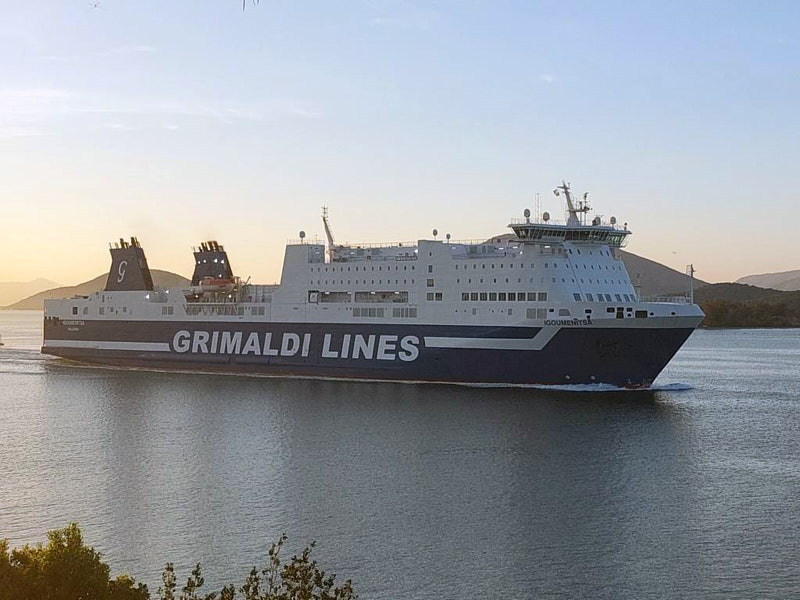
In the latest issue of Grimaldi News, there is an editorial dedicated to what is called as “a battle against the nonsensical handing out of taxpayer money to loss-making carriers on routes that are perfectly viable without them.”

According to the Naples-based ferry company, “whereas subsidies for non-viable services may be justified to ensure vital maritime connectivity, in some cases, on other routes, governments tend to throw money out of the window while propping up poor performers. This has long been the case on routes between mainland Italy and its major islands, in particular Sardinia, where subsidies of over EUR 70 million a year have traditionally been doled out.”

Grimaldi Group underlined its decision to set up commercial services (“without a penny of taxpayer funding”) in competition with subsidized carriers plying Sardinia routes from Italy mainland as well as between Ravenna, Brindisi and Catania. “Our venture succeeded in that we quickly took market share from our rivals. The market reacted positively to a better service based on professionalism and quality tonnage.”

Today the subsidy framework for island services in Italy has been reworked and the amounts on offer have been reduced, generating yearly savings of EUR 45 million for the State. The Naples-Palermo, Ravenna-Brindisi-Catania, Livorno-Cagliari and Genoa-Olbia services operate without public State subsidy.

“If national governments are determined to continue with direct subsidy schemes, so be it. It would, however, be advisable to involve maritime operators in the drafting of the public tenders, thus meeting the real needs of the market” Grimaldi stated. Then also added: “Still today, some requirements of the public tenders concerning the frequency of the service, the age and the characteristics of the vessels deployed, as well as the service speed, are often in contradiction with the urgent need to reduce CO2 emissions and reach environmental sustainability”.

For the service between Naples, Cagliari and Palermo, Grimaldi continues its dialogue with national institutions in order to be able to ply the route under better environmental conditions: “The existing contract stipulates a high speed on this route. We believe the same quality service could be achieved at slower speed, which would see vessels consuming less fuel. The benefits of such a change would impact both our bunker fuel bill and, more importantly, on the CO2 emissions produced on the route”.

The Italian shipowner also underlined that “it might be sensible for authorities to include efficiency criteria in public tenders in the future”.

Bulbous Bow Installed on Hull 802, Marking further Progress at Scottish Shipyard

By | 2021 Newsletter week 35 | No Comments

Ferguson Marine (Port Glasgow) has completed another significant milestone in the dual fuel ferry project with the installation of the bulbous bow on Hull 802.


In recent weeks, three stern units have been lifted into place on Hull 802.  When finished, these units will house the steering gear and other equipment and will support the car deck and stern ramp.

Earlier this year, structural work on first vessel GLEN SANNOX was completed following the installation of a reworked funnel and newly constructed mast, as well as completion of the structure around the stern and inside the hull.

GLEN SANNOX is scheduled to be delivered between July 2022 and September 2022.

Hull 802 is scheduled to be delivered between April 2023 and July 2023.

Kick Off for New Ferry Service between Sweden and Germany

By | 2021 Newsletter week 35 | No Comments

Hansa Destinations’ ferry DROTTEN departed for the first time from Nynäshamn to Rostock on Monday 30 August.

Swedish Minister of the Environment and Climate Per Bolund attended the inauguration ceremony in Nynäshamn.

The ceremony was attended by Per Bolund, Deputy Prime Minister and Minister of the Environment and Climate, Pia Berglund, National Coordinator for Domestic Shipping and Eco Bonus at the Swedish Transport Administration, Fredrik Lindstål, Chairman of the Port of Stockholm Ports and Harry Bouveng, Chairman of the Municipal Board in Nynäshamn Municipality, and Håkan Johansson, CEO of Rederi AB Gotland.

GLOBAL MERCY To Arrive in Antwerp September 12

By | 2021 Newsletter week 35 | No Comments

The world’s largest civilian hospital ship, the GLOBAL MERCY, was delivered to the charity organization Mercy Ships in June.


The GLOBAL MERCY has been built at the Tianjin Xingang shipyard in northern China under the project management of Stena RoRo.

The ship is in the last leg of the journey to the Port of Antwerp, where she will be further equipped and crewed.  The ship is scheduled to arrive on 12 September in Belgium (Antwerp) and remain until early next year.

Volunteers from home and abroad will set up and finish the private hospital ship. This includes the installation of medical equipment and IT systems, as well as the supply and crewing of the ship for its first mission.

Color Line’s H1: Company Expects to Be Back on Track Quickly

By | 2021 Newsletter week 34 | No Comments

Traffic volumes in H1, 2021:

98,510 passengers (621,781 last year and 1,634,408 in H1, 2019)

89,337 freight units (85,759 last year and 89,503 in H1, 2019)

Financial figures H1, 2021:

  • Operating revenues NOK 629 (1,116 million last year and 2,278 in H1, 2019) from which:
    • Revenue Cargo NOK 268 million
    • Norwegian Government compensation scheme NOK 185 million.
  • Operating loss/profit NOK -48 million (-189m last year’s H1 and 290m the H1 before)
  • Operating loss (EBIT) NOK –349 million (-490 million last year’s H1 and -8m the H1 before)
  • Profit before tax was NOK -421 million (NOK -756 million in H1, 2020)
  • Profit after tax was NOK -329 million (NOK -590 million in 2020)
  • The total result was NOK -279 million (NOK -639 million in 2020).
  • Color Line was hit hard by Covid-19 related travel restrictions.
  • Color Line expects a continued gradual reopening, and that during the autumn of 2021 there will be more easing of entry restrictions / requirements in general in Norway.
  • Freight market has been good.
  • The company expects to achieve profitability relatively quickly in a normalised market, with a historically low cost base, and expects a result for 2021 which is slightly better than 2020.

BC Ferries: Traffic Showing Signs of Improvement while Pandemic Continued to Impact Q1 Results

By | 2021 Newsletter week 34 | No Comments

Q1 results for the three months ended June 30, 2021

+37% cars compared to Q1, 2020 and -27% compared to Q1, 2019 (pre-Covid)

+40% passengers compared to Q1, 2020 and -46% compared to Q1, 2019 (pre-Covid)

Revenues increased $91.8 million, primarily as a result of the Safe Restart Funding, increases in traffic volumes and net retail sales.

Net earnings were $4.7 million, an increase of $66.7 million compared to a net loss of $62.0 million in the same period in the prior year.

In December 2020, BC Ferries received $308 million through the Safe Restart Program, a federal-provincial initiative intended to help provinces and territories safely restart their economies.

Safe Restart Funding of $60.0 million was applied towards BC Ferries’ operating losses in the three months ended June 30, 2021. Without the Safe Restart Funding of $60.0 million, revenues in this period would have been $169.2 million and net losses would have been $55.3 million.

The company continues to modernize the fleet with four more battery-electric hybrid Island Class vessels and one more LNG-fuelled Salish Class vessel.

Capital expenditures in this quarter totalled $38.7 million and included new vessels, major overhauls and inspections, marine ramp structure upgrades, hardware upgrades and various other projects.