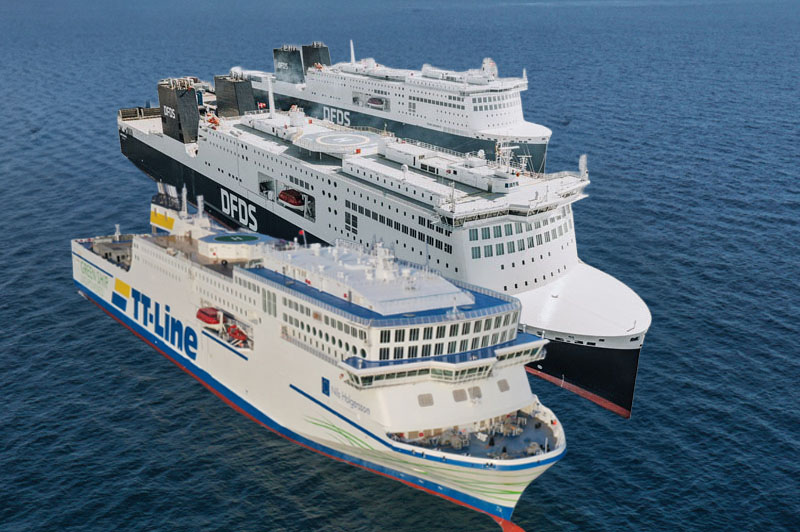

The European Commission has approved, under the EU Merger Regulation, the acquisition of sole control of MacGregor Pte Ltd of Singapore and MacGregor Sweden AB of Sweden (jointly ‘MacGregor’) by Triton Fund 6 SCSp of Luxembourg.
MSC and GNV Confirm Order for Four Additional LNG-Powered RoPax Ferries
GNV, part of the MSC Group, has officially announced a new order for four additional RoPax vessels to be built by Guangzhou Shipyard International.
Each vessel will:
- Be powered by LNG
- Accommodate up to 2,500 people and 3,500 lane metres of cargo
- Measure 237m in length and 33m in width
- Have a gross tonnage of 71,300 GT
- Feature 527 cabins
The first delivery is expected in early 2028, with the remaining ships arriving at six-month intervals. Between 2025 and 2030, GNV’s fleet will be reinforced with a total of eight new-generation vessels.
“Every moment of the journey counts”
GNV has launched a new brand campaign, coinciding with the announcement of eight new vessels joining the fleet by 2030. The campaign reflects a renewed focus on service quality, comfort, and safety—across the entire customer journey.
Developed by Dentsu Creative, the campaign went live on 7 May, the day of the announcement.
Six shipbuilders have been shortlisted to deliver the highly anticipated new Cook Strait ferries. The process is being led by Ferry Holdings Limited, a government-established entity tasked with managing contractual negotiations with shipyards and port stakeholders.
Chair Chris Mackenzie confirmed that the company’s management team has invited the selected yards to submit formal bids, with contracts expected to be awarded later this year.
In addition, Ferry Holdings has appointed key advisors to support the procurement process. Naval architecture firm Knud E. Hansen will oversee technical design, while OSK Design will handle the vessel interiors. Legal counsel will be provided by maritime law specialists Holman Fenwick Willan, and BRS Shipbrokers will act as the appointed shipbroker.
Fred. Olsen Express is set to enhance its cargo operations with the addition of the RoRo BREÑAS CARGO, which will begin service this summer, connecting La Palma with the islands of Tenerife, Gran Canaria, Fuerteventura, and Lanzarote.
With the arrival of BREÑAS CARGO—formerly AKRANES of Smyril Line—the company will operate three RoRo vessels dedicated exclusively to freight transport. These services are managed through Fred. Olsen’s freight division.
CLdN’s RoRo DELPHINE has completed her first sailing since the onboard fire incident on 16th April. She undertook the overnight voyage between Zeebrugge and Killingholme after being authorised to operate at a reduced capacity (6,000 lane metres vs 8,000 lane metres).
While the official investigation into the cause of the fire remains to be concluded, CLdN can confirm the incident originated from a car unit loaded onboard the ship.
Based on the information gathered so far, CLdN has ruled out a fully electric vehicle (BEV) as the cause of the incident.
Last week, we published the “Battery MWh Top 5”, but we mistakenly omitted HINNØY, the latest ferry from Torghatten Nord. We have now also included CHINA ZORRILLA, which is scheduled for delivery later this year.
Just look at AMPÈRE, the first electric ferry, equipped with only 1 MWh of batteries!
- CHINA ZORILLA – 42MWh (Buquebus)
- AURORA BOTNIA – 12.6 MWh (Wasaline)
- GUILLAUME DE NORMANDIE / SAINT-MALO – Stena E-Flexer – 12.0 MWh (Brittany Ferries)
- FUTURA – 10 MWh (Scandlines)
- HINNØY – 9.6 MWh (Torghatten Nord)
- HAVILA CAPELLA / CASTOR – 6.1 MWh (Havila Voyages)
- COLOR HYBRID – 4.7 MWh (Color Line)
- AMPERE – 1 MWh (Norled)
Scandlines has renewed its long-standing cooperation with NABU for another three years, further strengthening its commitment to sustainable ferry operations. Key initiatives include:
- Supporting the shift to battery-hybrid and fully electric ferries.
- Reducing underwater noise through advanced thruster technology.
- Promoting biodiversity at the port of Puttgarden with rewilding and nesting initiatives.
In anticipation of the new “ECAMED” (see under “organisations”, MONTE D’ORO and MÉDITERRANÉE have completed scheduled refurbishment works to meet the new requirements.
Corsica Linea has been preparing for this shift for over five years, with a clear focus on reducing the environmental footprint of its fleet while maintaining operational reliability. Measures already in place include:
- Five vessels equipped with scrubbers
- Three ships converted to low-sulphur MDO
- LNG-fuelled newbuilds, with A GALEOTTA delivered in 2023 and a second vessel due in 2026.
Hydrogen Powers Ships at Berth – a Pioneering Pilot Project in the Port of Gothenburg
As part of a forward-thinking pilot project, green hydrogen is now being used to generate electricity for ships at berth in Gothenburg. The hydrogen-powered generator supplied vessels like STENA SCANDINAVICA and STENA GERMANICA via existing shore power connections — offering a promising solution for ports lacking the infrastructure for traditional OPS.
With stricter EU regulations approaching in 2030, mobile hydrogen generators could be a game changer for ports worldwide seeking to reduce emissions.
Baleària started operating the Tarifa-Tangier Ville route on May 8 with the fast ferry AVEMAR DOS. Later, a second vessel will be added.
Earlier, on Sunday May 4, FRS Iberia Maroc / DFDS ended operations on the same route, after 25 years of service.
The company said in a press release it will continue operating its routes between Algeciras-Tangier Med and Algeciras-Ceuta as normal.
DFDS said also it maintains a long-term vision for the region, maintaining service quality and exploring new opportunities for the future.