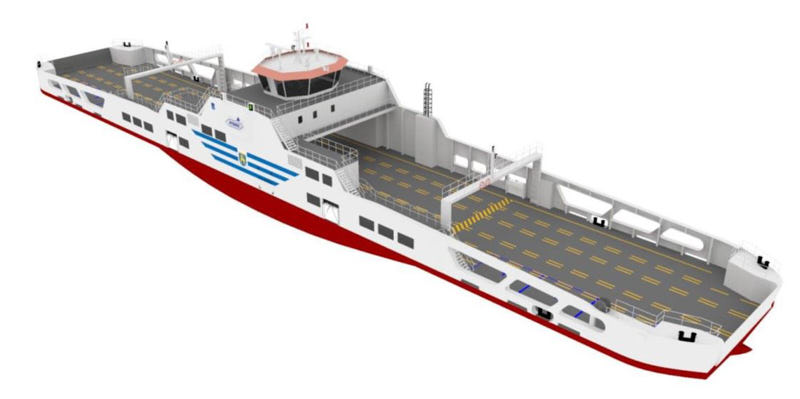
Brevik Fergeselskap IKS has ordered a 42m electric car ferry at Holland Shipyards BV.
The small ferry will have a battery capacity of 1.000kWh. The ferry will be delivered in December 2020.
Route: Brevik -Bjørkøya – Siktesøya – Sandøya
Brevik Fergeselskap IKS has ordered a 42m electric car ferry at Holland Shipyards BV.
The small ferry will have a battery capacity of 1.000kWh. The ferry will be delivered in December 2020.
Route: Brevik -Bjørkøya – Siktesøya – Sandøya
Fjord1 Q2/H1: Lower Volumes And High Investments In A Transition Year
Q2, 2019
Fjord1 reports revenue of NOK 689 million, EBITDA of NOK 225 million and net profit after tax of NOK 104 million in the second quarter.
Financial result impacted by temporary revenue decline mainly explained by transitional changes in the ferry portfolio
Overall stable operations in a period with high overall activity due to preparations of new contracts starting up in 2020 and seasonal variations
High investments in newbuilds, rebuilds, quays and infrastructure to allow for zero- and low emission fuel and strengthen competitiveness in future tenders
Temporary increase in net interest bearing debt (NIBD) to 3.7 billion – remaining in compliance with loan covenants
Current year is a transitional year for Fjord1 with significant investments in vessels and infrastructure combined with preparations for start-up of new contracts next year. This led to a decline in revenue and EBITDA and an increase in the NIBD level in Q2 compared to last year.
In addition, the loss of the high traffic route Halhjem-Sandvikvåg in Bjørnefjorden, with effect from 1 January 2019, explains lower volumes and revenues in Q2.
“Despite that we are in a transitional year with lower volumes and large investments, we have positive results in all four segments and EBITDA-margin of 33% which is at the same level as second quarter last year.”, says Dagfinn Neteland, CEO
“We are satisfied with the operational progress in the second quarter. Following quarter end, we are pleased to have signed the contract for the Halsa-Kanestraum connection for the period 2021-2030. The signing on 16 August, marks our position as a leading player in the Norwegian ferry market”, says Neteland
H1, 2019
Revenue of NOK 1.329 million, EBITDA of NOK 383 million and net profit after tax of NOK 118 million
The revenue was down by 12% compared to first half 2018, mainly explained by the ongoing transitional changes in the ferry portfolio and loss of high traffic route Halhjem-Sandvikvåg. The revenue is temporarily down in 2019 but set to grow with new contracts starting up 1 January 2020.
H1, 2019 Main Figures:
Future prospects unchanged: Operating income for 2019 will remain on a par with operating income for 2018 or improve.
Comments from President and CEO Jan Hanses:
lower passenger volume.
The regional ship agents’ association in Sardinia calls for a relocation of the ferry and ro-ro traffic in Cagliari, from the old harbour in the city center to the so called ‘Porto Canale’ where the local container terminal managed by Contship Italia is set to be shut down soon.
The Cagliari International Container Terminal had a yard area of 400,000 m2 and 1,520 metres of linear quays.
According to the local ship agents’ association, “a broader reorganization of the port spaces is needed. Our idea would be to move from the old port all the activities related to ro-ro and ro-pax traffics thus leaving Rinascita and Sabaudo quays to the cruise traffic and yachts”.
As of today, the only ferry company calling at the port of Cagliari is Tirrenia, while Grendi Trasporti Marittimi offers a maritime ro-ro link to and from Marina di Carrara, and Grimaldi Group to and from Civitavecchia.
FSN had contact with Björn Boström, CEO Port of Ystad, who was very happy with this year’s results so far.
For the first seven months this year, the passenger ferry traffic to Poland and Bornholm had an all time high.
With a total number of almost 1.4 million ferry passengers, it was an increase of 8,5%. Also, the freight traffic showed a small increase, although the freight capacity was a little less than last year on the Polish services.
The big investment, to enlarge the port with a new ro-pax terminal is ongoing and ahead of Schedule. The objective is to be finished by the end of 2020.
It’s been ten years since the formal takeover of Pier II by the Chinese Cosco and by the end of the year, the port of Piraeus will be winning -for the first time- the first place in the Mediterranean Sea in container traffic volumes.
It is reported that at the end of July it has left behind the Spanish port of Valencia which is also “running” at fast pace. It is worth mentioning that in the first half of 2019 the port of Valencia had an increase of 8.72% in container traffic (2.739.198 TEU) while at the same period the port of Piraeus reached 2,57 million TEU showing a rise of over 23%!
The sharp increase of more than 700% since 2009 has reportedly led Piraeus Port Authority (PPA) management to request the creation of a fourth container pier in the master plan, which will be submitted to the Planning and Development Committee for approval in the forthcoming days. According to the same information, the addition of the fourth pier is considered necessary as the existing volume management capacity has already become limited.
At the same time, the Master Plan includes, among other things, the creation of shopping malls, recreational areas, hotels, new logistic warehouses, a car terminal as well as a shipyard.
The new government has shown a positive view of PPA’s new master plan, while a decision by the Council of State has appealed positively for the construction of a shipyard.
ACO Marine Retrofitted Three Jadrolinija’s Ferries With Wastewater Treatment Units
ACO Marine announced to have successfully completed the commissioning of wastewater treatment units aboard the ro-pax sisters SVETI KRŠEVAN, SUPETAR and CRES operated by Jadrolinija.
The three 87.6m vessels were each retrofitted with a Clarimar MF-2 biological-type sewage treatment plant at the Dalmont shipyard in Kraljevica, Croatia.
Italy’s La Fornitrice, ACO Marine’s engineering partner in the region, completed the commissioning of the system aboard CRES, the final ship in the series.
Prior to the installation and commissioning of the Clarimar units, the 600-passenger capacity ferries did not treat wastewater streams but instead collected the effluent in holding tanks. In the busy summer months, this meant that the tanks needed emptying on a daily basis.
The Scottish government has set a deadline for a new delivery schedule for two ferries being built at the now publicly-owned Ferguson shipyard.
It took control of the base in Port Glasgow last week after bosses at the yard served notice of intent to put the business into administration.
Ferguson Marine’s administration is not complete, but nationalisation is assured.
In public ownership, the plan, for now, seems very limited – to completing two CalMac ferries.