
Saturday, 28 September. After a fire developed on one of the garage decks of OLYMPIC CHAMPION, the ferry had to return to Igoumenitsa. The case is being investigated.
Tsokos Lines has seen its new ferry PROTOPOROS XV launched on 21 September in Perama.
Founded in 2004 by the Tsokos family, Tsokos Lines has built 15 ships in 15 years.
Port of Antwerp has a tug powered by hydrogen, the first in the world. This unique “Hydrotug” is driven by combustion engines that burn hydrogen in combination with diesel. This ultra-low-emission tug is being built by Compagnie Maritime Belge (CMB), a pioneer in the field of hydrogen power for shipping. With this world first Antwerp is making an important step in the transition to a sustainable, CO2-neutral port.
Meanwhile CMB has teamed up with the Ghent-based engine builder ABC to set up the BeHydro joint venture with the aim of further developing the technology for medium-speed engines with higher power output. The Hydrotug for its part is the first vessel with output in the 4,000kW class to be powered by hydrogen-diesel dual fuel.
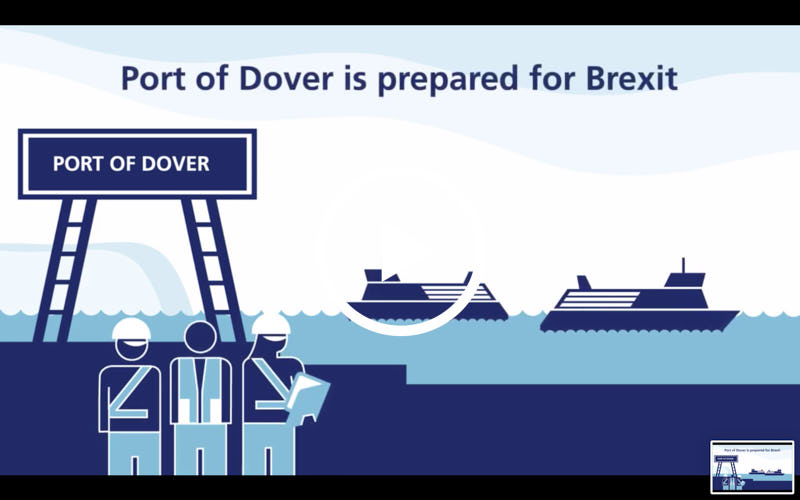
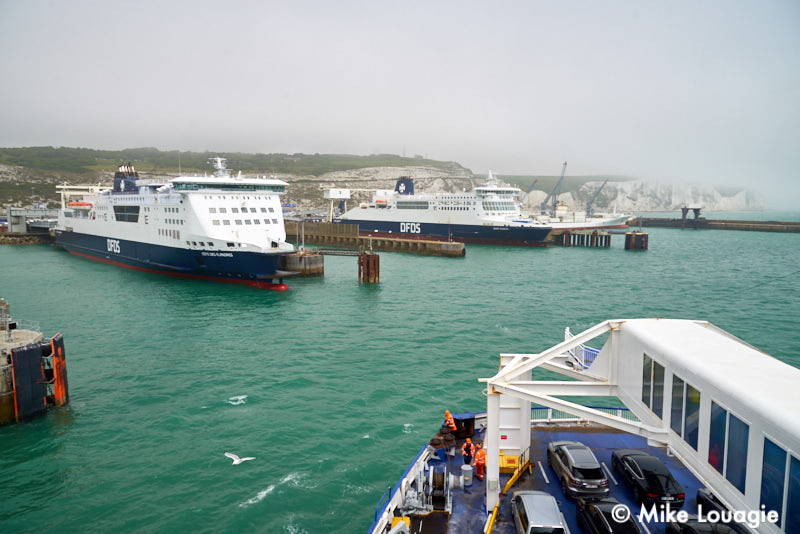
Britain needs Dover and its ferry operations. Before and after Brexit. That’s the message of the new video.
“Dover’s fast-paced operations cannot be replicated elsewhere without vast consumer impact.”
Eight Companies Signed Up To Freight Procurement Framework As UK Department of Transport Launches Competition For Brexit Capacity
- 8 firms signed up to freight procurement framework, creating a list of approved operators to provide freight capacity: Brittany Ferries, DFDS, Irish Ferries, P&O Ferries, Seatruck, Stena, Air Charter Services and Eurotunnel.
- Competition launched allowing firms to bid to bring vital medicines into the UK after Brexit on 31 October 2019
- Combined expertise of the high-quality firms appointed guarantees long-term national resilience after Brexit, says Transport Secretary Grant Shapps.
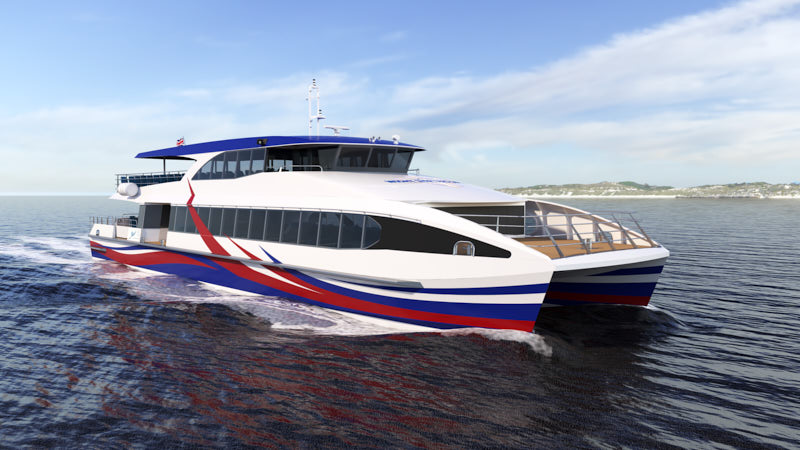
UK shipbuilder Wight Shipyard Co is continuing its successes in the fast ferry sector securing a four-ferry order from an EU based ferry operator.
The order consists of four newbuild ferries, two 20m and two 33m ferries, all to be designed by Australia based One2Three Naval Architects.
Peter Morton, CEO, Wight Shipyard, said: “The key design and build features of these new vessels focuses on ultra-low running cost and fuel efficiency. We are currently working to integrate the boarding design of these brand-new vessels with a number of interesting and unique requirements from the ferry operator.”
The two 20m harbour waterbus ferries will replace older inefficient ferries. They will be designed to service low wharves, providing easy embarkation and debarkation for passengers.
These vessels will have a similar design to Wight’s top performing LochNess Jacobite Maverick 20m day cruise passenger catamaran, which was also designed by One2Three Naval Architects. The 20m is a slower harbour waterbus designed for going stop to stop in and around the port and harbour environment.
The two 33m medium speed vessels meanwhile will service a new commuter and tourist ferry service. It’s a new design for Wight Shipyard, but based on a commuter boat currently used on Sydney harbour.
The build of the ferries is a whole new enterprise for the operator designed to bypass the slow road network and move commuters and tourists quickly and efficiently.
Joining the ‘Getting to Zero’ coalition, DFDS supports accelerating the development and deployment of zero emission vessels by 2030
The Getting to Zero coalition was officially launched on the day of the UN Climate Action Summit of 23 September. It aims to bring together industry leaders to innovate and achieve the IMO’s target of reducing greenhouse gas (GHG) emissions from shipping by 50% compared to the level in 2008.
“We want to be part of developing technology that, by 2030, will allow zero-emission vessels and zero-emission fuels to be technically feasible, safe, and commercially viable for deep-sea shipping. This is supported by the more than 70 organisations which have joined the coalition, and 10 countries spanning five continents have also endorsed it so far,” says Torben Carlsen, CEO of DFDS.
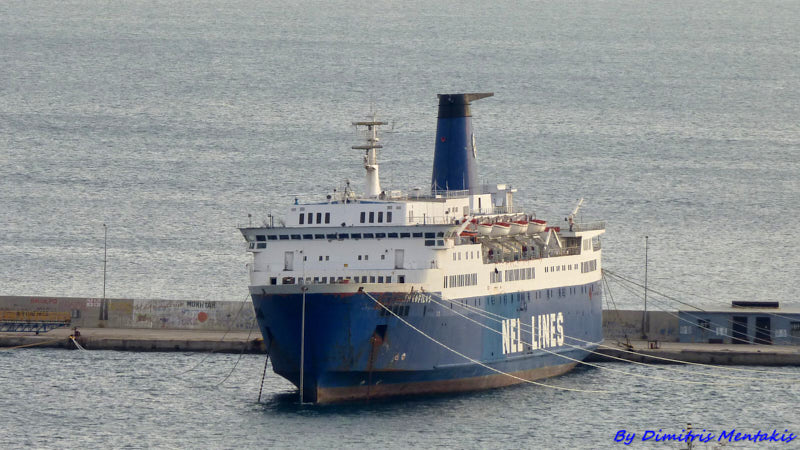
On October 30, 2019, it was eventually decided to have a public tender for the sale and removal of the collapsed NEL LINES’ THEOFILOS (13.572gt/1975).
The ex-TT-Line veteran is laid up and rusting at Karavostasi in the Elefsis bay since 2018, while the starting price for the tender was set to EUR 1,938,546 plus VAT. It seems that the old German build ferry will end up for scrap…
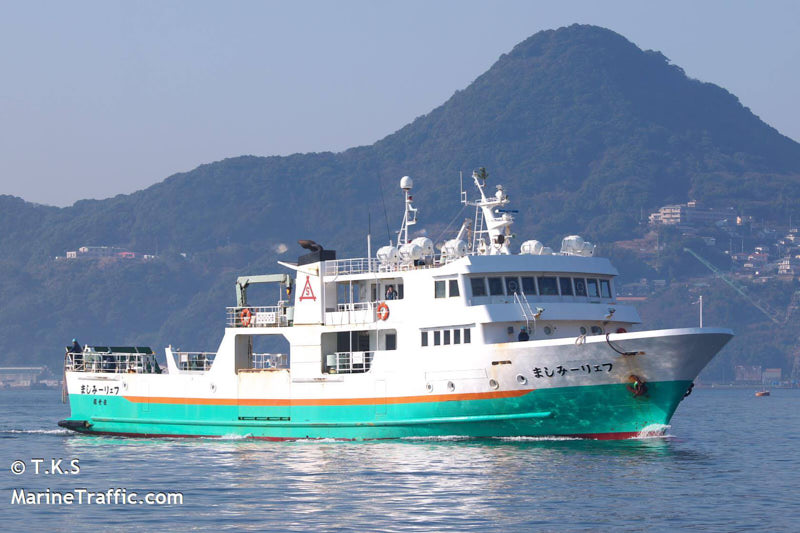
Kerkyra Lines is eventually the mysterious buyer of the small FERRY MISHIMA (271gt/1995) of the Japanese Sakido Kisen Co which operates on the Sasebo-Sakido-Ejima-Hirashima-Tomozumi line.
The small ferry was built in Japan in 1995 (Mukai Shipyard Nagasaki). She is 271gt (77 dwt), 44,24m long, 8,60m wide and 3,39m draught. Her carrying capacity is for 167 passengers, 4 trucks and 2 private cars. She has 2 Daihatsu 6DLM 225 diesel engines (2.000 bhp) and her service speed is 13,8 knots.
The ship was purchased for USD 500.000 and she is expected to be leave Nagasaki in October.
After her conversion in Greece she will probably be introduced on the Corfu-Othonoi run.
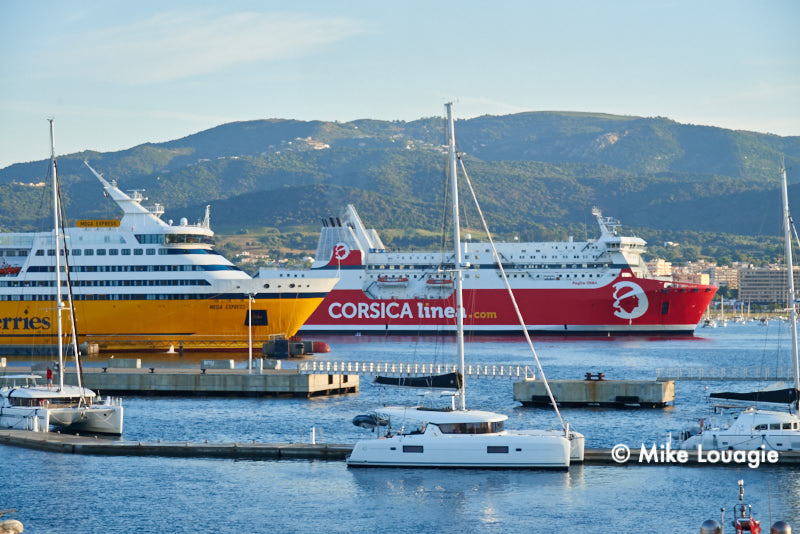
Corsican Ports In July: Less Passengers, More Cargo
In its first summer statistics, the ORTC (l’observatoire régional des transports de Corse) has seen a overall drop of passengers and vehicles for the month of July.
- -8.7% Ferry passengers (732,444)
- -8.2% Private Cars (238,396)
- -2.7% Flight passengers (670,254)
Especially the ferry lines coming from France were affected, with a drop of -12.58% (464,323)
The passengers coming by ferry from ‘other countries’ (Italy) were almost status quo, with a -0.98% drop (268,121)
When counting ferry and air together, the downwards trend for July is -5,91% (a total of 1,402,698 persons).
One remark: July had one weekend less compared with last year.
Freight continues to be good, with an 11.5% rise in July (244,000 lane meters).
Last 12 months
When looking at the statistics over the last 12 months, one can see the airlines on the winning hand, with an increase of 3.22% (4,302,482).
Ferry passengers are in decline, with -4.81% (3,963,870).
It seems people are less enthusiast to take their car across. The average number of cars over a period of 12 months has seen a total decline of -4.11% since July 2018.