


- Viking Line has become the first shipping company to integrate with Matkahuolto’s Matkat transport app.
- Travellers can now book and pay for their entire journey in one place, combining local transport, coaches or rail with Viking Line sailings to Tallinn, Stockholm or Åland.
- The app allows passengers to plan door-to-door journeys across Finland, comparing routes and timetables and purchasing all tickets in a single transaction.
- The service aims to make public transport connections to ports easier and more sustainable for travellers.
On 4 March, the European Commission launched its EU Ports Strategy, a 28-page framework outlining the future direction of Europe’s ports.
The European Sea Ports Organisation (ESPO) welcomed the document as a good starting point for further dialogue with EU institutions. The strategy recognises the growing complexity of ports, which must combine their role as competitive trade hubs with public service responsibilities supporting Europe’s economic resilience.
ESPO particularly welcomed:
- The focus on maintaining the global competitiveness of European ports
- The intention to review the impact of EU ETS and FuelEU Maritime
- Recognition of the major investment needs in ports and their industrial clusters
- Efforts to accelerate permitting procedures
- The proposal for a high-level EU Ports Board
- Plans for a cybersecurity forum linking ports, Member States, and the Commission
At the same time, ESPO warned against adding extra sector-specific regulatory layers or increasing reporting obligations for ports.
The organisation also called for further dialogue on shipping decarbonisation, the evolution of bunkering markets, and the role ports should play in the energy transition.
- Interferry supports the European Commission’s Industrial Maritime Strategy, which recognises the strategic role of ferries in Europe.
- The association particularly welcomes the proposal to reinvest EU ETS revenues into maritime decarbonisation.
- Shipping’s annual financing needs for fleet decarbonisation are estimated at EUR 2.4–8.5 billion, while ETS collections could reach about EUR 10 billion per year.
- Interferry stresses that funds should support practical measures for the existing fleet, including shore power, electrification and alternative fuels.
- The organisation also backs efforts to reduce administrative burdens and avoid double payments once a global IMO measure is in place.
Baleària closed 2025 with strong financial results, surpassing €800 million in turnover and significantly improving profitability, driven largely by the expansion of its international routes.
Key Financial Highlights
- Turnover: €801 million (+16%)
- EBITDA: €170 million (+29%)
- Net profit: €63 million (+152%)
President Adolfo Utor said the results confirm the robustness of the company’s business model and its ability to grow sustainably in a competitive market.
International Routes Gain Strategic Weight
In revenue terms, North African connections—both domestic and international—now contribute a share comparable to that of the Balearic Islands, traditionally Baleària’s core market.
Traffic figures underline the shift:
- 6.5 million passengers transported (+15%)
- 1.6 million vehicles (+11%)
- International passengers: +68%, nearly 2 million in total
Morocco has consolidated its position as Baleària’s main international market. The 15-year concession for the Tarifa–Tangier City route has strengthened passenger flows, while new services to Algeria have further expanded the company’s North African footprint.
Over the past decade, Baleària has doubled its passenger volumes.
Cargo: A Structural Pillar
Cargo remains central to the business model:
- 8.4 million linear metres transported (+10%)
- Equivalent to approximately 622,000 lorries
- Represents 36% of total turnover
Morocco accounts for 29% of total cargo volume, emerging as a strategic logistics hub. The Balearic Islands remain the largest single market, with 59% of cargo volumes.
Operational Efficiency Offsets Regulatory Costs
Fleet expansion and new route launches improved productivity and operational efficiency, allowing Baleària to absorb rising environmental compliance costs without compromising profitability.
The company sailed 1.9 million miles in 2025 (+1.5%), while maintaining tight cost control.
Sustainability And Emissions Reduction
Baleària continues to position sustainability as a competitive lever:
- Emissions per passenger: -15%
- Total carbon footprint: -1.4%
- Emissions per mile sailed: -2.85%
- Emissions per linear metre of cargo: -12%
- Greenhouse gas intensity: -5.25%
The use of natural gas and biogas, alongside eco-efficiency investments, has enabled measurable progress despite higher activity levels.
Strategic Outlook
With EBITDA growth outpacing turnover and international routes gaining importance, Baleària has reinforced its standing in the European ferry market.
The company combines geographic diversification, cargo resilience, and decarbonisation efforts, positioning itself for further expansion while maintaining financial discipline.

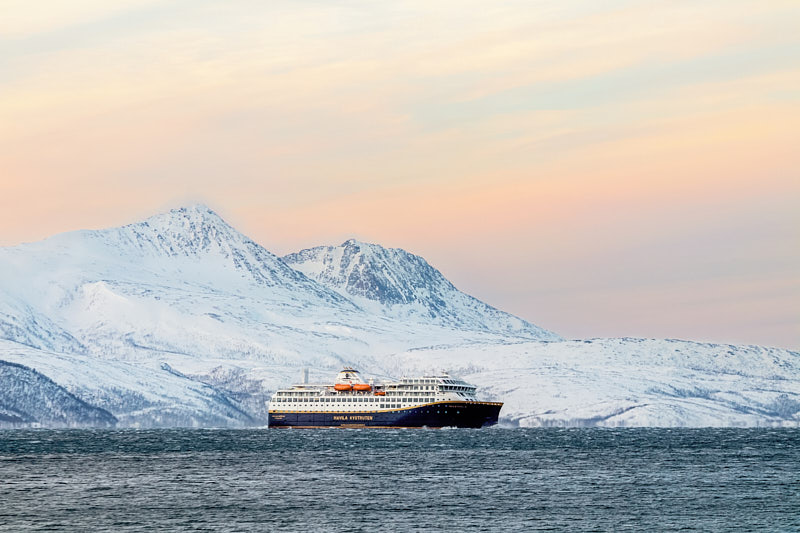
Havila Voyages has published its Q4 2025 figures, confirming a strong second full year with all four ships in operation on the Norwegian coastal route.
Key Financials 2025
- Revenue: NOK 1.775 billion (2024: NOK 1.523 billion)
- Increase: NOK 252 million (+17%)
- Operating result before depreciation: NOK 373 million
- 2024: NOK 218 million
- 2023: NOK -191 million
The improvement reflects stronger demand, pricing power, and operational stability.
Operational Performance
- 100% operational uptime in 2025 (2024: 98%)
- Passenger nights up 3%
- Average Cabin Rate (ACR) up approx. 20%
- Q4 CO₂ emissions 38% below 2017 reference levels
CEO Bent Martini highlighted the significance of full-year uptime along the demanding Norwegian coast, calling it “an achievement everyone in the company should be proud of.”
Havila Voyages operates under a “power-by-the-hour” agreement with Kongsberg Maritime, ensuring 24/7 monitoring and proactive technical follow-up. This supports high technical reliability and predictable service delivery under the public-service contract.
Costs And Investments
Total operating expenses reached NOK 1.402 billion (2024: NOK 1.310 billion), an increase of around 7%.
Cost drivers included:
- Higher guest volumes
- General inflation
- Expansion of shore-based organisation
- Increased sales and marketing spend
The company deliberately increased marketing investments in Q4 to strengthen forward bookings. As a result, short-term profitability softened, but early indicators for 2026 are positive.
More than 63% of total 2026 capacity is already sold.
Outlook
Following refinancing in 2024, management expects further improvement in both revenue and profitability in 2026.
The combination of stable operations, higher yields, and continued emissions reductions positions Havila Voyages for stronger financial performance going forward.
Download the report here
Adria-based CNV (former Cantiere Navale Vittoria) and Trapani-based Cantiere Navale Giacalone have been awarded contracts to build 17 new ferries for ACTV, the public transport company of Venice and part of AVM (Azienda Veneziana della Mobilità).
CNV will construct four vessels for approximately EUR 15 million.
Giacalone will build 13 hybrid ferries for almost EUR 34 million.
The newbuildings will operate on passenger services in the Venice lagoon.
ACTV recently also launched a public tender to acquire a second-hand double-ended ferry for lagoon deployment.
Start Romagna is preparing to launch a new public tender for a fully electric ferry to operate between Porto Corsini and Marina di Ravenna.
The vessel will serve as a short-sea link across the Candiano Canal.
According to local media RavennaToday, chairman Andrea Corsini and director Angelo Erbacci confirmed that the new tender budget has been increased to EUR 6 million.
The previous tender, launched in October 2024, had a budget of EUR 5 million.
The current ferries on the route — BALENO (built 1990) and AZZURRO (built 1996) — are considered too old for continued operation.
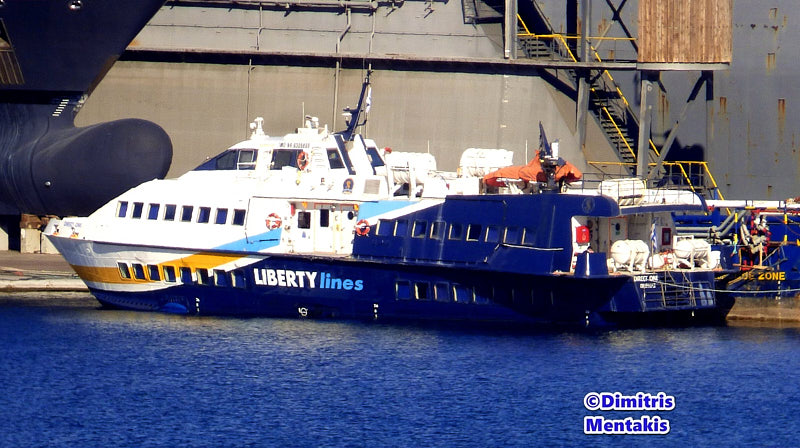
On 23 February 2026, the new acquisition of the Greek-based Alpha Lines, HSC DIRECT ONE (ex ESCHILO), arrived in Greece.
The vessel was purchased from Liberty Lines in January and will join the Alpha Lines fleet on the Piraeus – Saronic Gulf service.
She was built in Italy in 2006.
Photo: Dimitris Mendakis
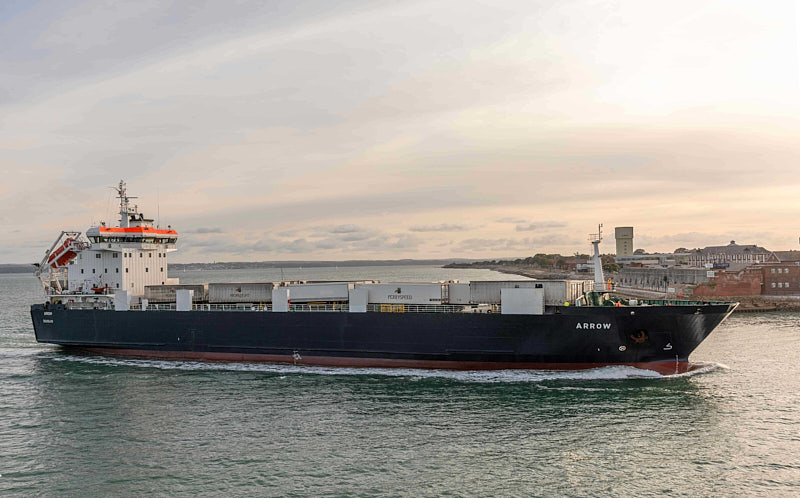
SSEN Transmission will charter RoRo vessel ARROW to support the Western Isles HVDC Link Project without burdening public ferry services. The vessel will carry construction materials and project freight separate from island ferry traffic. The charter was secured in partnership with Balfour Beatty, Stornoway Port, Comhairle nan Eilean Siar and Ullapool Harbour Trust.
When not needed for the project, the RoRo can be made available to other operators to boost local maritime capacity. SSEN says this approach protects ferry resilience during infrastructure works.
Source: SSEN Transmission
A succession of severe storms at the start of 2026 significantly disrupted ferry operations in the Strait of Gibraltar.
Ferry rotations fell by 15%, with temporary line suspensions due to adverse weather conditions.
Traffic Impact (January)
- Passengers: 384,350 (-4%)
- Vehicles: 89,935 (-3%)
- Trucks: 40,825 (-10%)
Active booking remains mandatory for trucks bound for Tanger Med with the four operating ferry companies.
Operational Response
Baleària operated extraordinary weekend sailings with BAHAMA MAMA and reinforced capacity with SICILIA to support recovery.
Measures were coordinated through a Crisis Cabinet involving authorities on both shores to rebalance tractor units and semi-trailers between the southern and northern sides of the Strait.
Sources: https://www.apba.es/estadisticas and José Galiano on Linkedin