Interview with Michael Goldmann Petersen, Scandlines COO

By | 2024 Newsletter week 27 | No Comments

Executive Summary 

Ferry Capacity and Operation: 

  • The new electric freight ferry Futura will enter service in late 2024, complementing Scandlines’ fleet with a capacity of 66 truck units. 
  • Futura will be fully electrically operated, initially charging in Rødby, with Puttgarden infrastructure ready by 2025. 

2023 Performance: 

  • Scandlines transported 6.4 million passengers, 1.6 million cars, and over 704,000 freight units. 
  • Passenger numbers increased by 5%, but freight business saw a 7% decline due to the economic slowdown in Europe. 

Leadership Changes: 

  • Michael Guldmann Petersen was appointed acting CEO in February 2024, continuing as COO until July, when Eric Gregoire will assume the CEO role. 

Sustainability Initiatives: 

  • Scandlines is investing in electric propulsion, with Futura being emission-free and two other ferries, Schleswig-Holstein and Deutschland, set to convert to at least 80% electric operation by 2025. 

Market Trends and Projections: 

  • The German market is growing, with an increase in German travelers to Denmark and Sweden. 
  • The Swedish market saw a decline in border shop visitors due to exchange rate impacts, despite similar spending levels in Swedish Kronas. 
  • Freight volumes are expected to be flat in the first half of 2024, with a slight increase in the second half. 

Infrastructure and Technological Developments: 

  • Rødby charging installation is complete, with Puttgarden expected to be operational by September 2025. 
  • Futura will operate in a two-hour rotation sequence, enabled by dual-port charging. 
  • Potential future enhancements include increasing battery capacity and considering emission-free operations in Rostock port. 

Challenges and Future Plans: 

  • The feasibility of converting additional ferries to electric power depends on securing funding from EU or Danish government sources. 
  • The ongoing Fehmarn tunnel project is not significantly disrupting ferry operations, although close monitoring and adjustments are required. 
  • Kronprins Frederik will continue as a backup ferry and support freight volumes during peak times. 

Click on this picture to read RoPax magazine – Photo Scandlines 

ASSARMATORI chose the fuels for the future: LNG and biofuel

By | 2024 Newsletter week 27 | No Comments

Neither ammonia nor hydrogen. For the Italian shipowners association ASSARMATORI the right choices for the future are LNG and biofuels because they are already available and well tested. This was the key message that emerged this week in Rome at the annual meeting of the association, chaired by Stefano Messina, which represents almost all the short-sea and deep-sea RoRo and RoPax companies based and active in Italy. 

ASSARMATORI has asked Italian and European governments to focus on and select incentives and financial support for these two types of fuels, which have a higher price compared to traditional fuels. 

The association’s goal from now onwards is to obtain all the viable financial resources from ETS and FuelEU to sustain the green transition of maritime transport (through incentives for modal shift, fleet renewals, pricing for new fuels, etc.). 

IMAGE CARDS

By | 2024 Newsletter week 27 | No Comments

At Guangzhou Shipyard International, China, the keel laying ceremony took place for the third new RoPax vessel commissioned by GNV. The LNG-fuelled new ship, already renamed GNV VIRGO, will have a capacity for 1,785 passengers, 420 cabins, and 2,780 lane metres. It is scheduled for delivery before the end of 2026.  

The fourth unit, still to be named, will also be dual-fuel LNG, while the first two under construction at GSI in China are fitted with scrubbers.  

GNV Polaris will be delivered before the end of the current year and GNV Orion in 2025. 

Bridgemans Services Group have renewed their agreement with Trinidad and Tobago’s Ministry of Works and Transport (MOWT) for RoRo Cabo Star to continue to connect Port of Spain and Scarborough until January 2026. 

The vessel has been an integral support to the Trinidad and Tobago economy since starting the regularly scheduled sea bridge service between the Port of Spain and the Port of Scarborough seven years ago, in 2017.  

Cabo Star now makes approximately 288 round trips between the ports on the islands of Trinidad and Tobago annually, reliably transporting approximately 66,000 vehicles, 5,500 trucks and trailers, 2,500 containers and 4,100 flatbeds each year.   

Source: Bridgemans 

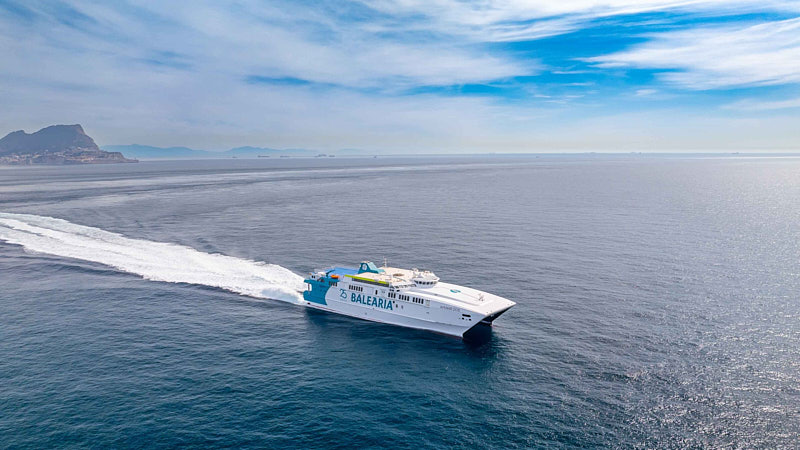
Baleària’s new fast ferry Margarita Salas’ is carrying out its natural gas sea trials. 

Soon she will be ready to sail between Barcelona, Ciutadella de Menorca and Alcudia, Mallorca. 

Photo: Baleària 

On Friday 28 June 2024, the keel laying ceremony of the first of the two all-new NewMax hybrid vessels took place in China Merchants Jinling Shipyard in WeiHai, China.  

Stena Futura, the chosen name for this ship, is one of two NewMax hybrid vessels that will play a key role in Stena Line’s journey to sustainable fuel as they will both be able to operate on methanol fuel. 

Baleària and Fred. Olsen Express have increased their activity on the route between Huelva and the Canary Islands with a fourth weekly connection in both directions between July 1 and September 30. The additional departure is necessary to meet the high demand expected for this summer period, both for passengers and freight. 

Source: Port of Huelva 

On June 29, HSC Hellenic Highspeed left Greece, chartered to Africa Morocco Link for the summer season of 2024. The ship is expected to enter service on the Algeciras – Tanger Med route on July 6, and she will remain until the end of the season. 

Photo: Attica Group 

It is reported that Finikas Lines’ Finikas Highspeed (ex Sfakia Pionner/Oniyouzu) has been introduced on the Corfu – Agioi Saranda (Albania) route on July 1, 2024. The ship was initially purchased by the Cretan based Anendyk Seaways on February 2019 for the Sfakia-Gavdos route. However, she remained laid up at the port of Souda (Crete) until March 2024 and sold to the Albania-based Finikas Lines. 

Photo: Finikas Lines 

Greek Saronic Ferries has chosen Swedish Nowhere Networks as supplier of high-speed internet for its fleet consisting of five ships operating in the Saronic region of Greece. 

Read more on Nowhere Networks 

BREAKING NEWS | Attica Group invests in green transition and fleet renewal

By | 2024 Newsletter week 26 | No Comments

Agreement with Stena RoRo for the long-term charter with purchase option of 2 new vessels and a potential option for 2 additional vessels

  • Agreement with Stena RoRo for the long-term charter with purchase option of 2 new E-Flexer vessels, plus an option for 2 additional vessels.
  • Vessels to be built at CMI Jinling Weihai Shipyard, China
  • Largest RoPax vessels ever ordered by a Greek shipping company.
  • Specifications: 240m length, 1,500 passenger capacity, 3,320 lane metres cargo decks (approx. 200 freight units per vessel).
  • Vessels are Methanol ready, with engines capable of operating on 3 different fuel types and equipped with state-of-the-art technology to optimise fuel consumption.
  • Expected to reduce the Group’s GHG emissions per transport work by 60% compared to existing vessels.
  • Agreement includes a 10-year bareboat charter scheme with a purchase option after the 5th year.
  • Delivery scheduled for April and August 2027.
  • Fleet redeployment to follow, reducing the environmental footprint by retiring older vessels.
  • Innovative design collaboration between Stena RoRo and Attica’s shipbuilding teams based on the successful E-Flexer model.
  • CEO Panos Dikaios highlights Attica Group’s 3-decade innovation history and the new agreement’s role in setting industry standards, reducing environmental footprint, and enhancing travel experience.
  • Per Westling, Managing Director of Stena RoRo, emphasises the bespoke E-Flexer vessels’ versatility, fuel flexibility, and importance in Attica’s green transition.

Green features

  • Installation of battery pack for storage and use of electric energy in order to reduce the operation of diesel generators.
  • Installation of solar panels for the production of renewable electrical energy.
  • Installation of OPS – electrical power supply from shore during the ships stay in ports to avoid the use of diesel generators and the alleviation of harmful emissions and noise.
  • Lighting of the ships with new technology LED to reduce the required energy.
  • Rudder bulb designed and constructed to fit the ship’s propellers for optimizing hydrodynamic efficiency.
  • Hull form design for optimum hydrodynamic efficiency.
  • Intelligent clima control system for optimum energy consumption.
  • Hybrid scrubbers for reducing SOx emissions.
  • Silicon paints of underwater hull for reducing resistance and fuel consumption.
  • New generation main engines, tri-fuel including methanol for reducing CO2

Other features:

  • Design of bow and stern ramps (drive through concept) to avoid maneuvering of heavy vehicles and allow faster loading/unloading from two decks simultaneously.

The Swedish Transport Administration awarded the Gotland contract to…

By | 2024 Newsletter week 26 | No Comments
  • Alvina Shipping has been awarded the contract for ferry services to and from Gotland for the period 2027-2035 (with two additional option years). (announcement Swedish Transport Administration)
  • Two routes: Nynäshamn–Visby and Oskarshamn–Visby.
  • Alvina Shipping is a Danish subsidiary of Swedish Gotlandsbolaget. This company will be responsible for financial and strategic management. It is a way to benefit from the Danish tonnage tax regime and the zero salary tax for seamen. However, Destination Gotland will operate the services under Swedish flag and crew.
  • The Swedish Government is developing the Swedish tonnage tax to align Swedish shipping with international standards. Gotlandsbolaget is optimistic that Gotlandstrafiken will be fully integrated into this system. If approved, financial and strategic management will be overseen from the island of Gotland too.
  • A ten-day period is available for appeals after the contract award (Nordic Ferry Infrastructure / EQT ?).
  • The current ferry fleet will continue, with a new hydrogen-powered vessel to be introduced in 2028. During the upcoming contract period, a climate requirement applies which means that the operator must reduce CO2 emissions by 30 percent.
  • The Swedish Transport Administration shares the risk of high fuel prices.
  • Note: Gotlandsbolaget also recently acquired the DFDS route between Oslo and Copenhagen.

Moby put half of Toremar’s fleet up for sale

By | 2024 Newsletter week 26 | No Comments

“We already cleared that we would not take part in the coming tender for the maritime continuity, so we sell the ships.” That’s what Moby said to Ferry Shipping News to explain why Toremar, a company controlled by Onorato Armatori and active on the maritime links between mainland Italy and the islands surrounding the Toscana region (Elba, Capraia, and Giglio), put up for sale four of its eight vessels.

More specifically, available for sale are:

  • Rio Marina Bella (2004 – 896 passengers and 85 cars)
  • Giovanni Bellini (1985 – 589 passengers and 60 cars)
  • Liburna (1980 – 692 passengers and 60 cars)
  • Schiopparello Jet (1999 – high-speed ferry – 145 passengers)

The other four vessels in Toremar’s fleet are the 1991-built Stelio Montomoli, the 1980-built Marmorica, the 1980-built Oglasa, and the 2005-built Giuseppe Rum.

New Italy – Montenegro maritime link to be operated by Adria Ferries

By | 2024 Newsletter week 26 | No Comments

The Italian shipping company Adria Ferries has just announced a new RoPax link starting from 9th July, which will operate twice per week between the two sides of the Adriatic Sea. AF MIA is the vessel to be deployed on the line linking the port of Ancona in Italy with Bar in Montenegro.

Some safety tests for the berth were conducted last week.

AF MIA, the 1997-built ex-CRUISE SMERALDA, was purchased last autumn from the Grimaldi Group and has a capacity of 1,500 passengers and 2,200 lane metres.

The other routes regularly covered by Adria Ferries link the Italian ports of Ancona and Bari with Durres in Albania.

Interview with Niclas Mårtensson, CEO of Stena Line, in RoPax 13 (May 2024):

By | 2024 Newsletter week 26 | No Comments
  • Performance in 2023:
    • Stena Line had a decent year in terms of volume and customer satisfaction.
    • The company faced high costs due to increased salaries, spare parts, and interest rates.
    • Brexit did not negatively impact traffic between Ireland and the UK, which remains stable and growing.
  • Market Challenges:
    • The Baltic Sea region was significantly impacted by the Ukraine war and higher interest rates, affecting macroeconomic activities.
    • Competition is intense, with other operators reducing prices.
  • Expansion and Investment:
    • Stena Line expanded in the Mediterranean by acquiring a 49% stake in African Morocco Link (AML).
    • New logistics hubs were established in Liverpool and Dublin, enhancing operations between Ireland and the UK.
    • The company is also developing a new port in Immingham, transitioning some services from Killingholme.
  • Sustainability Efforts:
    • Stena Line continues to explore green fuel options, including methanol and hybrid solutions combining biodiesel and batteries.
    • The “Stena Electra” project remains of interest, but its future depends on infrastructure investments in electricity.
  • New Ventures:
    • Stena Line sees potential in the Morocco-Spain route, emphasizing the strategic importance of Morocco’s infrastructure investments and its role in connecting Europe and Africa.
  • Future Outlook:
    • Despite market fluctuations, Stena Line is focused on infrastructure investments rather than acquiring customers.
    • The company remains adaptable in its approach to fuel and propulsion systems, seeking to balance sustainability with economic feasibility.

Read the full interview in RoPax magazine: PDF

IMAGE CARDS

By | 2024 Newsletter week 26 | No Comments

MSC-controlled GNV (Grandi Navi Veloci) celebrated the launching at Guangzhou Shipyard International of the newly-built GNV ORION, second of four new ro-pax ships commissioned by the Geneva-based MSC Group.

The delivery will take place during the summer 2025 while the first unit (renamed GNV POLARIS) is scheduled for delivery before the end of the current year.

GNV POLARIS and GNV ORION will be 218m long with a capacity for 1,785 passengers and 3,100 lane metres of freight.

Two more sister ships will follow and will be LNG-powered.

Liberty Lines, a company owned by the Morace family, has taken delivery of the second high-speed craft named CRISTINA M, sister ship of the VITTORIO MORACE, built by Astilleros Armon shipyard in Navia, Spain.

With a length of 39.5 meters and a capacity of 251 passengers, it is the second HSC hybrid fast unit under construction. It is equipped with two MTU-Rolls Royce hybrid engines, allowing it to operate entirely in electric mode within ports before recharging the batteries while sailing at 30 knots in open sea.

CRISTINA M is the second of the 9 innovative fast hybrid ships that will join the fleet by 2026 and 2027 and be deployed on the routes to and from Sicily.

Polferries has announced the start of ticket sales for their new ship, the Varsovia. Replacing the Cracovia on the Świnoujście-Ystad route from July 27, 2024, the Varsovia will offer daily departures.

Polferries RoPax Cracovia will leave the Świnoujście-Ystad line on July 1, 2024 and will be employed in the Mediterranean Sea for the next year. Charterer unknown.

As the construction of Spirit of Tasmania IV nears completion, the ship took to the open seas for the first time on a five-day trial run from Rauma Marine Constructions Oy in Finland.

It is reported that Africa Morocco Link chartered Virtu Ferries’ HSC Maria Dolores mid-June. The ship is operating on the Tarifa – Tanger Ville route along with Morocco Express 1, which was recently introduced following the successful agreement between Stena and Attica Group. HSC Maria Dolores was active on the above route, chartered (2022-2023) by the collapsed Moroccan Intershipping and then laid up at Valletta (Malta). She was built in Australia (2006).

Photo: Austal

Magic Sea Ferries reported that its HSC Cat 1 (1994), will be introduced on the Lavrion-Kea-Kythnos-Serifos-Sifnos-Milos route on July 4, 2024.

Last summer, she served on the Mandoudi (Evia) – Sporades line. She was built in Japan (1994). Her carrying capacity is for 1000 passengers and 200 cars.

Photo: Kostas Papadopoulos