Zeebrugge-Tilbury’s Second RoRo Joined the P&O Fleet

By | 2026 Newsletter week 07 | No Comments

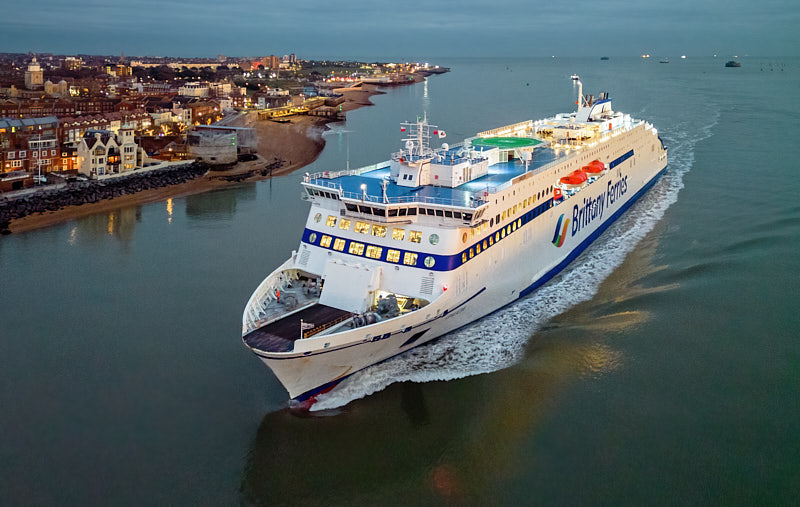
P&O Ferries long-term charter LISMORE, sister ship of LONGSTONE.

The RoRo vessel has now joined the fleet.

The two vessels will operate together on the Zeebrugge–Tilbury route.

The weekly lane metre capacity for the route has the potential to be uplifted by 9000m.

Kasper Moos, CEO, P&O Ferries, said: “Our focus is on being a trusted, long-term partner to freight customers. By increasing capacity on the Zeebrugge–Tilbury corridor, we’re making it easier for customers to secure guaranteed space, plan with confidence and support their growth. This investment underlines our determination to offer a service that is dependable, competitive and aligned with evolving demand across key European supply chains.”

Green Corridor Stockholm–Turku: Two Years On

By | 2026 Newsletter week 07 | No Comments

Viking Line, Åbo Hamn and Stockholms Hamnar have marked two years of cooperation to establish a fossil-free maritime corridor between Stockholm and Turku, targeting full implementation by 2035.

A joint roadmap is in place, with progress in shore power planning, port electrification and access to renewable fuels.

Key steps so far:

  • Battery pre-studies and Elogrid installations on VIKING GRACE and VIKING GLORY
  • Tenfold increase in renewable biogas use in 2025 vs 2024
  • Shore power preparations in Turku aligned with Ferry Terminal Turku
  • First public charging station for heavy vehicles in a Finnish port
  • Stockholm advancing port electricity supply to enable zero emissions at berth

The partners stress that continued coordination between shipping companies, ports and policymakers is essential to deliver a fossil-free corridor by 2035.

Photo: Viking Line Daniel Eriksson

Read more: https://www.portsofstockholm.com

Corsica – Maritime Traffic Holds Growth in November 2025

By | 2026 Newsletter week 07 | No Comments

Passenger Traffic (Ferry Only – Excluding Cruise)

In November 2025, Corsica recorded:

  • 100,300 ferry passengers
  • +2.1% year-on-year

Growth remains modest but positive in the shoulder season. The 24-month trend shows the usual strong summer peak and stable winter base, confirming structural seasonality rather than volatility.

Port Distribution (November 2025)

Passenger market share by port:

  • Bastia: 49,000 passengers (50%)
  • Ajaccio: 30,000 (30%)
  • L’Île-Rousse: 5,000 (5%)
  • Bonifacio: 5,000 (5%)
  • Porto-Vecchio: 4,000 (4%)
  • Propriano: 3,000 (6%)

Bastia remains the dominant gateway, handling half of all ferry passengers in November.

Operator Market Share (November 2025)

  • Corsica Ferries: 56,000 passengers (56%)
  • Corsica Linea: 27,000 (28%)
  • La Méridionale: 10,000 (10%)
  • Moby Lines: 6,000 (6%)
  • Ichnusa Lines: marginal

Corsica Ferries maintains clear leadership, with more than double the volume of its nearest competitor.

Three Reasons Behind Last Week’s Corsica Maritime Transport Strike

By | 2026 Newsletter week 07 | No Comments

Unions at La Méridionale and Corsica Linea cite three core issues behind the early February strike:

  1. Fierce Competition on Maghreb Routes

The Maghreb market represents up to 35–40% of turnover and an even higher share of profits. Competition has intensified, notably from Grandi Navi Veloci (GNV), part of MSC, which secured a strong position in Sète–Algeria services in 2025

  1. Higher-Cost French Flag

The two operators (La Méridionale & Corsica Linea) sail under stricter and more costly French social, safety and environmental rules than GNV’s Italian international flag. Talks with the French Transport Ministry are ongoing, with an eight-week working timeline agreed

  1. EU Carbon Costs (ETS)

The EU ETS regime adds further cost pressure. Greece secured exemptions for its islands; Corsica has not

Source: France 3 Corse ViaStella (in French)

HSC NATCHAN WORLD Sold to Greek Interests

By | 2026 Newsletter week 06 | No Comments

HSC NATCHAN WORLD has been sold to Greek shipowners.

Delivery is expected after 15 February.

The vessel is a sister ship of TERA JET 2 (ex NATCHAN RERA, built 2007), which was sold in Greece in January 2024.

Originally built by Incat in Tasmania in 2008, HSC NATCHAN WORLD has a capacity of 800 passengers and 355 cars.

The vessel initially operated on the Aomori–Hakodate route for Tsugaru Kaikyō Ferry.

In November 2011, following economic difficulties, she was chartered by Japan’s Ministry of Defense for military logistics and transport. Between 2011 and 2017, the vessel was transferred to Towa Enterprise Co. Ltd., followed by Kosoku Marine Transport KK.

In later years, she operated under charter within the Japan Maritime Self-Defense Force framework, supporting maritime transport operations. In 2024, the vessel was laid up at Hakodate, mainly used for events, charters, and limited operations.

A NEPITA Arrived in Greece for Conversion

By | 2026 Newsletter week 06 | No Comments

On 2 February 2026, RoPax A NEPITA (ex-SUPERFAST X) of Corsica Linea arrived at the Perama repair zone to undergo a series of modifications to her ramps and visor, reflecting her new operational role.

The vessel has been chartered for five years by Canadian operator Marine Atlantic and will replace the older RoPax LEIF ERICSON (1991) on the North Sydney–Port aux Basques route. Marine Atlantic previously chartered her sister vessel ATLANTIC VISION (ex-SUPERFAST IX), which operated on the same route between 2008 and 2024.

  1. NEPITA was built in Germany in 2002 by HDW.

Photo: Kostas Papadopoulos

Viking Line Continues Major Investment In Biogas

By | 2026 Newsletter week 06 | No Comments

Viking Line is renewing its offer of travel and transport powered by a high share of renewable European biogas in 2026.

Key points:

  • After increasing biofuel use tenfold in 2025, Viking Line has secured another year at the same ambitious level.
  • Biogas is used alongside LNG on VIKING GLORY and VIKING GRACE on the daily Turku–Stockholm route.
  • The combination delivers very low sulphur and particle emissions and a significantly reduced climate footprint.
  • Viking Line expects 50% biogas coverage for the first half of 2026.
  • In 2025, greenhouse gas emissions on the two vessels were reduced by nearly 50,000 tonnes.
  • The company is developing a green shipping corridor with the Ports of Stockholm and the Port of Turku.
  • The objective is for the corridor to become completely fossil-free by 2035.

CEO Marcus Risberg calls the biogas investment one of the clearest large-scale examples of shipping’s practical transition towards fossil-free operations.

Tallink Grupp Shuttle Moving Towards 100% Renewable Fuel

By | 2026 Newsletter week 06 | No Comments

Tallink’s shuttle vessels MEGASTAR and MYSTAR, operating on the Tallinn–Helsinki route, are close to running entirely on renewable energy.

In January, 74% of the fuel used by the two ships consisted of liquefied biomethane (LBM), marking a significant step towards replacing conventional LNG completely.

The company’s stated objective is to substitute its full LNG demand with LBM in the near future, subject to favourable pricing and secure supply. According to CEO Paavo Nõgene, the transition represents a long-term strategic move rather than a temporary fuel switch, positioning the route as a low-emission corridor across the Gulf of Finland.

A full conversion to liquefied biomethane is expected to reduce greenhouse gas emissions by approximately 75% compared with fossil fuels.

Photo: Karl-Robert_Kurm

POLSCA Baltic Ferries To Launch Gdańsk–Karlshamn Route

By | 2026 Newsletter week 06 | No Comments

POLSCA Baltic Ferries is developing its Baltic Sea network with a new ferry connection between Gdańsk and Karlshamn.

Key points:

  • The new route is part of POLSCA S.A.’s next phase in building a joint brand for Polish ferry operators.
  • An agreement has been signed with the Port of Karlshamn and the Port of Gdańsk.
  • The Gdańsk–Karlshamn line will complement existing Polish ferry routes:
    • Świnoujście–Ystad
    • Świnoujście–Trelleborg
    • Gdańsk–Nynäshamn
  • The service will be operated by two vessels with a strong cargo focus, each able to carry around 90 truck units.
  • Sailings are planned six times per week, with evening departures and morning arrivals.
  • Crossing time will be approximately 13 hours.
  • The opening is planned for later this year, subject to completion of port infrastructure adaptations in Karlshamn.

Source: Port of Karlshamn