

Tallink Reports Higher Half-Year Revenue And EBITDA As Cargo Volumes Improve

By 2026 Newsletter week 30
  • Q2 revenue: EUR 207 million, broadly stable year-on-year.
  • Q2 EBITDA: EUR 34.3 million, down EUR 3.1 million.
  • Q2 net result: Loss of EUR 2.5 million, including EUR 12.5 million in dividend-related income tax.
  • Passengers: 1.45 million in Q2, down 2.2%.
  • Cargo: 68,986 units, up 2.9%.
  • Passenger vehicles: 199,025 units, down 6.5%.
  • Fuel pressure: Fuel costs increased by almost EUR 8.4 million, while EU ETS costs also weighed on performance.
  • H1 revenue: EUR 356.4 million, up 3.5%.
  • H1 EBITDA: EUR 36.4 million, up 8.5%.
  • H1 net result: Loss narrowed to EUR 24.5 million, from nearly EUR 36 million a year earlier.
  • Investments: EUR 21.5 million, mainly for maintenance and upgrades of SILJA SYMPHONY, BALTIC QUEEN and VICTORIA I.
  • Net debt: EUR 409.6 million at the end of Q2, EUR 28.1 million lower than at the end of March.

Tallink said it will continue to focus on efficient fleet deployment, debt reduction and operational improvements, while maintaining a stable dividend policy.
MSC Group Reinforces Support For GNV With EUR 400 Million Capital Injection

By 2026 Newsletter week 30

MSC Group has strengthened its commitment to ferry operator GNV (Grandi Navi Veloci) by injecting an additional EUR 400 million into the Genoa-based company through its Luxembourg holding company, Shipping Agencies Services (SAS).

According to CEO Matteo Catani, 2025 marked a turning point for GNV after a difficult 2024, which was affected by technical issues across the fleet. With all vessels back in service, the company achieved double-digit growth in cargo and passenger revenues while significantly improving profitability.

GNV generated EUR 752 million in revenue in 2025. EBITDA remained negative at EUR 75 million but improved substantially from negative EUR 148 million in 2024, while the net loss narrowed by 21% to EUR 201.5 million.

On an adjusted basis, assuming the entire fleet, including vessels bareboat-chartered from MSC, is treated as owned in accordance with IFRS 16 accounting principles, adjusted EBITDA improved to around negative EUR 14 million, compared with negative EUR 107 million the previous year, highlighting a strong operational recovery.

The company carried 2.45 million passengers (+5.3%) and transported 5.5 million lane metres of freight (+15.4%). Passenger revenue increased by 15.8%, freight revenue by 28.2%, onboard services by 21.9%, and charter income by 34.6%.

Fuel costs rose moderately to EUR 273 million thanks to MSC’s hedging strategy, while labour costs increased by 19.1% following workforce expansion. The EU Emissions Trading System (ETS) added approximately EUR 40 million in costs during 2025.

Île Rouge Completes Successful Sea Trials Ahead Of Departure For Canada

By 2026 Newsletter week 30

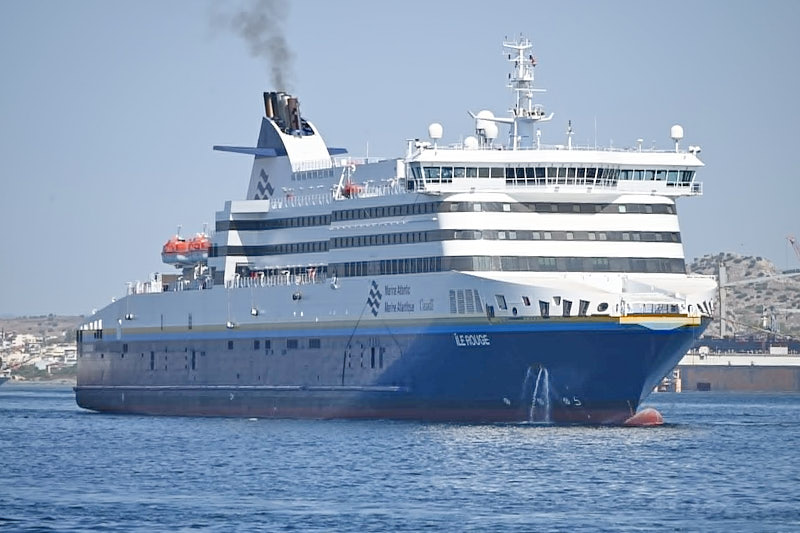
On 16 and 17 July, ÎLE ROUGE (ex A NEPITA, SUPERFAST X, SEAFRANCE MOLIÈRE, DIEPPE SEAWAYS, STENA SUPERFAST X) successfully completed two days of sea trials in the Saronic Gulf following conversion and modification work at the Perama repair zone.

VDN Ippocampos managed the conversion project. The ship arrived in Greece in February 2026 for ramp and bow visor modifications ahead of a five-year charter to Canadian operator Marine Atlantic for service between North Sydney and Port aux Basques.

Built by HDW in Germany in 2002, ÎLE ROUGE has capacity for 1,200 passengers and 1,920 lane metres. Her service speed is 27 knots.

Photo: Ben Ayre

EUR 4 Million Antitrust Fine Imposed On Caronte & Tourist Annulled

By 2026 Newsletter week 30

Italy’s Consiglio di Stato has overturned a EUR 4 million antitrust fine imposed on ferry operator Caronte & Tourist in 2022 for alleged abuse of a dominant position in the RoPax maritime transport market in the Strait of Messina. The ruling reverses a previous decision by the Lazio Administrative Court, which had upheld the penalty.

The court identified several flaws in the Italian Competition Authority’s decision. It ruled that the Authority had failed to prove that the market was effectively closed to competition or that significant barriers prevented new entrants.

The judges also found that the Authority had used a government study for a purpose different from that originally disclosed during the investigation, infringing the company’s right to defend itself.

In addition, the court rejected the Authority’s economic analysis, finding its methodology for assessing the company’s revenues and costs unreliable. It also criticised the unusually long preliminary investigation, which lasted 855 days and made it difficult for the company to retrieve the requested accounting records.

As a result, the Consiglio di Stato annulled the antitrust decision and ordered the Competition Authority to cover the legal costs of both court proceedings.

CMAL Completes Outline Design For Oban Berth Upgrade

By 2026 Newsletter week 30

On its LinkedIn page, Caledonian Maritime Assets Limited (CMAL) announced that the outline design for the preferred option for the Oban 1 Berth Upgrades Project has been completed.

The project will improve port infrastructure to support existing ferry operations and accommodate future vessels, including those planned under the Small Vessel Replacement Programme (SVRP).

Work is continuing on the Outline Business Case, which is expected to be submitted to Transport Scotland for approval. Subject to approval, detailed design is anticipated to begin towards the end of 2026.

Further work will include shore power proposals and additional ground investigations. CMAL also plans to launch a first public consultation on a revised Harbour Revision Order later in 2026.

Experts Warn Swedish Transport Research Cuts Could Weaken Innovation

By 2026 Newsletter week 30

Fourteen researchers and transport-sector executives have warned that planned cuts to the Swedish Transport Administration’s research budget could have serious consequences for innovation, skills and the green transition.

  • Research funding: The Swedish Transport Administration’s research budget is set to fall from SEK 7.4 billion to SEK 4 billion over 12 years.
  • Narrower scope: Funding will increasingly focus on areas such as infrastructure maintenance and total defence.
  • Areas at risk: Electrification, renewable fuels, climate transition, digitalisation and other transport innovation fields could lose funding.
  • Industry impact: The signatories warn that reduced research funding will also weaken industry access to specialist knowledge, researchers and future recruits.
  • EU funding not enough: They argue that strong national research capacity is essential for Swedish organisations to compete successfully for European research programmes.
  • Long-term concern: Once research teams, doctoral students and specialist expertise disappear, rebuilding that competence can take many years.
  • Call to government: The group wants the cuts reversed, the research mandate kept broad and existing research results translated more rapidly into practical applications.

The signatories include representatives from IVL, the University of Gothenburg, Linköping University, VTI, KTH and Chalmers, as well as executives from Terntank, Gotland Tech Development/Gotlandsbolaget, Port of Luleå, Port of Piteå, Bring and Soya Group.

The debate article argues that transport research should be viewed not as a cost, but as an investment in Sweden’s competitiveness, innovation capacity and future transport system.

Source (in Swedish)