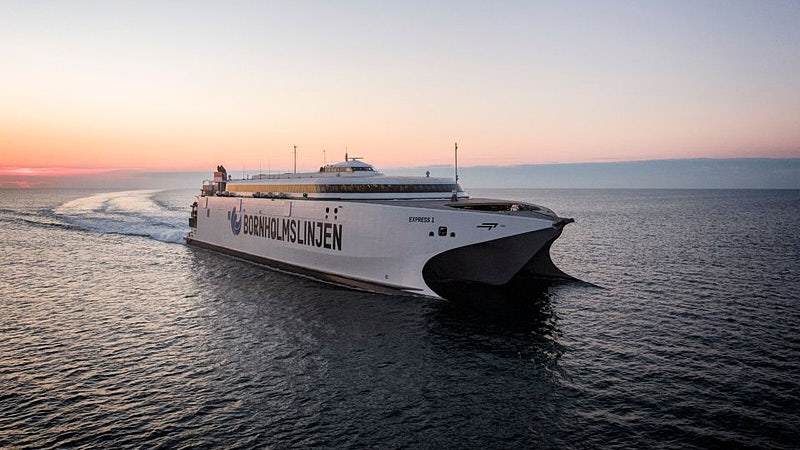


Charles-Henry de Lignac to Lead La Méridionale

By 2026 Newsletter week 34

Charles-Henry de Lignac will become Managing Director of La Méridionale on 1 September, succeeding Étienne Melliani, who was appointed in January 2026.

Melliani will remain within the CMA CGM Group and is reportedly set to join its Mediterranean Short Sea Lines activities.

De Lignac, who has previously held management responsibilities at La Méridionale, becomes the company’s fourth Managing Director in around three years. The company says his appointment will ensure continuity of ongoing projects and support its next phase of development.

The management change comes as La Méridionale prepares for the delivery of two new 180-metre LNG-powered RoPax vessels in the first quarter of 2027. The ships, intended for services between mainland France and Corsica, will accommodate 1,000 passengers and freight.
Jarosław Kotarski Appointed President of PŻB

By 2026 Newsletter week 34

Polska Żegluga Bałtycka (PŻB), operating under the Polferries brand, has appointed Jarosław Kotarski as President of its Management Board. He took up the position on 19 August, succeeding Piotr Redmerski.

Kotarski brings extensive maritime and ferry experience. A graduate of the Maritime University of Szczecin, he has worked within the Polska Żegluga Morska group since 1993. He previously headed Unity Line and served in senior management positions at Żegluga Polska.

Remark (source: gospodarkamorska.pl): Redmerski was dismissed due to changes in the management structures of the shipping companies and the need to separate responsibilities within PŻB in connection with the establishment of the POLSCA brand by PŻB, PŻM, and EuroAfrika.

CMAL Calls for Continuous Investment in Scotland’s Ferry Network

By 2026 Newsletter week 34

CMAL CEO Kevin Hobbs has called for ferry investment in Scotland to become a continuous programme rather than a series of stop-start investment cycles.

With new vessels entering service, seven electric ferries under construction and further projects progressing, CMAL expects half of the Clyde and Hebrides fleet to be renewed by the end of the decade. Once the vessels currently under construction enter service, the average fleet age should fall below 15 years.

Hobbs stresses that maintaining this momentum requires long-term planning. A ferry typically takes around five years from concept design to entering service, meaning vessels required beyond 2030 need to be planned and procured now.

The same approach is needed for ports, with continuous investment required for maintenance, shore power, electrification and future decarbonisation.

Read Kevin Hobbs’ full perspective:

From the Helm: Maintaining Momentum Through Continuous Investment (Linkedin)

Crossing the Strait of Gibraltar OPE 2026

By 2026 Newsletter week 34

The main OPE 2026 trends through 15 August are:

  • Overall traffic remains slightly below 2025: passengers -3.1%, vehicles -2.1% in the completed outbound phase.
  • Fewer sailings (-6.0%) than last year, while traffic declined less sharply, pointing to higher average utilisation.
  • Algeciras is losing traffic, with outbound passengers down 7.6%; the Ceuta route is particularly weak.
  • Tarifa–Tanger Ville is the clear outperformer: outbound passengers +7.0% and vehicles +12.6%. Return traffic is also showing double-digit growth.
  • Almería is growing, while Motril is substantially down.
  • The key trend is therefore not simply declining OPE traffic, but a redistribution between ports and routes, with Tarifa gaining strongly.

Detailed OPE figures through 15 August in El Estrecho (in Spanish)

DFDS Launches Strategy Review As Q2 Earnings Improve

By 2026 Newsletter week 33

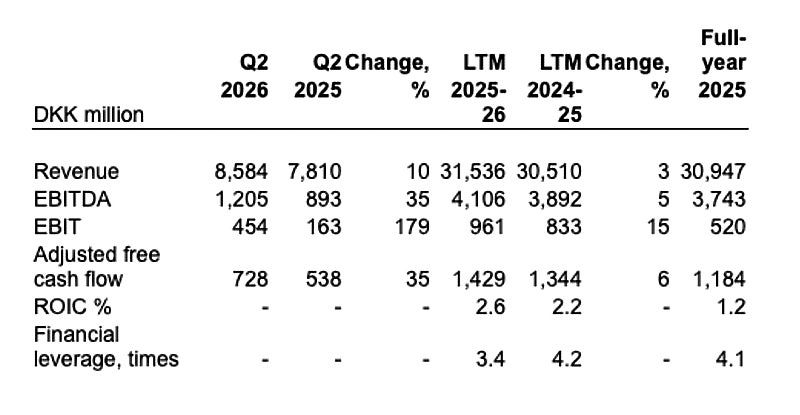
DFDS has launched a strategic review aimed at defining its long-term vision, positioning and priorities, as the group reported improved financial performance in Q2 2026.

“We have launched a strategy review to clarify our long-term vision, positioning, and priorities,” said Michael Hansen, CEO of DFDS. The review, including new financial ambitions, is expected to be completed within six months.

Hansen acknowledged that while DFDS is well positioned in most of its markets, its financial performance remains “far from where it should be”, making improved profitability a top priority.

In Q2, revenue increased 10% to DKK 8.6bn, while EBIT improved by DKK 291m to DKK 454m. Both the Ferry and Logistics divisions increased earnings compared with Q2 2025. Adjusted free cash flow reached DKK 728m and financial leverage improved to 3.4x NIBD/EBITDA.

DFDS also raised its 2026 outlook. Revenue growth is now expected at 3-5%, while the EBIT outlook has been narrowed upwards to DKK 1.2-1.4bn. Adjusted free cash flow is expected at around DKK 500m.

CO2e emission intensity across the total network increased by 2.0% during the quarter.

Read the Q2 2026 interim report here:

https://www.dfds.com/en/about/investors/reports-and-presentations/q2-report-2026

DFDS July Volumes

By 2026 Newsletter week 33

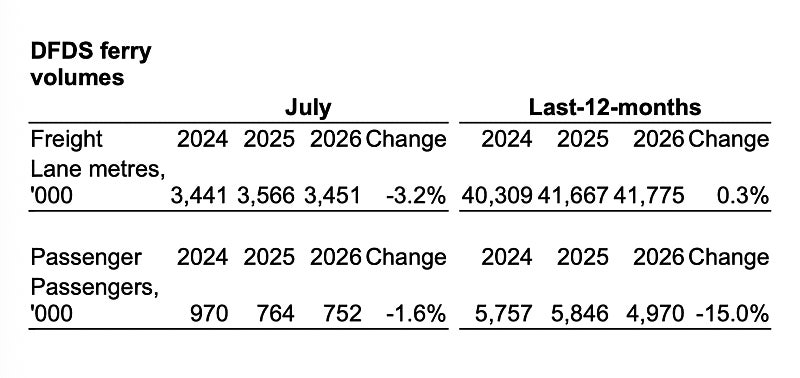
DFDS transported 3.5m freight lane metres in July 2026, down 3.2% compared with July 2025.

North Sea volumes were just below last year as growth on Continent–UK routes was offset by lower volumes out of Scandinavia. Mediterranean volumes declined due to a softer overall market and reduced capacity on certain routes, while Channel volumes were also below 2025.

Baltic Sea freight volumes remained stable. Strait of Gibraltar volumes increased, while growth continued on the Egypt route.

Over the last twelve months, freight volumes increased 0.3% to 41.8m lane metres, but decreased 0.5% when adjusted for route changes.

Passenger volumes decreased 1.6% in July to 752,000, mainly due to lower traffic on the Strait of Gibraltar. On a rolling twelve-month basis, passenger numbers were down 15.0%, or 5.1% adjusted for route changes.

Viking Line: Half Year Financial Report January – June 2026

By 2026 Newsletter week 33

Q2, 2026 

  • Sales amounted to EUR 129.3 M (EUR 128.4 M).
  • Other operating revenue was EUR 0.4 M (EUR 0.2 M).
  • Operating income totalled EUR 6.8 M (EUR 6.9 M).
  • Net financial items were EUR -5.9 M (EUR -2.0 M).
  • Income before taxes totalled EUR 0.9 M (EUR 4.8 M).
  • Income after taxes was EUR 0.8 M (EUR 4.8 M).

H1, 2026 

  • Sales amounted to EUR 214.0 M (EUR 215.8 M).
  • Other operating revenue was EUR 0.5 M (EUR 0.6 M).
  • Other operating income totalled EUR -12.0 M (EUR -11.2 M).
  • Net financial items were EUR -6.6 M (EUR -6.0 M).
  • Income before taxes totalled EUR -18.6 M (EUR -17.2 M).
  • Income after taxes was EUR -18.7 M (EUR -17.3 M).
  • Investments mainly in Viking Grace totalled EUR 11.0 M (EUR 12.4 M mainly in Gabriella and Viking XPRS).

Outlook for the financial year 2026

The Board of Directors has previously assessed that the uncertainty regarding cost levels, energy prices and market developments has been such that the Company has not provided any forecast for the full-year 2026 result.

The Board of Directors estimates that higher energy prices, both through their direct impact on the Group’s cost base and their indirect impact on consumer demand, together with weaker performance in the Group’s associated companies, will result in income before taxes for the 2026 financial year being lower than in 2025.

Bornholmslinjen Records Second-Best July

By 2026 Newsletter week 33

Bornholmslinjen recorded its second-best July ever, carrying 373,043 passengers to and from Bornholm, up 4.4% compared with July 2025. Car volumes increased 5.7% to 99,811 vehicles.

However, the strong traffic figures were accompanied by significant delays, resulting in a penalty of more than DKK 1.3 million for operator Molslinjen.

Commercial Director Lucas Kragh pointed to reconstruction works at the Port of Rønne and speed restrictions in Ystad as contributing factors. Molslinjen will conduct a deeper analysis of the delays after the high season.

Scandlines Carries 1.17 Million Passengers in July

By 2026 Newsletter week 33

Scandlines carried 1.173 million passengers on its Puttgarden–Rødby and Rostock–Gedser routes in July, slightly up from 1.152 million in July 2025.

The busiest day was 18 July, when almost 62,000 passengers travelled with Scandlines, more than 10% above last year’s busiest day and the highest daily figure since before the pandemic.

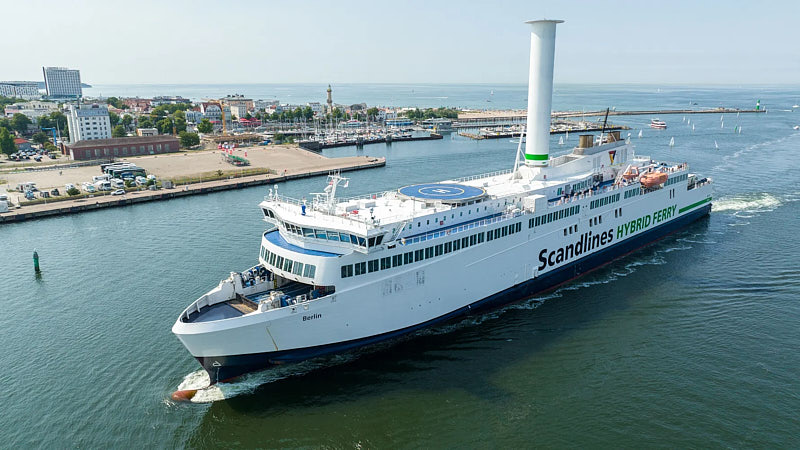
Scandlines says additional capacity provided by the new freight ferry THE BALTIC WHALE helped accommodate the strong summer demand (it freed up additional capacity on the other ferries). The company expects to carry around 2.5 million passengers over the three summer months.

Photo: Matthias Tasler for Scandlines

DP World Revenue Rises 13.1% in H1 2026

By 2026 Newsletter week 33

DP World, parent company of P&O Ferries, reported revenue of $12.7 billion for the first half of 2026, up 13.1% year-on-year. Growth across Logistics, Marine Services and the international Ports and Terminals portfolio helped offset lower activity at Jebel Ali, where vessel traffic was affected by disruption in the Middle East.

Adjusted EBITDA declined 5.6% to $2.86 billion, while container volumes excluding Jebel Ali increased 6.5% on a like-for-like basis. DP World invested $1.5 billion during H1 and expects total capital expenditure of approximately $3 billion in 2026.