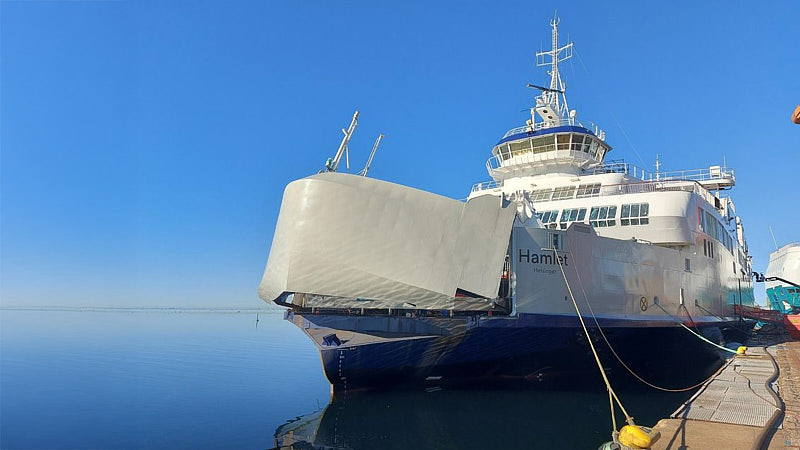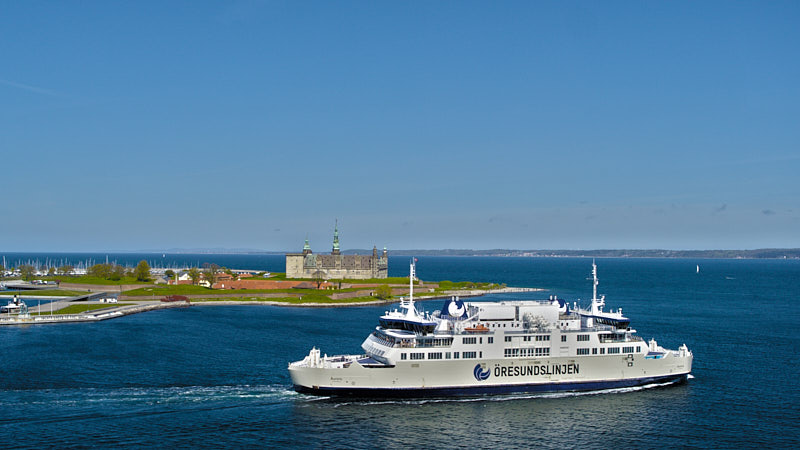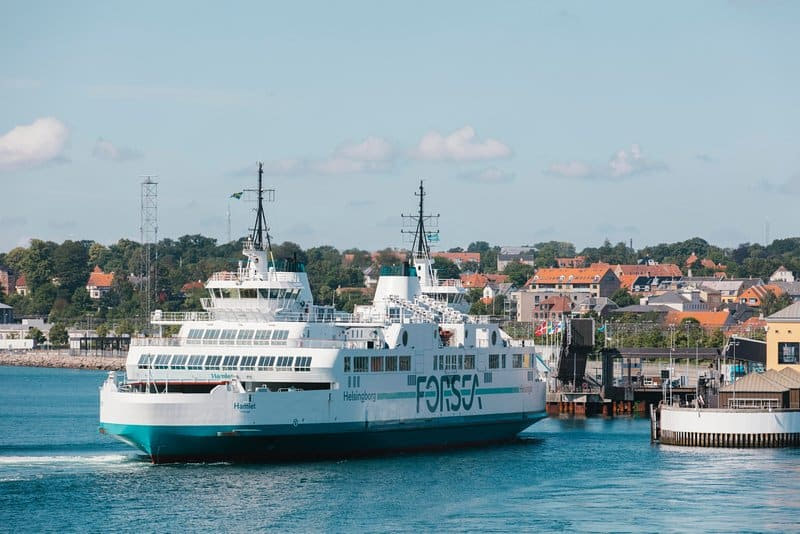

Øresundslinjen has taken another major step towards a fully green maritime corridor between Denmark and Sweden. The ferry HAMLET has entered Oresund Drydocks in Landskrona for a full conversion from diesel engines to battery power.
When HAMLET returns to service in mid-December 2025, she will operate as a fully electric ferry powered by renewable energy. This marks the third vessel on the Helsingør–Helsingborg route to undergo electrification.
The ferries AURORA and TYCHO BRAHE have operated on battery power since 2018. TYCHO BRAHE also installed the world’s largest maritime battery pack in 2021, at 6,400 kWh. Øresundslinjen was the first operator globally to run electric RoPax ferries on a high-frequency service.
HAMLET’s conversion includes:
- 2,800 kWh of batteries (Echandia) in four containers on Deck 6
- ABB charging modules on both sides of the Øresund
- Structural reinforcement completed during two earlier dockings
CO₂ Emissions Sharply Reduced
The route previously emitted 37,800 tonnes of CO₂ annually. After the first two conversions, emissions fell to 10,200 tonnes in 2024. With HAMLET electrified, emissions will drop to 2,500 tonnes after full implementation. The three conversions together will remove 35,300 tonnes of CO₂ per year.
HAMLET will return to service on 15 December 2025.