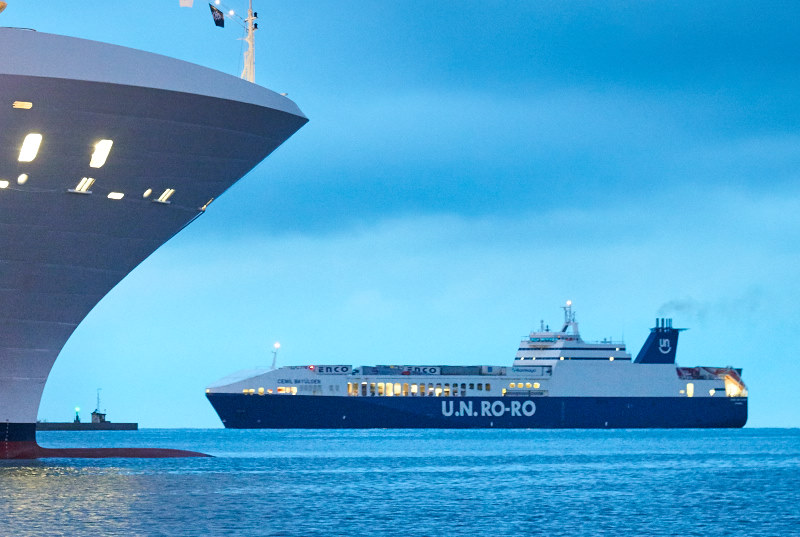
A ferry service from Rosyth is not dead in the water, according to a local Member of Parliament. DFDS recently decided to pull the plug from the Zeebrugge – Rosyth service.
DFDS Q1 Review: Strong Logistics Performance In Q1
“Both growth and earnings were ahead of expectations in Q1 and our full-year growth expectation is now raised to 4% and to 10% including U.N. Ro-Ro. European growth is robust and continues to support our ferry routes and logistics activities. Our continuous improvement projects are on track and will also contribute to earnings this year,” says Niels Smedegaard, CEO.
Some highlights:
- Revenue growth of 9%, adjusted
- Passenger volumes up 14% boosted by Easter
- Ferry freight volumes up 3% despite negative impact from Easter and a collision
- Profit before special items and tax up 18%
Outlook 2018
- Revenue growth increased to 4% from 2%, excl. U.N. Ro-Ro
- EBITDA range of DKK 3,000-3,200m, incl. U.N. Ro-Ro
- Investments of DKK 5.2bn, incl. U.N. Ro-Ro
Click on the image to start the download of the report.
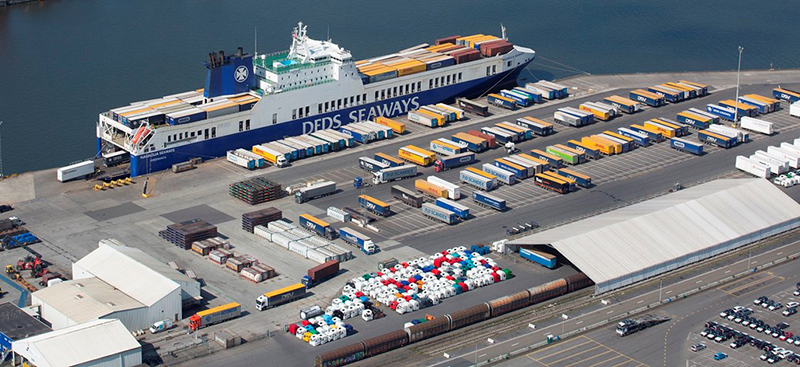
DFDS has signed a long-term sub-concession agreement and partnership with the Port of Ghent’s Mercatordock concessionaire, the Belgian group Sea-Invest. In this way, DFDS ensures it will continue operating and managing its own terminal. The Mercatordock is where DFDS handles the Ghent – Gothenburg/Brevik RoRo route, together with container barge connections to deep sea ports of Antwerp, Rotterdam and Zeebrugge.

Photo: North Sea Port
Last week we announced that DFDS is going to charter one of the Stena RoRo E-Flexers under construction in China. In fact the vessel is the fifth in the series, and Stena RoRo has a further three options on vessels for delivery from 2021 and onwards.
In 2016, Stena RoRo placed an order for four large ro-pax ferries with the Chinese shipyard AVIC International with an option for a further four vessels. The vessel now ordered is the fifth in the series.
From the first batch of four vessels, three will be operated by Stena Line on the Irish Sea, and one by Brittany Ferries.

DFDS has decided to deploy a new ship specially designed for the services in the English Channel from 2021. The ship will be built in Avic Weihai shipyard for Stena RoRo, and will be chartered for 10 years, with an option to buy.
The ferry will be highly efficient with an expected reduction in oil consumption of around 25% compared to current ferries. It will be able to carry 3,100 lane metres of cargo and 1,000 passengers. With this capacity, it will be the largest of the ships on the Channel.
The ship will be delivered in 2021, and market developments will determine whether it will be as an addition to the existing fleet or a replacement of the 1991-built CALAIS SEAWAYS.

Photo: Mike Louagie
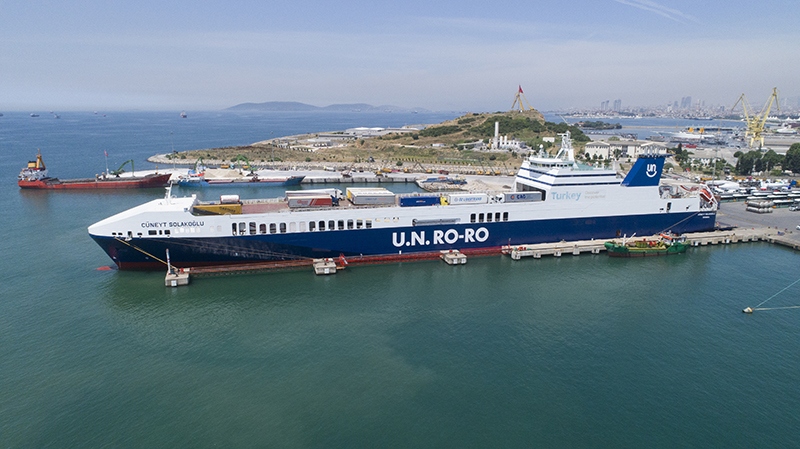
DFDS Expands Into the Med By Acquiring U.N. Ro-Ro
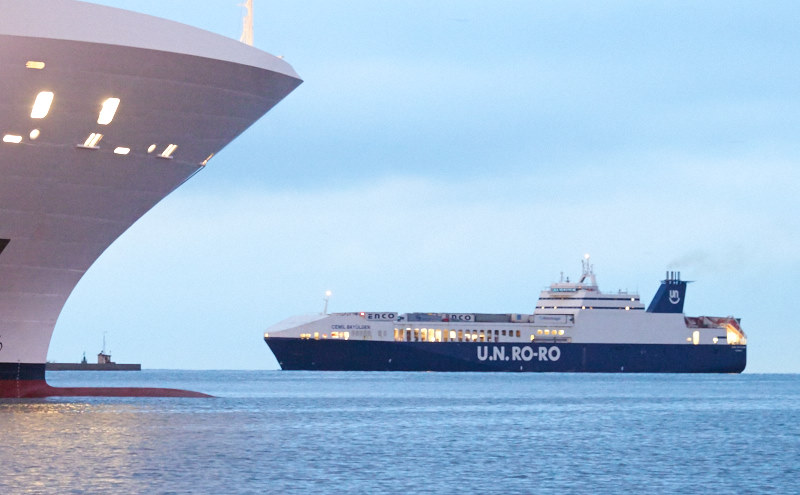
In a company announcement, DFDS says it acquires U.N. Ro-Ro, the Turkish operator of freight shipping routes in the Mediterranean, connecting Turkey with Italy and France.
This means a geographic expansion of the DFDS route network, with a considerable expansion in the Mediterranean.
DFDS is to acquire 98.8% from owners, the Turkish private equity firms Actera Group and Esas Holdings.
U.N. Ro-Ro is highly profitable, with an enterprise value of EUR 950 million.
“With the acquisition of U.N. Ro-Ro, we are expanding into one of Europe’s most attractive freight markets which is operationally similar to northern Europe. This gives us opportunity together with the existing strong management team to leverage our network, fleet, experience and skills to develop the business further while supporting the growth of U.N. Ro-Ro’s customers”, says Niels Smedegaard, CEO of DFDS.
The transaction is subject to approval by the Turkish, Austrian and German competition authorities as well as Italian authorities in relation to the transfer of the Trieste terminal as a strategic asset. Closing of the transaction is expected to take place in June 2018.
U.N. Ro-Ro operates five freight shipping routes in the Mediterranean between Turkey and EU: four routes connect to Italy (Trieste) and one to France (Toulon).
The routes carried 202,000 freight units in 2017.
By the end of 2017, U.N. Ro-Ro deployed 12 ro-ro ferries, all built by the Flensburg shipyard, where also some of DFDS’ ships are built.


The ro-ro vessel that was involved in a collision on the River Scheldt estuary (see previous news) left the Fayard shipyard on Thursday last week, and re-entered service in Gothenburg on Sunday April 8.
On Wednesday April 10 DFDS returned to the normal schedule when stand-in JUTLANDIA SEAWAYS rejoined the Cuxhaven – Immingham route.
From 15 May 2018, DFDS will offer individuals the opportunity to sail as passengers on the ro-ro ships between Zeebrugge and Rosyth. It has been possible to sail as a private passenger on the Ghent – Gothenburg route for many years.
With 32 hours at sea en route to or from Sweden, and 23 hours to or from Scotland, it is the ultimate in slow travel, and there is a market for this.

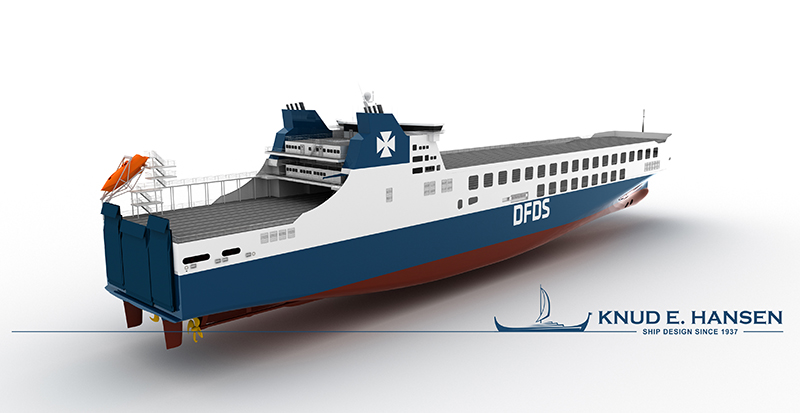
Deltamarin Ltd has signed a contract with Chinese Guangzhou Shipyard International Co, Ltd (GSI) for consultancy and engineering services for the DFDS ro-pax ferries.
DFDS originally signed a contract with OSK-ShipTech for the development of the outline concepts and tender documents, for both the ro-ro vessels now contracted at Jinling, and the ro-pax vessels contracted at GSI.
When MSC/GNV/Moby decided to order ferries at GSI too, DFDS said it wanted to prefer to have an advisor not involved in both projects.
The shipbuilding contract for two ro-pax ferries was signed on February 12 between DFDS and GSI. Both ro-pax ships are planned to be delivered in 2021.
The 4,500 lane metres, 600-pax ships will be deployed on one of the Baltic routes connecting Lithuania to either Sweden or Germany.

Two new ro-pax ferries have been ordered on February 12 for delivery in Q1 and Q3 2021 respectively.
The ships are designed to each carry 4,500 lane metres of freight and passenger vehicles, as well as 600 passengers (with up to 690 berths/250 cabins available).
The two ships will be built by Guangzhou Shipyard International Co, Ltd. at their Nansha Yard in China.
Both ships are planned to be deployed on one of the routes connecting Lithuania (Klaipeda) with either Sweden (Karlshamn) or Germany (Kiel).
The deployment in 2021 is planned to be a catalyst for a reallocation of ships in the Baltic route network ultimately increasing the network’s total freight capacity by around 30%.
DFDS opts for scrubber technology.
The ships will have a 1C ice class.
The investment in the two ships totals around DKK 1.8bn