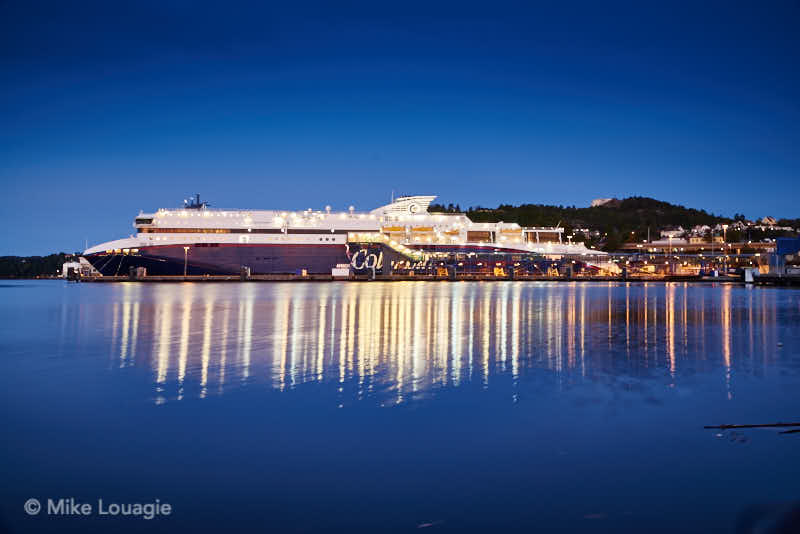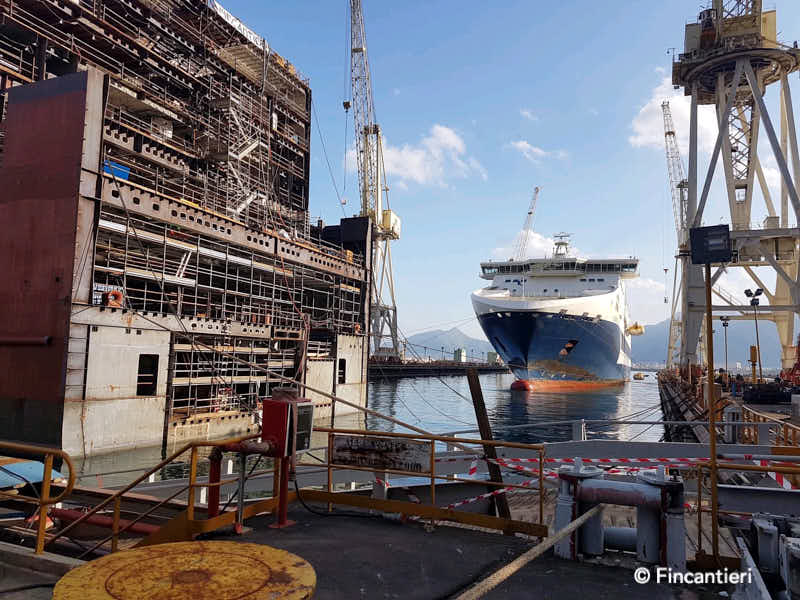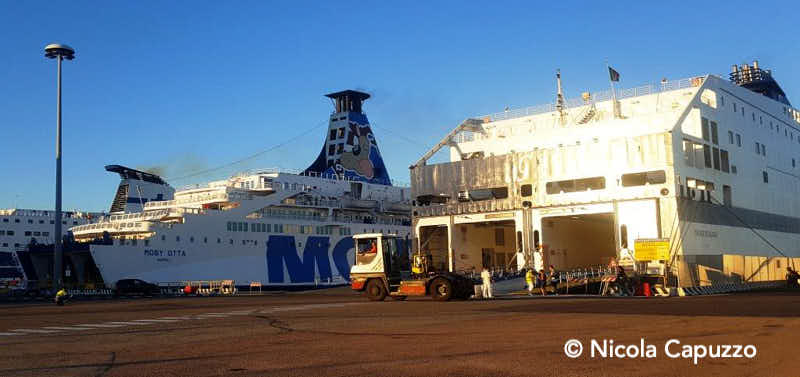
Entering the Port of Genua, is like entering a comic strip.
Photo: Mike Louagie

Entering the Port of Genua, is like entering a comic strip.
Photo: Mike Louagie
One month ago, P&O Ferries announced its plan to increase its capacity by 25% on Zeebrugge-Teesport, without revealing the name of the ship. (see: P&O Ferries Jumps On An Opportunity ).
Now we know! It will be the ESTRADEN, which has previously been working on Europoort – Teesport.
She will work in tandem with the BORE SONG, “to form the fastest and easiest gateway to Scotland for exporters to and from the continent.”
The ESTRADEN (2,270 lane meter) replaces the MISTRAL (1,625 lane meter).
To complete the reconfiguration of ships on its North Sea freight routes, P&O has chartered the STENA CARRIER (2,715 lane meter) to replace the ESTRADEN on Europoort – Teesport.
P&O Ferries currently carries more than 100,000 freight units a year on 6 return sailings a week between Teesport and its continental hub at Zeebrugge. The goods transported include chemicals, plastics, steel, automotive parts and alcoholic and non-alcoholic drinks.

In spite of a healthy EBITDA of EUR 135 million in 2017, Moody’s Investors Service downgraded Moby S.p.A. by two notches on May 14th.
The reasons can be found in uncertainties:

The Turkish competition authorities have approved the purchase of 98.8% of the shares of UN RoRo by DFDS.
Now DFDS has to wait for the approval of Italy, Germany and Austria too. The final completion of the DKK 7.1 billion transaction is expected before July.

As from Saturday, June 9, TT Line will send a ro-pax ferry from Trelleborg to Klaipeda, and vice versa, on a weekly basis.
The timetable shows a Saturday morning departure from Sweden and an evening arrival in Lithuania. The return voyage starts in Klaipeda at 01:30, with an arrival in Trelleborg at 17:30.
One of the reasons for this new route is the fact that freight is not allowed on German motorways on Sundays. Most of the ferries have a layover in Trelleborg. This created the possibility to start a new line.
Another reason is the trade growth between Scandinavia, Denmark, Baltic States, Belarus, Ukraine and Russia.
Port of Klaipeda is the largest ro-ro hub in the Baltic States (with a strong presence of DFDS). It offers excellent access to deep hinterland, e.g. Kazakhstan, Ukraine, Belarus and Russia.
The service will be for both accompanied and unaccompanied freight.
Via transshipment the cargo can be rerouted to Lübeck – Travemünde, Rostock and Swinoujscie.

Tallinn Terminal D Works Commenced
On Monday, 25 June construction works commenced in Tallinn Old City Harbour’s Terminal D where Tallink ferries are served.

E-Dea, the Italian IT provider of integrated software solutions for Ferry Companies, Ports and Terminals, has provided Scandlines with their flagship product, eBooking©, as part of the centralized and integrated passenger Reservation System.
The fully integrated reservation system supports Scandlines core processes including scheduling, products configuration, pricelist configuration, special offers, packages, etc. Thanks to its straightforward design, the system allows Scandlines to properly manage special offers and flexible prices to maximize seasonable revenue.
Also BC Ferries has chosen E-Dea, to have a key role in the implementation of the ACE (Automated Customer Experience) program. The core component of the ACE program is the streamlining of Booking, Ticketing and Check-in services.

Hitachi Europe Ltd has partnered with Stena Line to implement artificial intelligence technology on ships to reduce fuel consumption costs and become an important tool in the company’s efforts to minimise environmental impact.
Stena Line aims to become the world’s leading cognitive shipping company by 2021.

As The Clock Ticks, Brexit Frustration Is Growing
CEO Port of Zeebrugge, Joachim Coens, and Deputy CEO Port of Calais Benoit Rochet paid a visit to the British House of Commons on June 5, for a session about “UK’s economic relationship with the European Union”. The Belgian and the French Port demand urgent clarity on what will happen post-Brexit in order to secure a smooth transition.
Mr Coens asked for clarity about the transition period. “The transition period of two years is fine, provided we know from the beginning of that transition period what we have to do. We cannot be ready if there is uncertainty in the transition period.”
Some of the hot topics outlined by Mr Coens:
“We know there is Brexit but we don’t know exactly what Brexit means,” said Port of Calais CEO Benoit Rochet.