One Year VARSOVIA

By 2025 Newsletter week 32

VARSOVIA, operated by Polish Baltic Shipping Company (Polferries), carried 109,329 passengers, 48,124 passenger cars, and 44,205 heavy goods vehicles during its first year on the Świnoujście–Ystad route. The ferry entered service on 27 July 2024, carrying nearly 500 passengers on its maiden voyage. Polferries took delivery of the vessel on 11 July 2024 from the Cantiere Navale Visentini shipyard near Venice. The ferry is on a 10-year charter, with a right of first refusal after six years.

Source: Portalmorski.pl

St Malo Becomes Guernsey’s Busiest Sea Route

By 2025 Newsletter week 32
  • St Malo handled 45,000 Guernsey passengers in H1 2025, up from under 27,000 a year earlier.
  • Poole dropped to second place, despite a 3% increase to 41,000 passengers.
  • The French port of Dielette saw a 37% rise, reaching 5,700 passengers.
  • Overall passenger numbers at Guernsey harbour rose by 6%.
  • Growth follows Brittany Ferries becoming majority owner of Condor.
  • Direct France–Guernsey sailings and new day-trip-friendly schedules helped boost demand.
  • Private vehicles totalled 29,835, a marginal rise of 151 year-on-year.
  • St Malo vehicle traffic rose by 13% to 7,565.
  • Poole saw an 11% increase in cars; the Jersey route fell by 59%.

Source: Guernsey Press

Finnlines Financial Review January–June 2025

By 2025 Newsletter week 31

Thomas Doepel, President and CEO:

“Fleet rationalisation and investment in passenger traffic are now paying off. Despite a weak freight market, reduced debt and lower interest rates have contributed to significantly better results.”

Key Figures (January–June 2025 vs 2024)

  • Revenue: EUR 351.9m (–2%)
  • EBITDA: EUR 84.5m (+1%)
  • EBIT: EUR 39.9m (+6%)
  • Result for the Period: EUR 36.3m (+50%)
  • Interest-Bearing Debt: EUR 313.7m (–150.4m)
  • Equity Ratio: 57.5% (up from 54.8%)

Operational Highlights

  • Cargo Units: 399,000 (–0.3%)
  • Cars: 37,000 (–21%)
  • Non-Unitised Freight: 584,000 tons (–11%)
  • Passengers (incl. drivers): 439,000 (+7%)

Strategic Developments

  • Green Lane service launched: 100% electric transport (Finland–Sweden) and biofuel use reduce emissions by up to 90%.
  • New RoPax Order: Three methanol-powered vessels for the Finland–Germany route in 2028–2029.
  • New Route: Gdynia added to North Sea rotation in June 2025.

Financial Notes

  • Operating Cash Flow: EUR 70.8m (+18%)
  • Capex: EUR 62.6m (up from EUR 8.8m)
  • Net Gearing: Improved to 41.6% (from 60.8%)

Market Outlook

  • Freight demand remains soft.
  • Passenger business shows strong recovery.
  • Full-year result expected to improve.

CLAUDIA MORACE Delivered to Liberty Lines

By 2025 Newsletter week 31

Liberty Lines, the ferry company based in Trapani and owned by Ettore Morace and his family, has taken delivery of the seventh hybrid high-speed craft built by Astilleros Armon (Vigo, Spain), named CLAUDIA MORACE.

The vessel is part of an initial order for nine units and will arrive in Sicily in the coming weeks for the official christening ceremony.

These new high-speed ferries feature an integrated propulsion system with MTU Series 4000 engines from Rolls-Royce. The hybrid configuration allows the vessels to enter and leave ports with zero emissions. They can sail up to 8 knots in full-electric mode and reach 30 knots in cruise mode.

The system supports both traditional and electric propulsion. It results from close collaboration between Liberty Lines, Astilleros Armon, Rolls-Royce, RINA, and Incat Crowther.

Liberty Lines plans to order six additional high-speed craft from the same Spanish yard. Deliveries are scheduled to begin in 2027. These newbuilds will be sister ships to the nine ferries ordered in 2022.

OSK Design Behind World’s Largest Electric Catamarans for Molslinjen

By 2025 Newsletter week 31

Molslinjen’s newly announced order for the world’s largest fully electric ferries marks a major leap in maritime electrification—and OSK Design is at the heart of it.

The two 129-metre electric catamarans, to be built by Incat in Australia, will operate on the busy Kattegat route and carry up to 1,483 passengers and 500 cars. Powered by 45,000 kWh battery systems, the vessels will sail at over 40 knots with zero emissions.

Danish design firm OSK Design provided both the concept and basic design, enabling full-electric operation on one of the world’s most demanding fast ferry corridors.

“This is not just a ship design—it’s a blueprint for the future,” said Jacob H. Thygesen, CEO of OSK Design.

Source: OSK Design

ANDROS KING to Enter Domestic Ferry Service

By 2025 Newsletter week 31

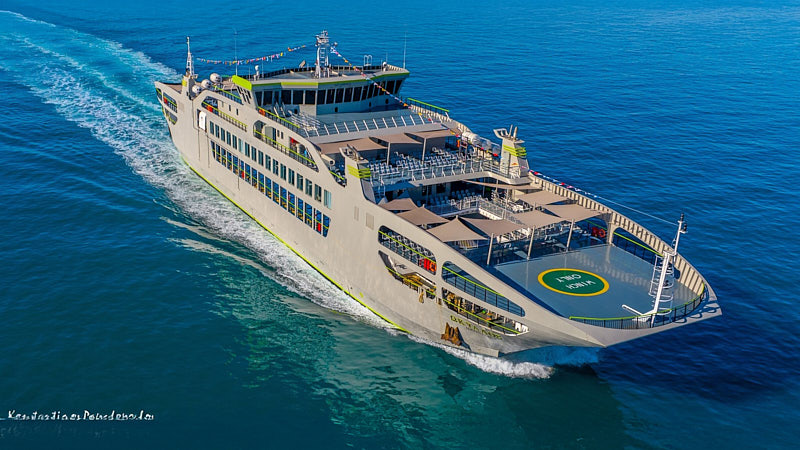
The extensive conversion and renovation of Golden Star Ferries’ ANDROS KING (ex-VOLCAN DE TABURIENTE) is progressing rapidly in the Perama Repair Zone. The ship was purchased in July 2024 and delivered in September 2024. She is currently being prepared for entry into service on the Rafina–Andros–Tinos–Mykonos route, possibly from 2026.

Built in Spain in 2006, she has a capacity of 1,500 passengers and 1,200 lane metres, and will operate at 22.5 knots.

Photo: Kostas Papadopoulos

HSC GOLDEN PRINCESS at Perama Dry Dock

By 2025 Newsletter week 31

In July 2025, Golden Star Ferries’ HSC GOLDEN PRINCESS (ex-GOTLANDIA II) entered the PIRAEUS II dry dock in the Perama Repair Zone for scheduled maintenance and repairs, due to continue until 8 August.

Acquired from Sweden’s Gotlandsbolaget AB in May 2023, she is intended to enter domestic service in Greece. Built in Italy in 2006, she can carry 900 passengers and 160 cars, and will sail at 32 knots.

Photo: Kostas Papadopoulos

BC Ferries Supports Local Ship Recycling Industry

By 2025 Newsletter week 31

BC Ferries is investing in local ship recycling by dismantling two retired Bowen-class ferries – BOWEN QUEEN and POWELL RIVER QUEEN – in British Columbia.

  • Work led by Marine Recycling Corporation (MRC) at Esquimalt Graving Dock and Surrey.
  • Up to 25 Point Hope Maritime employees involved.
  • Initiative avoids costly cross-country transport and supports BC jobs.
  • Complies with WorkSafeBC, Transport Canada, and environmental standards.

More than 900 vessels in BC will require disposal over the next decade. This project marks a first step in building west coast recycling capacity.

2024 Transport Trends Show Mixed Picture in Corsica

By 2025 Newsletter week 31

Transport activity in Corsica in 2024 showed diverging trends across sectors, according to the  annual figures published recently.

Maritime passenger traffic, excluding cruise passengers, remained volatile throughout the year, with notable growth during the high summer season. August (+6.7%) and December (+2.6%) recorded increases year-on-year, while some shoulder months, such as September (–0.2%) and November (0.2%), were largely stable. Total maritime passenger flows still performed better than air, which saw several months of decline, particularly September (–0.3%) and October (–10.9%).

Freight transport by sea saw sharper fluctuations. Tonnage of goods (excluding tare) dropped heavily in June (–26.6%) and October (–12.4%) but rebounded in December (+16.7%), reflecting the ongoing instability in cargo demand.

Air travel was hit hardest, with several months recording steep year-on-year declines, notably October (–10.9%) and April (–7.0%). Nevertheless, August (+8%) and December (+7%) confirmed the continuing strength of peak holiday periods.

The mixed performance highlights an ongoing sensitivity to seasonal demand patterns and wider economic conditions, particularly for freight and air travel. Maritime passenger transport remains relatively resilient, boosted by summer tourism flows.

Q1 2025 Transport Trends in Corsica

By 2025 Newsletter week 31

Air passenger traffic started slightly down in January (–1.9%), rose sharply in February (+12.4%), but dropped significantly in March (–15.7%).

Maritime passenger traffic was weak in January (–1.3%) and plunged in February (–22%), before rebounding in March (+17.1%).

Freight transport by sea remained negative throughout the quarter, with modest declines each month.

The first quarter reflects a highly unstable start to the year, with strong weather or economic effects likely distorting February and March results. March’s maritime rebound may indicate a recovery, but freight remains under pressure.