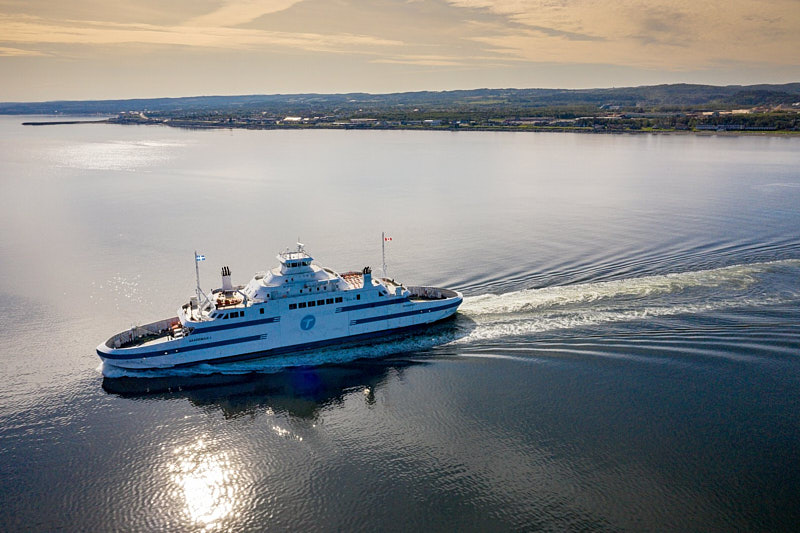
FRS Elbfähre Glückstadt Wischhafen draws a positive balance after a year under FRS management

By | 2021 Newsletter week 43 | No Comments

After the first year, FRS draws a positive conclusion about the takeover of the Elbfähre Glückstadt Wischhafen.

  • First steps towards digitalization: new sales system + onboard card payment.
  • The takeover by FRS took place in the middle of the pandemic: difficult first seven months due to lockdowns.
  • Since June 1, the four ferries have been running for the first time since the start of the pandemic to the same extent as they were last time in March 2020.
  • Since August, the transport volume have also been back to pre-Corona levels.

Future

FRS Elbfähre has developed a concept paper that sets up the future of the ferry line with green mobility for northern Germany.

  • Emission-free ferry operation is possible with new propulsion technologies of the existing ships, or with newbuildings.
  • Relocating the ferry pier in Wischhafen could also reduce the crossing time and thus increase the number of departures.
  • FRS is in talks with politicians and the nature conservation associations BUND and NABU to discuss the alternatives to the A20 Elbe Tunnel project. “This project is not justifiable for ecological, financial or economic reasons,” says FRS. (see the statement in German on the FRS website).
  • The silting up of the Wischhafener Süderelbe represents a major challenge in ferry traffic. Due to the deepening of the Elbe, among other things, the side arm of the Elbe is silting up more and more, making smooth ferry operations increasingly difficult.

Proman and Stena jointly develop methanol as the pathway to sustainable shipping

By | 2021 Newsletter week 43 | No Comments

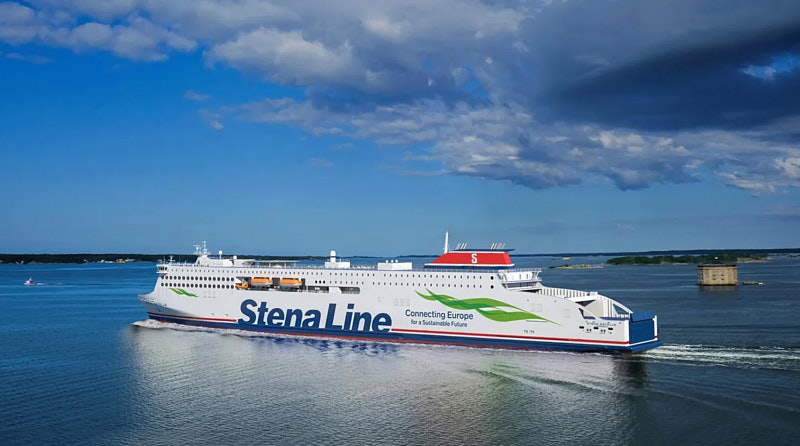
“Transitioning to low-carbon fuels will be essential to secure the long-term future of the industry. Methanol offers not only immediate, and urgently required, benefits but the only clear pathway to a sustainable future,” says Stena.

Proman and Stena are committed to jointly developing a Retrofit & Supply solution, enabling both Stena’s vessels as well as third party vessels to experience the immediate environmental benefits and greenhouse gas emission reductions delivered by methanol.

XRTC’s 20th Annual Report on the Greek Ferry Market 2021

By | 2021 Newsletter week 43 | No Comments

Ferry Shipping News already wrote about this report from XRTC Consultants. Below you can now access the English version of this study.

  • One of the biggest challenges facing the industry is the renewal of the (Greek) Ferry Fleet.
  • According to a relevant study by NEE and SEEN, in 2030, 32.7% of the Ferry Fleet will be older than 40 years, with 18 ships being older than 50 years.
  • Characteristic of the aging of the fleet is that the whole fleet is over 7 years old with a median age of 25 years.
  • This means that in the next 10 years, 50% of the existing fleet will have to be replaced.

Seaspan Ferries believes in carbon-neutral Renewable Natural Gas

By | 2021 Newsletter week 43 | No Comments

Seaspan became the first Canadian marine company to pilot the use of Renewable Natural Gas (RNG) to reduce greenhouse gas emissions produced by its LNG-powered fleet. Seaspan expects that data from the pilot will confirm that, by using RNG, greenhouse gas emissions can be reduced by upwards of 85 per cent versus traditional diesel fuel.

Seaspan has worked closely with FortisBC Energy Inc. to secure a source of certified carbon neutral RNG.

When bacteria break down organic waste from sources such as landfill sites, agricultural waste and wastewater from treatment facilities, it produces a biogas mostly made of methane. FortisBC captures and purifies this biogas to create RNG, a certified carbon neutral energy source, preventing the release of methane into the environment.

Mull & Iona Ferry Committee knows what kind of ferries users want

By | 2021 Newsletter week 43 | No Comments

The Mull & Iona Ferry Committee have been undertaking an extensive public consultation on what the users want from their new ferries.

The completed Specification of User Requirements (SUR) was delivered to the Government department that manages the ferry system, Transport Scotland.

Extract:

“The central criticism has been that whilst communities needed a larger number of smaller vessels, what was delivered is a small number of very large vessels. Take for example the Loch Seaforth, operating between Ullapool and Stornoway – islanders on Lewis wanted two smaller vessels, because they could see that would give them higher capacity, more sailings, and more reliability. Instead they got one large ferry, that delivers just two departures per day, and then runs an overnight freight service that used to be operated by a separate vessel.”

Future INSULA OYA III has been presented to users

By | 2021 Newsletter week 43 | No Comments

The Department of Vendée and the Pays de la Loire Region presented the new ropax cargo ferry operated by the Compagnie Yeu Continent and which provides the daily connection between Fromentine and Île d’Yeu.

In August 2022, the new vessel will replace INSULA OYA II on the Fromentine – Yeu Island route.

Length 55m | 391 passengers | 40% cargo carrying capacity, 154 tonnes |Shore power

A part of the ferry is being built by Kership and will be assembled by Piriou.

After resilience comes the time for competitiveness for Brittany Ferries

By | 2021 Newsletter week 43 | No Comments

Brittany Ferries will benefit from an exceptional state subsidy of 45 million euros, as well as the waiver of debts for a total of 16 million euros. This was announced by the French prime minister Jean Castex.

Jean-Marc Roué, president of Brittany Ferries, has welcomed the French government’s announcement.

For over a year, Brittany Ferries has warned the French state of its deteriorating financial situation as it has battled the Brexit and Covid crises. In particular, the closure of passenger services on the English Channel, a direct consequence of travel restrictions put in place by various European governments to control the Covid pandemic, has had a massive impact.

Support first came to the company last year in the form of government-backed loans issued by French banks to the tune of €117m. The company was further supported by the regions of Brittany and Normandy. It was therefore able to rely on its resilience for nearly two years, in the face of the double storm of Brexit and Covid.

However, significant accumulated losses made it impossible to resort to further loans to guarantee a return to growth. Brittany Ferries, which is the largest employer of French sailors as well as being a vector of economic and tourist development of the Brittany and Normandy regions, had no other recourse than seek reimbursement for the damage suffered as a direct consequence of the forced closure of passenger services.

Norwegian contracts for Norled and Torghatten

By | 2021 Newsletter week 43 | No Comments

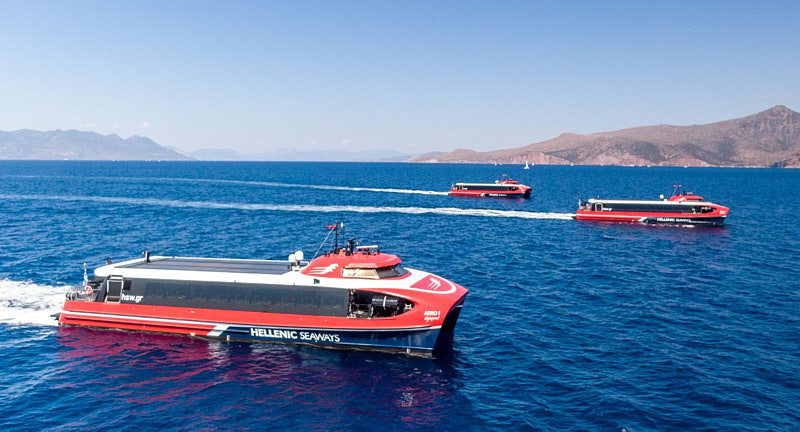
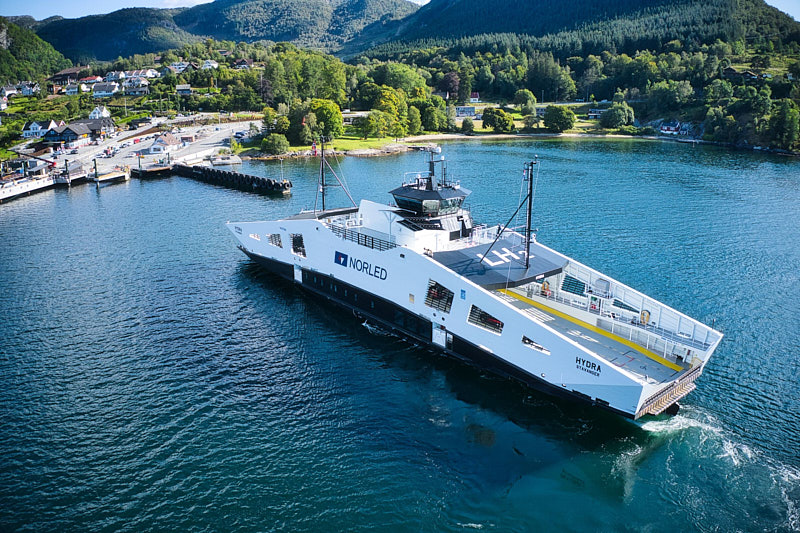
Norled has been awarded a contract for the operation of fast ferries in Kinn, Bremanger, Stad, Vik, Høyanger, Sogndal and Lærdal municipalities, from 2024 to 2036.

The contract has clear requirements related to a CO2 cut of at least 52%.

Norled wants to introduce battery technology on fast ferries.

Torghatten Nord has won a 10-year contract for an electric ferry service on the Bognes-Lødingen route with a design from Norwegian Ship Design.