

PORTS

By | 2025 Newsletter week 18 | No Comments

Key highlights from North Sea Port’s Q1 2025

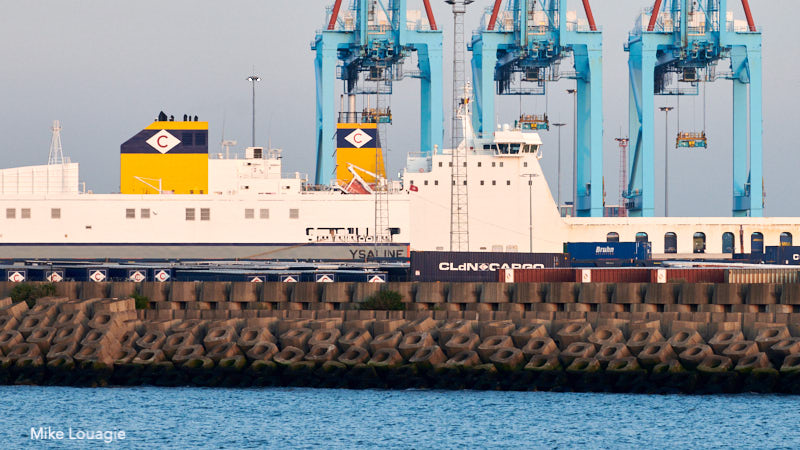
North Sea Port= Gent, Terneuzen and Vlissingen

General Throughput

  • Total seaborne cargo: 16.6 million tons, up 0.9% year-on-year (+200,000 tons).
  • Growth mainly driven by liquid bulk and container handling.
  • Follows a positive year in 2024 with +0.7% growth.
  • Diversified activities continue to provide stability amidst global uncertainty.

Cargo Segment Highlights

  • Liquid bulk: Up 7.8% to 3.9 million tons (+300,000 tons).
  • Dry bulk: Down 1.9% to 8.7 million tons (-200,000 tons).
  • Container traffic: Up 33% to 45,000 TEU (~500,000 tons).
  • Break bulk Slight drop of 1.5% to 2.5 million tons (-40,000 tons).
  • Ro-Ro: Decreased 5.1% to 950,000 tons (-50,000 tons).

Geopolitical & Trade Trends

  • United Kingdom: Continued growth of +9.8%, remains largest trading partner.
  • United States: Trade up +11.5%, including a 100,000-ton increase in exports.
  • Russia: Trade declined -32%, now at just 500,000 tons, due to EU sanctions.

Geopolitical tensions (e.g. US trade war) may affect future performance.

https://en.northseaport.com/north-sea-port-also-records-modest-growth-in-the-first-quarter-of-2025

DIGITAL

By | 2025 Newsletter week 18 | No Comments

Hyundai Glovis Embraces Digital Fire Safety for EV Shipping

As EV exports rise, Hyundai Glovis is tackling fire risks with digital innovation. Partnering with Consilium Safety Group, the company is equipping its fleet with the SMiG system—an advanced fire control interface that maps real-time smoke and heat data across ships.

Instead of vague alerts, crews now get pinpoint locations and early warnings—often gaining up to four extra minutes to respond. “It’s a digital guardian at sea,” says Consilium’s Nordberg.

The goal? Smarter, faster, data-driven safety—onboard and potentially in car parks and logistics hubs on land.

Read the full article: https://www.consiliumsafety.com/en/hyundai-glovis-and-consiliums-push-for-safer-ev-shipping/

IMAGE CARDS

By | 2025 Newsletter week 18 | No Comments

Incat Hull 096 – the world’s largest battery-electric ship – was officially launched at the Incat shipyard in Hobart.

Constructed for South American ferry operator Buquebus, Hull 096 is the most significant vessel ever built by Incat and represents a giant leap forward in sustainable shipping. When it enters service between Buenos Aires and Uruguay, it will operate entirely on battery-electric power, carrying up to 2,100 passengers and 225 vehicles across the River Plate.

FINANCE, FACTS AND FIGURES

By | 2025 Newsletter week 17 | No Comments

Port of Antwerp Bruges Is Carefully Monitoring the Trade Climate

In Q1 2025, Port of Antwerp Bruges handled 67.7 million tonnes of cargo, a 4% decrease compared to the same period last year. The drop is mainly due to a significant decline in bulk traffic, although container volumes showed growth. RoRo did grow a little too.

The port continues to navigate a challenging environment marked by shifting market trends, geopolitical tensions and ongoing pressure on the European chemical sector. With the United States as its second-largest trading partner, the port is closely monitoring how the changing trade climate may impact the months ahead.

More details in the newsroom of Port of Antwerp Bruges.

Tallink Q1: Results Affected by Economic Environment and Idle Vessels

By | 2025 Newsletter week 17 | No Comments

Tallink Grupp published its unaudited Q1 financial results.

Key challenges:

  • Low consumer and business confidence.
  • Difficult economic environment in home markets.
  • Ongoing global geopolitical tensions.
  • Extended docking periods.
  • Four idle vessels, significantly impacting results.

CEO Paavo Nõgene stated:

  • Excluding the impact of idle vessels, results are comparable to Q1 2019.
  • One idle vessel, passenger ferry STAR I, has been sold and handed over.
  • Docking is also an investment in technology and customer experience.
  • Positive feedback already for refreshed BALTIC PRINCESS.
  • Preparing for high season with special cruises and surprises planned.

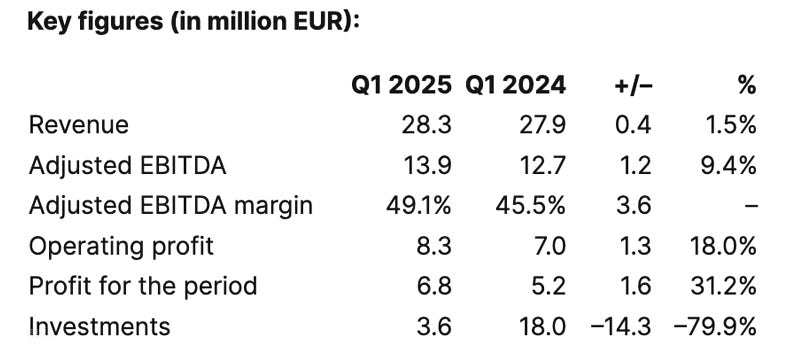
Key figures:

  • Revenue: EUR 137.3 million.
  • Net loss for the quarter: EUR 33.2 million.
  • EBITDA: Negative EUR 3.8 million.
  • Investments: EUR 13.3 million — mainly for refurbishing BALTIC PRINCESS and SILJA SERENADE.
  • Loan repayments and interest: EUR 20.8 million in early 2025.

Viking Line Q1 Characterized by Ship Dockings and a Challenging Market Environment

By | 2025 Newsletter week 17 | No Comments

Financial Highlights (Q1 2025 vs Q1 2024)

  • Sales: €87.3M (↓ 6.3% from €93.2M)
  • Operating income: €-18.0M (vs €-10.4M)
  • Income before taxes: €-22.0M (vs €-14.2M)
  • Net income: €-22.1M (vs €-14.3M)
  • Investments: €9.0M (mainly in GABRIELLA and VIKING XPRS)
  • Cash flow from operations: €-10.0M (vs €+1.3M)

Market & Operations

  • Passenger volumes: 767,353 (↓ from 871,828)
  • Cargo units: 36,352 (↑ from 32,993)
  • Passenger market share: 31.2% (↓ from 34.6%)
  • Cargo market share: 20.5% (↑ from 17.4%)
  • Passenger cars market share: 26.0% (↓ from 29.9%)

Fleet Activity

  • GABRIELLA docked (technical work)
  • VIKING XPRS docked (refurbishment and shop rebuild)
  • BIRKA GOTLAND had a planned traffic break
  • VIKING CINDERELLA temporarily operated on Helsinki–Tallinn route during XPRS docking

CEO Insights – Jan Hanses

  • Results aligned with expectations but weaker than Q1 2024
  • Two dockings negatively affected performance
  • Passenger demand still soft, but onboard consumption slightly stronger
  • Increased costs due to:
    • Finnish fairway fees (reversal of previous discount)
    • Emissions Trading System (ETS) now at 70% implementation
    • General cost pressure from maintenance, emissions, and fairway fees
    • Positive outlook expected toward the end of Q2

Financial & Investment Notes

  • Debt fully repaid for VIKING GRACE
  • Cash reserves down to €26.0M (vs €65.7M in Q1 2024)
  • Unutilised credit lines: €22.1M
  • Debt/equity ratio: 52.5% (vs 50.1%)

Key Risk Factors

  • Continued economic uncertainty in core traffic area
  • Geopolitical tensions affecting energy and transport markets
  • Unclear long-term trade prospects
  • Ongoing pandemic-era support repayments: €1.1M provision booked

Outlook

  • 2025 result before taxes expected to be in line with 2024
  • Uncertainty remains high due to external factors (economy, fuel prices, demand)

SHIPS

By | 2025 Newsletter week 17 | No Comments

From LNG To Hybrid: WILLEM DE VLAMINGH Upgraded for the Future

Over the past three months, Rederij Doeksen’s ferry WILLEM DE VLAMINGH underwent a major technical transformation. The vessel is now an LNG hybrid, thanks to the installation of a 900 kWh battery system.

This innovative refit, developed in-house by Doeksen’s own technical team, was carried out by Werft Shipbuilding (Urk) at Damen Shiprepair in Harlingen, with vital contributions from Piet Brouwer Elektrotechniek and VCU, both also based in Urk.

  • Permanent magnet generators were installed on the crankshafts of the main engines to recover unused engine capacity and convert it into electricity.
  • This power is stored in the new battery system and used for the onboard hotel load and bow thrusters.
  • Two extra bow thrusters have been added, improving manoeuvrability in strong winds.
  • Embarkation and disembarkation can now take place fully electrically and emission-free.
  • The battery system is charged overnight with shore power, reducing LNG consumption — and paving the way for even lower emissions as shore power availability increases.

Sister ship WILLEM BARENTSZ is scheduled for the same upgrade in early 2026.

“Using crankshaft-mounted generators on gas engines like this hasn’t been done anywhere else in the world,” says Jitze Landman, senior fleet inspector. “It’s a small technical revolution.”

Ropax TENACIA Back in Service for GNV After Nine Months

By | 2025 Newsletter week 17 | No Comments

Almost ten months after a fire broke out while sailing to Ibiza, the RoPax ship TENACIA—owned by Isabella Grimaldi’s “Grimaldi Investments” but operated under a bareboat charter by GNV—is back in service.

MSC-controlled GNV confirmed that “TENACIA will return to operations this summer after a period of work necessary to completely restore the technical parts damaged last July.”

The repair work was carried out at the Nuova Meccanica Navale shipyard in Naples, a company in which MSC also holds a stake.

The incident occurred on 8 July in the high seas, north of Ibiza, following a fire outbreak in the engine room. At the time, the ship was carrying goods and approximately 400 passengers and crew between Valencia and Palma de Mallorca.

Farewell to RIACE – Welcome SIKANIA II

By | 2025 Newsletter week 17 | No Comments

After over four decades of faithful service on the Strait of Messina, the double-ended ferry RIACE is heading for retirement.

Built in 1983 and capable of carrying 393 passengers and 300 lane metres of vehicles, she has long been a vital link between Sicily and Calabria. Now, she awaits her final journey to Turkey for scrapping.

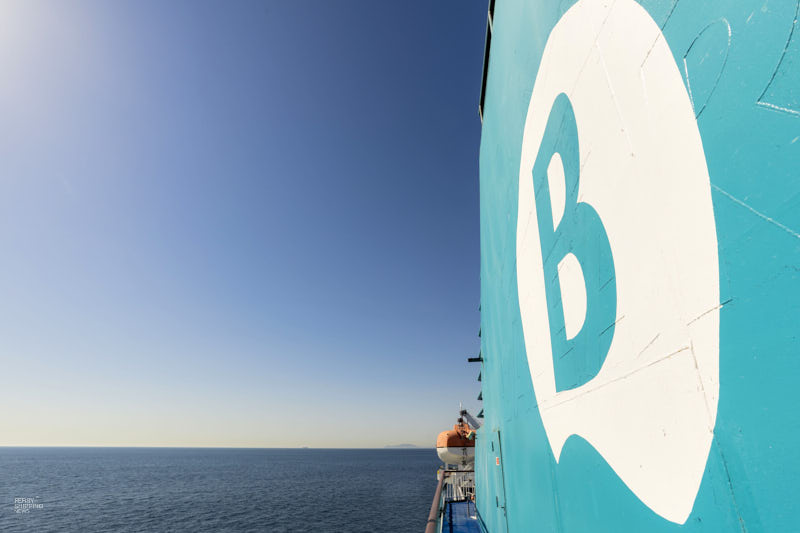
Her replacement? The SIKANIA II – a brand-new hybrid ferry currently being built by Celt in Greece. With a length of 105 metres, the vessel is designed to carry 22 heavy vehicles or 125 cars, along with 400 passengers. She will soon take over the route between Villa San Giovanni and Messina.

Bluferries’ fleet renewal is well underway — combining sustainability, innovation, and continuity for one of Italy’s most iconic ferry crossings.

Photo ©ML

Corsican Ferry Operators Lead on EV Safety

By | 2025 Newsletter week 17 | No Comments

With electric vehicles (EVs) increasingly common on ferries, Corsican operators are proactively updating safety protocols—despite the lack of national regulation in France.

As reported by Corse Net Infos (in French), both Corsica Ferries and Corsica Linea have introduced measures to manage the unique risks of EVs, particularly potential battery fires at sea.

Corsica Ferries has trained its crews specifically on EV handling and fire prevention, and informs passengers at the dock, recommending battery levels stay below 30% before boarding.

Corsica Linea now categorises vehicles by propulsion type when booked, placing EVs in separate areas on board. Firefighting systems have been upgraded, and the company plans to have Marseille marine firefighters on every crossing.

While countries like Greece and Norway have imposed restrictions, France’s ferry lines are choosing innovation and preparedness. Interferry supports this approach, citing research that EV fire risks are comparable to those of petrol vehicles. (https://interferry.com/e-cars-on-board-brochure/)
(313