

Caronte&Tourist Protests for the Lack of LNG Bunkering for Its Ferry ELIO in The Strait Of Messina

By 2020 Newsletter week 39

Two years ago, Caronte&Tourist took delivery of the dual-fuel ship ELIO which has been running up to date with marine gasoil since LNG is not available in the Strait of Messina.

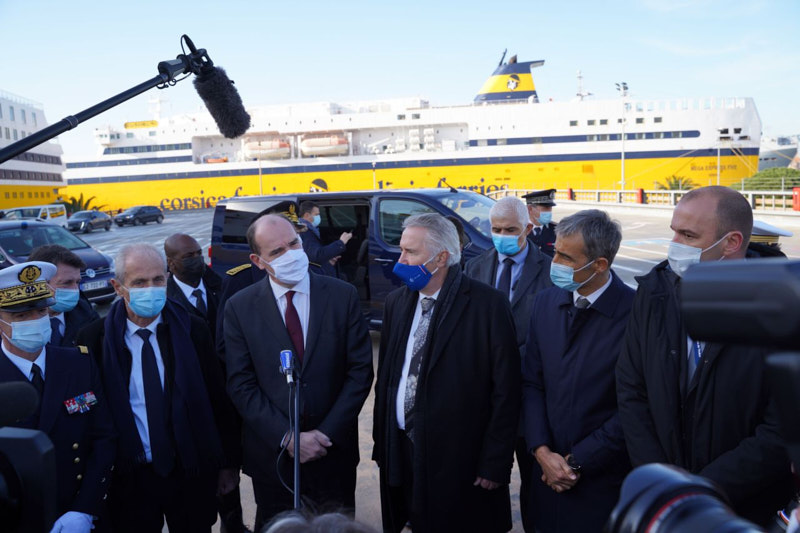
A few days ago,  CEO Vincenzo Franza publicly protested during the opening ceremony of a LNG station for trucks in Catania. This summer, Caronte’s application to realise a small LNG depot in Tremestieri, in order to make LNG available for ELIO, was rejected for the second time.

Mario Mega, newly appointed chairman of the port authority in Messina, replied that they are evaluating the opportunity to build up a larger LNG depot also for cruise vessels therefore a smaller one would be in case not necessary.

Franza underlined that ELIO will not be able to bunker LNG until a depot is opened in Messina.

Baleàrias New LNG High-Speed Craft Launched

By 2020 Newsletter week 39

Baleària’s new fast ferry ELEANOR ROOSEVELT was launched on Friday 18 September at the Armon shipyard in Gijón.

This innovative ship is scheduled to begin operating in the first quarter of 2021.

Lots of focus goes to the use of LNG as fuel.

However, equally important is what Baleària has achieved in the digitization of services, with the “Smart ship” concept.

  • Passengers will be able to access by means of a QR code that they will receive via WhatsApp, with the indication of the assigned seat number
  • Internet service and WhatsApp coverage for text messages during crossing
  • Free digital entertainment platform for mobile devices
  • See the pets through webcams installed in the cages.

The Construction of Finnlines’ Second Hybrid RoRo Started

By 2020 Newsletter week 39

The construction of Finnlines’ second new hybrid ro-ro vessel –FINNECO II– started at the Chinese Nanjing Jinling shipyard. The first steel plates were cut in the traditional steel cutting ceremony on 16 September 2020.

Finnlines’ ongoing EUR 500 million newbuilding program, which includes three green hybrid ro-ro vessels as well as two eco-friendly Superstar ro-pax vessels, will further increase Finnlines’ energy efficiency.

In addition to lithium-ion battery banks, which enable ‘zero emissions in port’, they will be equipped with several advanced technologies to save energy and thus reduce emissions further.

The ro-ro vessels are expected to be delivered during 2021–2022 and the Superstar ro-pax vessels are set to start in traffic in 2023.

Perfect Debut for FRS’ High-Speed Craft SKÅNE JET

By 2020 Newsletter week 39

FRS Baltic’s high-speed ferry SKÅNE JET made her commercial inaugural voyage on Thursday 17 September.

She sailed from the port of Sassnitz-Mukran to Ystad.

Initially the season will last until November 1. A restart is planned for April

Fjord Line’s former FJORD CAT was built by InCat in 1998. She offers the shortest (111km) and fastest (2h30m) crossing between Germany and Sweden.

Canada Acquires Interim Ferry for Replacement of MADELEINE

By 2020 Newsletter week 39

Government of Canada awarded a $155 million contract to purchase the ropax ferry VILLA DE TEROR as an interim measure to replace the MADELEINE ferry. This follows an Advance Contract Award Notice published on July 2, 2020.

She will be renamed MADELEINE II and will undergo essential work while being dry-docked before its expected arrival in Canada in spring 2021.

The vessel will then undergo refit as required in Canada in order to deliver reliable ferry service from the summer of 2021 until 2026, when Chantier Davie Canada Inc. is expected to deliver the permanent new replacement vessel JEAN LAPIERRE.

As far as Ferry Shipping News understands, this ordered has not been finalized yet.

INDUSTRY ASSOCIATIONS

By 2020 Newsletter week 39

Ferry Safe: Taking to Water Seen As Safer Than Travelling by Plane, Train or Coach

Research from industry body Discover Ferries, reveals that more Brits would feel safe from Coronavirus infection travelling by ferry than by aeroplane, train or coach.

In total, 32% said they would feel safe from Coronavirus infection travelling by ferry. That compares with 24% for planes, 30% for trains and 26% for coaches. Discover Ferries is encouraging those who are still concerned to visit www.discoverferries.com/ferrysafe

to learn more about measures being taken on board.

“It is encouraging to see that Brits consider ferry travel to be the safest form of public transport during the pandemic,” said Abby Penlington, director of Discover Ferries. “What worries us more is the significant proportion who remain unconvinced and may therefore be delaying travel plans as a consequence.”

Operators have been working hard to implement and communicate strict COVID safe measures on board. However, the survey also shows that factors outside the control of the industry are adding to travellers’ anxiety, the most significant being quarantine restrictions. When considering future holidays abroad, just under three quarters of Brits (74%) say they are concerned about the possibility of having to quarantine when they arrive at their destination and 65% are concerned about the possibility of having to quarantine when they return home.

“We believe that the government should adopt a more regional approach to travel sanctions. It should also carefully consider allowing testing to shorten quarantine times, once testing capacity is available. This would bring greater stability to the industry and, in turn, reassure passengers who wish to book an autumn get-away or their 2021 break now.”