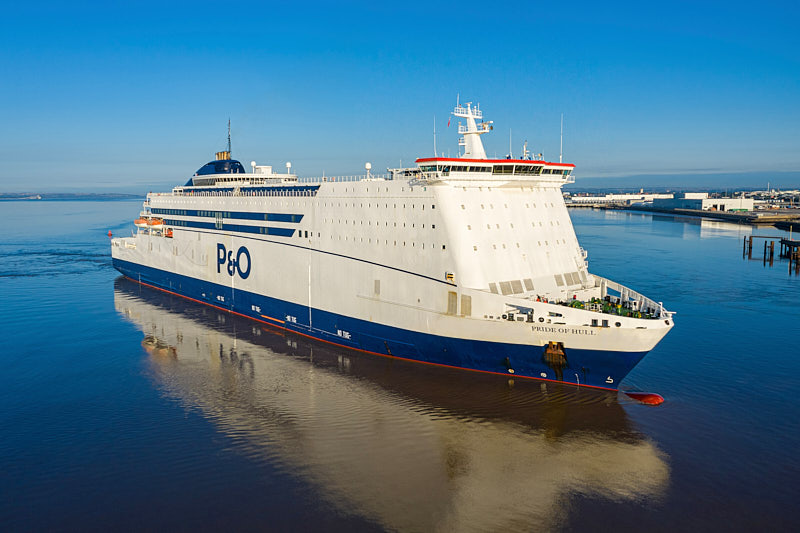

P&O Ferries has announced that Peter Hebblethwaite stepped down as director on 1 September 2025. The termination of his appointment was confirmed in a Companies House filing on 2 September.
With reference to the stock exchange release on May 5, 2025, regarding the appointment of a new CEO for Viking Line Abp, it is announced that Marcus Risberg will assume the position of CEO on November 3, 2025.
- 18 French politicians (Provence-Alpes-Côte d’Azur, Corsica, Occitanie) wrote an open letter in Le Marin.
- They accuse GNV, controlled by MSC, of “predatory dumping.”
- GNV operates RoPax routes from Sète to Morocco and Algeria.
- French Politicians claim MSC injected €290 million in 2024, covering losses.
- Strategy seen as undermining “sustainable” operators and national sovereignty.
- French unions denounce unfair competition via Italian ship register.
Source: Le Marin (in French)

Fraser Shipyards has delivered the innovative ice-strengthened RoRo ferry NIIGAAN ENAAZHEK to the Beausoleil First Nation. The double-ended vessel will ensure safe, year-round service between Christian Island and Cedar Point, Ontario, accommodating 150 passengers and 36 vehicles.

Damen Shipyards has launched the second of four new Island Class ferries for BC Ferries at its Galati yard in Romania. Once delivered, it will be the eighth Island Class vessel built for the Canadian operator. The ferries, based on Damen’s 8117 Electric Ferry (E3) design, are fitted with diesel-electric hybrid propulsion and are prepared for future full-electric operation once charging infrastructure is in place.
The ships will serve routes between Nanaimo and Gabriola Island, and Campbell River and Quadra Island. The latest generation has also been adapted to reduce underwater radiated noise, supporting BC Ferries’ Long Term Underwater Management Plan to protect marine life, including the endangered Southern Resident Killer Whale.
Damen is also supplying onshore charging equipment and will continue to support BC Ferries via its local service hub.
Color Group reported satisfactory results for H1 2025, despite fewer passengers and freight units compared to 2024.
- Revenue: NOK 2.9bn (down NOK 30m vs 2024)
- EBITDA: NOK 255m (vs NOK 389m in 2024, which included a NOK 45m one-off gain)
- Volumes: 1.6m passengers, 76,000 freight units (12-m equivalents)
CEO Trond Kleivdal
- Demand for routes and products remains high.
- Lower activity due to:
- Extended shipyard stays for environmental upgrades.
- Weak freight market.
- Reduced travel appetite in Norway from weak krone.
- Group expects a satisfactory annual result. Growth expected in foreign markets.
- On track with green transition and digital transformation.
Kleivdal warned of rising climate costs hitting the industry:
- EU Emissions Trading System already adds significant costs.
- IMO rules from 2028 could lead to double taxation on emissions.
- Calls on Norway to ensure the industry is not unfairly exposed.
Click on the cover below to access the report
Group Highlights
- Revenue: €309.9m (+8.5%).
- EBITDA: €54.9m (+10.5%).
- Operating profit: €24.6m (+41.4%).
- Profit before tax: €20.5m (+40.4%).
- Net debt: €224.1m (up from €162.2m at year-end 2024).
- Interim dividend: 5.37c per share (2024: 5.11c).
- Strong liquidity maintained despite €90.2m in capital expenditure.
- Investments: purchase of cruise ferry JAMES JOYCE and container vessel CT ENDEAVOR.
- All eight ferries now owned or under purchase obligation.
Irish Ferries (Ferries Division)
- Revenue: €206.0m (+4.3%).
- EBITDA: €40.0m (+7.0%).
- Operating profit: €14.1m (+48.4%).
- Car volumes: 264,900 (-4.4%).
- Passenger volumes: 1.28m (-3.5%).
- RoRo freight volumes: 393,300 (+2.2%).
- Passenger revenue: €84.5m (+8.6%) despite fewer sailings.
- Freight revenue: €100.8m (+1.4%).
- Disruption from Holyhead Port closure in early 2025, partial recovery since January.
- Fleet developments:
- JAMES JOYCE purchased from Tallink, deployed on Dublin–Holyhead.
- ISLE OF INISHEER redeployed to Dublin–Cherbourg, enabling daily service with WB YEATS.
- OSCAR WILDE operating Dover–Calais since June 2024.
- Fuel & emissions costs: €43.1m (down from €46.3m) due to lower fuel prices but higher EU ETS charges.
Sustainability
- Dublin Swift and ISLE OF INISHEER trialling Hydrotreated Vegetable Oil (HVO), cutting emissions by up to 80%.
- EU ETS coverage rose to 70% of emissions in 2025.
- 80% of heavy terminal equipment now powered by renewable electricity.
- Ongoing trials with biofuels and battery-powered tugs for terminal operations.
Outlook
- Freight volumes strong; car volumes recovering on Ireland–UK and Ireland–France routes.
- Dover–Calais volumes impacted by capacity changes.
- Holyhead Port repairs continue into late 2025 and Q1 2026, with operational restrictions.
- New daily Dublin–Cherbourg service launched.
- EU Entry/Exit System (EES) will affect Dover–Calais and Ireland–France routes from late 2025.
- Continued regulatory cost pressure from EU ETS and FuelEU.
Read the full report here.
Naviera Armas Trasmediterránea, through its holding Bahía de las Isletas SL, has signed two binding agreements.
- To Baleària: sale of routes, assets, and employees in the Canary Islands, the Iberian Peninsula, Algeria, and the Alboran Sea, plus its land transport business.
- To DFDS and Baleària: transfer of Strait of Gibraltar activities, including vessels, concessions, and employees.
Assets and Revenue
- Inter-island Canary Islands, Peninsula, Alboran, and Algeria routes generated €420m in 2024.
- Assets include vessels VOLCÁN DE TENO, VOLCÁN DE TAMADABA, VILLA TAZACORTE, VOLCÁN DE TINAMAR, VOLCÁN DE TINDAYA, JUAN J SISTER, ALMARIYA, and VOLCÁN DE TIMANFAYA.
- Also included are port terminals, offices, and concessions in key ports such as Tenerife, Arrecife, Cádiz, Melilla, Motril, Almería, La Palma, La Gomera, and Nador.
- Strait routes generated €66m in 2024.
- Baleària acquires the ferry CIUDAD DE MÁLAGA and a concession in Algeciras.
- DFDS acquires VOLCÁN DE TAMASITE, VILLA DE AGAETE, and terminals in Algeciras, Ceuta, and Tangier Med.
Next Steps
- Completion is subject to competition authority approval.
- Shareholders and creditors have already given their consent.
Leadership Comments
- Sergio Vélez, CEO Armas Trasmediterránea: “This step consolidates our future, opens new opportunities, and marks the conclusion of a successful restructuring process.”
- Adolfo Utor, President Baleària: ““If this deal goes ahead, it will help a local Spanish shipping (Baleària) company to continue competing efficiently with the large groups that have recently arrived and are already operating in our waters.”
- Mathieu Girardin, Head of Ferry Division, DFDS: “The growth of the Strait of Gibraltar ferry market has exceeded our expectations since we entered the market in 2024. The two ferries we are purchasing are already operating on overlapping routes and we expect to deliver a smooth transition and an immediate enhancement of services to both passengers and freight customers.”
- From Baleària’s legal advisors Albors Galiano Portales on Linkedin: “Two strategic pillars have guided this operation: the territorial cohesion of our country, ensuring the connection between the islands and the mainland, and the creation of a major Spanish shipping company prepared to face the challenges of the future.”
About the deal with DFDS Iberia SL
- The two ferries being purchased are the RoPax ferry VOLCAN DE TAMASITE (2004) and the HSC VILLA DE AGAETE (1999).
- In addition, the capacity share of the freight RoRo EOS shared among the incumbent operators on Algeciras-Tanger Med is increased.
- Viking Line will increase renewable biofuel purchases sixfold this autumn, equivalent to VIKING GLORY’s annual consumption.
- Bio-LNG will be used on the Turku–Stockholm route by VIKING GLORY and VIKING GRACE, alongside LNG.
- Fuels generate virtually no sulphur or particulate matter emissions and support the circular economy through waste-based raw materials.
Emission Impact
- Annual biogas use rises from 600 tonnes to 3,800 tonnes.
- Greenhouse gas emissions cut by 17,000 tonnes, equal to 1,700 Finns’ annual footprint.
- Viking Line contributes to Gasum’s pooling service for FuelEU Maritime compliance.
Customer Choice
- For the first time, passengers, conference guests, and cargo customers can opt for fully fossil-free journeys on all routes.
- Demand aligns with trends: 45% of Finns surveyed plan to make more sustainable travel choices.
Future Investments
- Viking Line invested EUR 450 million in VIKING GLORY and VIKING GRACE.
- Developing green corridors Turku–Stockholm and Helsinki–Tallinn.
- Plans for a 100% electric passenger car ferry on Helsinki–Tallinn by the 2030s.
CEO Jan Hanses:
- “We want to be pioneers as Finnish maritime transport shows the way to a fossil-free future.”
- LOCHMOR, the first of two new vessels for the Little Minch routes, was launched on Saturday 23 August at Cemre Marin Endustri in Yalova, Turkey.
- Together with sister ship CLAYMORE, she will replace the current single-vessel service provided by HEBRIDES. The two-vessel operation will serve Uig (Skye), Tarbert (Harris) and Lochmaddy (North Uist).
- LOCHMOR can carry 450 passengers and 100 cars, or 14 commercial vehicles, increasing capacity and resilience for the communities served.
- Transport Scotland allocated £115m in 2022 for the Little Minch ferries project, including port upgrades. Cemre Marin Endustri won the build contract in February 2023.
- LOCHMOR is the third of four standardised vessels being built at the Turkish yard for CMAL.
- The launch was attended by CMAL and project stakeholders. The ferry was officially launched by Kay MacLeod, a long-serving CalMac employee at Tarbert.
- The vessel will now be outfitted and tested in Turkey before sailing to Scotland in 2026 for crew familiarisation and service entry.
Photo courtesy of Brian Fulton, CMAL
On 18 September 2025, RoPax SUPERFAST III (ex-OLYMPIC CHAMPION) will be withdrawn from Adriatic service for scrubber installation. The work will be carried out at Elefsis Yards (ONEX).
She will be replaced on the Patras–Igoumenitsa–Ancona route by fleet mate RoPax LEFKA ORI on 19 September.
Built in Norway in 2000, she has capacity for 1,850 passengers and 2,045 lane metres. Her service speed is 30 knots.
Photo: Kostas Papadopoulos