


- Interferry supports the European Commission’s Industrial Maritime Strategy, which recognises the strategic role of ferries in Europe.
- The association particularly welcomes the proposal to reinvest EU ETS revenues into maritime decarbonisation.
- Shipping’s annual financing needs for fleet decarbonisation are estimated at EUR 2.4–8.5 billion, while ETS collections could reach about EUR 10 billion per year.
- Interferry stresses that funds should support practical measures for the existing fleet, including shore power, electrification and alternative fuels.
- The organisation also backs efforts to reduce administrative burdens and avoid double payments once a global IMO measure is in place.
Interferry is calling for an immediate halt to the further phasing-in of the EU Emissions Trading System for maritime transport.
The association wants the surrendering obligation for ferry emissions frozen at 70% in 2025, with the planned increase to 100% in 2026 put on hold.
Interferry argues that the current approach undermines the level playing field, following the EU decision to continue exempting road transport from a parallel ETS scheme and the absence of clear rules on how ETS revenues are allocated.
“This action must remain in place until road transport is also in an ETS and funds collected are actually ringfenced for maritime decarbonisation,” said Mike Corrigan, CEO of Interferry.
Key concerns raised by Interferry:
- Ferry operators face full ETS costs, while road transport remains exempt.
- ETS risks shifting freight and passengers back to already congested road networks.
- More than half of the world’s RoRo and passenger ship tonnage operates in European waters.
- EU ferries transport around 400,000,000 passengers and 200,000,000 vehicles and freight units annually.
According to Interferry, every euro increase in ferry freight rates increases the risk of modal shift back to road, directly contradicting EU transport policy objectives.
“This exemption of road transport creates a severe competitive disadvantage for RoRo and passenger ferries,” said Johan Roos, Director Regulatory Affairs at Interferry.
Interferry also points to the IMO decision in October 2025 to delay a global GHG pricing mechanism by at least 12 months. That framework was expected to replace the EU ETS and provide clarity on how revenues would be used.
Interferry estimates that the EU ETS is currently taxing intra-EU ferry transport by around €1,000,000,000 per year, while most revenues flow into national budgets rather than supporting e-fuels, port electrification or charging infrastructure for electric ferries.
The association stresses that it supports maritime decarbonisation, but only if policy measures genuinely enable investment in cleaner technologies rather than eroding the sector’s financial capacity to deliver them.

- Interferry has appointed six new directors to its Board, reflecting the association’s growing global reach. The appointments were approved at the AGM in Sorrento on 6 October.
- Götz Becker (FRS) has been appointed Chairman of the Board, while Supapan Pichaironarongsongkram (Chao Phraya Express Boat Co., Ltd.) becomes President for the coming year, succeeding Guido Grimaldi.
- New directors (four-year terms):
- Oluwadamilola Emmanuel, Lagos State Waterways Authority – Interferry’s first African Director
- Guido Grimaldi, Grimaldi Group / ALIS
- Morgan Mooney, San Juan Clipper & Fire Island Marine Services
- Mary Ann Pastrana, Archipelago Philippine Ferries
- Katy Taylor, Wightlink (UK)
- Mark Wilson, Bay Ferries / Northumberland Ferries
- Interferry CEO Mike Corrigan praised the expanded diversity and expertise on the Board, noting it strengthens the organisation ahead of its 50th Anniversary Conference in Bangkok in 2026.
- Outgoing directors Chet Pastrana, Emanuele Grimaldi, and Tim Mooney were thanked for their dedicated service.
- The EU will launch the Entry-Exit System (EES) on 12 October 2025, with a progressive, six-month roll-out.
- EES records non-EU travellers’ biometrics (face and fingerprints) and replaces passport stamps at external Schengen borders. Applies from age 12.
- Ferry routes linking third countries to the EU, e.g. UK and Morocco, will be affected. Expect extra border processing.
- Interferry warns of port delays, especially for car and coach passengers, and calls 100% biometric checks from day one unworkable.
- New Regulation (EU) 2025/1534 allows a ‘progressive approach’ to implementation. Member States choose pace and must file national plans by 25 September 2025.
- Communication duties are with port operators as border-crossing infrastructure owners, not ferry companies. Operators should stay in close contact with their ports.
- Interferry contact for guidance: Johan Roos, Director of Regulatory Affairs.
After more than 15 years of negotiations, the IMO has adopted global rules to reduce the carbon intensity of shipping fuels, marking a major step toward meeting its greenhouse gas targets. Under the new Global Fuel Standard, ships must gradually reduce the carbon content of the energy they use, starting in 2028 and benchmarked against 2008 levels.
The compliance system includes financial penalties for high-emission fuels and rewards for low-carbon alternatives. Revenue will help fund the IMO’s Net-Zero initiatives. Interferry supports the move, though notes the new system’s complexity.
Read more on the Interferry website: https://interferry.com/regulatory-reports/
And this is the IMO announcement: https://www.imo.org/en/MediaCentre/PressBriefings/pages/IMO-approves-netzero-regulations.aspx
Interferry has released a new brochure addressing one of today’s most discussed maritime topics: the safety of battery electric vehicles (BEVs) on ro-pax ferries.
Drawing on recent research and findings from EU-funded projects such as Lash Fire, the brochure provides clear and accessible guidance for ferry operators, passengers, and stakeholders.
Core message: BEVs do not present a greater fire risk than conventional internal combustion engine vehicles.
Presented in a Q&A format, the publication:
- Explains why BEV fires are statistically less frequent
- Clarifies common misconceptions around fire causes, intensity, extinguishing methods, and fume toxicity
- Details safe storage practices and the safety of on-board charging
“As electric vehicle numbers rise globally, so do questions about their impact on ferry safety. With the travel season approaching, it’s more important than ever for operators to provide passengers with clear and accurate information. This brochure is a practical tool to support that.”
Johan Roos, Director of Regulatory Affairs at Interferry
The brochure is free to download and share—membership not required.
Ferry operators are encouraged to make it accessible to passengers to support informed, confident travel.
Download the brochure and print instructions (ZIP, 1.2 MB): https://interferry.com/e-cars-on-board-brochure/
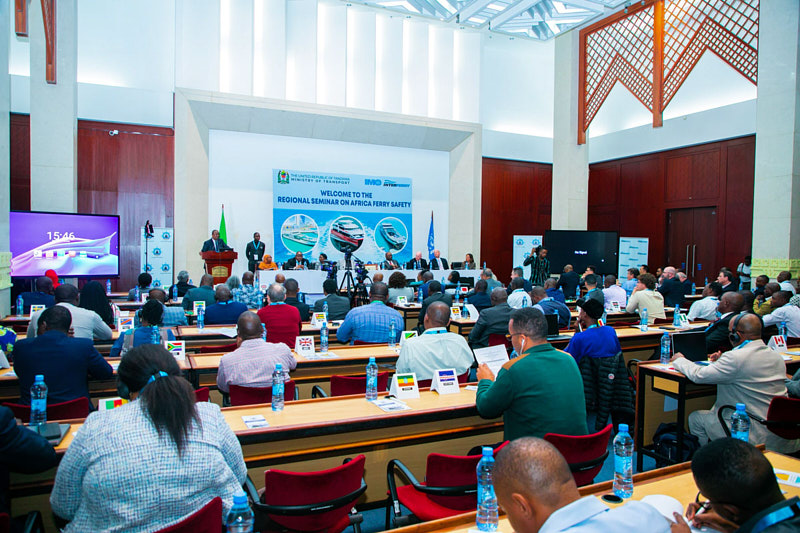
A collaborative effort to elevate ferry safety standards in Africa concluded April 17th, after a two-day intensive seminar co-hosted by Interferry and the International Maritime Organization. Over 100 participants from across the African ferry industry and Interferry´s global network convened in Dar es Salaam, Tanzania, united in the wake of recent regional tragedies.
The association fielded a delegation of 15 seasoned professionals from its worldwide operator and supplier members, whose purpose was to listen, exchange experience and share best practices on both operational and regulatory levels. Open discussions focused on critical areas impacting safety, including ticketing and passenger counting, cargo loading and stowage, vessel design and classification, insurance and financing, management culture and technical management, incident reporting, and the crucial role of political will in driving safety improvements.
Interferry is calling on governments and electricity utilities to prioritise investment in Onshore Power Supply (OPS) development to help the ferry sector maintain its lead in maritime electrification and hybridisation.
Read more here

A meeting between ESPO and Interferry has agreed a common work programme to promote an environmentally sustainable future for the European ferry business through the provision and use of onshore power supply (OPS).
- Ferries must be recognised as a sustainable passenger transport mode.
- Ferry ports should act as soon as possible to deploy OPS, and ferry lines should commit to using OPS whenever it is available.
- Investments should initially be made where it makes most sense in terms of maximising emissions reductions per installation.
- Both ports and ferries call for a coherent and predictable framework that provides legal certainty for stakeholders.
- Huge investments require funding
- New fuels and technologies for greening the shipping industry should be encouraged and promoted, alongside development of the relevant safety and operational standards.
EU-wide tax exemption for electricity provided to ships at berth.
Interferry has launched a call for papers addressing the ‘Power and People’ themes of its 46th annual conference taking place in Seattle, USA, this October.
Under the Power theme, presentations are invited on any sustainable, future-proof vessel powering options and the related challenges – notably the regulatory targets for greenhouse gas emissions reductions of some 50% by 2030 and a ‘net zero’ scenario by 2050.
The People sessions aim to explore issues facing operators regarding staffing and succession planning, with particular attention to training and retention at a time when the maritime sector, like all industries, is facing an acute shortage of skilled labour.
