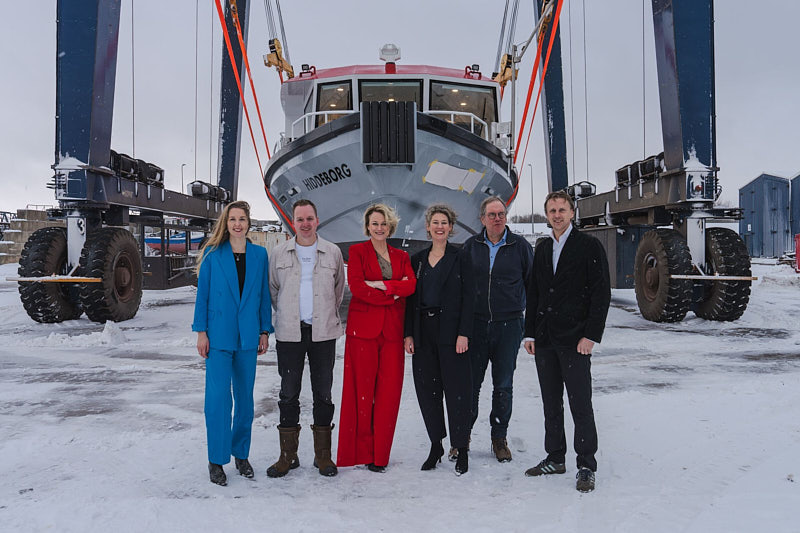
- Interferry has appointed six new directors to its Board, reflecting the association’s growing global reach. The appointments were approved at the AGM in Sorrento on 6 October.
- Götz Becker (FRS) has been appointed Chairman of the Board, while Supapan Pichaironarongsongkram (Chao Phraya Express Boat Co., Ltd.) becomes President for the coming year, succeeding Guido Grimaldi.
- New directors (four-year terms):
- Oluwadamilola Emmanuel, Lagos State Waterways Authority – Interferry’s first African Director
- Guido Grimaldi, Grimaldi Group / ALIS
- Morgan Mooney, San Juan Clipper & Fire Island Marine Services
- Mary Ann Pastrana, Archipelago Philippine Ferries
- Katy Taylor, Wightlink (UK)
- Mark Wilson, Bay Ferries / Northumberland Ferries
- Interferry CEO Mike Corrigan praised the expanded diversity and expertise on the Board, noting it strengthens the organisation ahead of its 50th Anniversary Conference in Bangkok in 2026.
- Outgoing directors Chet Pastrana, Emanuele Grimaldi, and Tim Mooney were thanked for their dedicated service.
Eckerö Line saw both passenger and freight traffic grow on the Helsinki–Tallinn route during the first nine months of 2025. Passenger numbers increased by over 3%, totalling more than 1.6 million travellers, while the company’s freight market share rose to 46% (up from 38% in 2024).
Around 60% of Eckerö Line’s freight now moves between Vuosaari (Helsinki) and Muuga (Estonia), bypassing city-centre congestion.
The company will take a major step toward electrified operations when RoPax FINLANDIA is fitted with a battery system in January 2026, making it the first hybrid ferry on the Gulf of Finland. The system will reduce annual fuel use by 500–600 tonnes (around 3%) and lower greenhouse gas emissions.
CEO Taru Keronen said the installation marks “the beginning of our journey toward fully electric, sustainable shipping.”
Eckerö Line will also upgrade onboard facilities on FINLANDIA and FINBO CARGO to enhance comfort and customer experience.
Parent company Rederi Ab Eckerö reported €181.1 million in revenue (+5%) and €21.6 million operating profit (+6%) for January–September 2025. The group expanded its network by acquiring the Fjärdvägen route between Naantali and Långnäs, introducing M/S SAILOR under the new Eckerö Link brand to improve capacity and energy efficiency.
Source in Finnish here
AS Tallink Grupp reported a net profit of €40.8 million for Q3 2025, driven by a strong summer season and revenue of €233.1 million. Passenger numbers rose 3% year-on-year to 1.77 million.
However, the first nine months reflect economic headwinds, vessel lay-ups, and maintenance periods. Revenue reached €577.3 million (–4.2%), while net profit dropped to €5.1 million (from €45.5 million). EBITDA was €102.5 million, down €47 million. Loan and interest payments totalled €96.2 million.
“The summer brought solid growth in passenger numbers and profitability,” said CEO Paavo Nõgene. “But full-year results still show the impact of the economic climate and geopolitical tensions.”
Maintenance work on BALTIC PRINCESS and SILJA SERENADE reduced volumes on Finland–Sweden routes, and up to four idle vessels also weighed on results. These ships have since been sold or redeployed.
Click on photo to access the Q3 report
Viking Line Abp reported a solid third quarter for 2025, with sales of €152.5 million (€151.5 million in Q3 2024) and operating income of €28.7 million (€29.4 million). Income after taxes rose to €29.3 million, up from €24.9 million.
For January–September 2025, sales reached €368.3 million (€370.6 million), and operating income stood at €17.5 million (€25.2 million). Net profit after taxes was €12.0 million (€12.4 million). Investments totalled €15.4 million, mainly in GABRIELLA and VIKING XPRS.
President and CEO Jan Hanses said the third quarter was “stronger than last year,” noting that better late-summer weather supported travel and onboard sales. “Our expectation of improvement was met, albeit modestly,” he added.
The accumulated result was affected by dockings of GABRIELLA and VIKING XPRS, but Hanses expects a full-year result in line with 2024. He also cited challenges from higher fairway dues, ETS charges, and a strained economic climate reducing consumer spending.
Hanses highlighted continued record-high customer satisfaction and thanked staff, customers, and partners for their commitment. After nearly four decades at the company, he will step down as CEO on 3 November, handing over to Marcus Risberg, and will continue as a board member.
The Board expects pre-tax profits for 2025 to be on par with 2024, in line with earlier forecasts.
Click on Viking Line Investors for the full report
Stena RoRo AB confirmed last week’s news: it has signed a Letter of Intent for 2+2+2 RoRo cargo ships with a capacity of 3,000-4,700 lane metres.
This LOI is a strategic investment for Stena RoRo in a segment which for a long time has been underinvested.
Stena C-Flexer, basic specifications:
- Length: 200 m
- Draught: 7,3 m
- Beam: 28 or 31 m
- Speed: 21 knots
Capacity: 3-deck version: 3,000 – 3,400 lane metres
Capacity: 4-deck version: 4,100 – 4,700 lane metres
Since 17 October 2025, FRS’s HSC SKÅNE JET has been renamed EUROCHAMPION JET 2 following her sale to Seajets of Greece. The vessel is currently moored in Trelleborg and is expected to depart for Greece by the end of October.
Built by Incat, Australia (1998), the vessel has a capacity for 900 passengers and 240 cars and operates at 41 knots, with a maximum speed of 48 knots.
The fast ferry has had a varied career, previously sailing for Scandlines (1998–1999), Mols-Linien (1999–2005), Master Ferries (2006–2008), Fjord Line (2008–2020), and FRS (2020–2025). As CAT-LINK V, she once set the eastbound transatlantic record for the fastest car-carrying passenger vessel.
Photo: FRS
The Grimaldi Group and China Merchants Shenzhen RoRo Shipping have signed a Cooperation Framework Agreement aimed at expanding capacity and strengthening service networks to support Chinese exports.
The new partnership leverages the complementary strengths of both companies, focusing on operational synergies, network integration, and enhanced logistics efficiency.
Customers will benefit from increased loading capacity, optimised resources, and a broader, more efficient service network across China and the Euro-Mediterranean region.
Both companies reaffirmed their commitment to innovation, reliability, and sustainable growth in global maritime transport and logistics.
- GNV VIRGO, the first LNG-powered vessel in GNV’s fleet, has been delivered by Guangzhou Shipyard International (GSI) in China.
- The ship is part of GNV’s fleet renewal plan, which foresees eight newbuilds by 2030.
- She follows GNV POLARIS and GNV ORION, already operating on Italian routes.
- A naming ceremony is scheduled for 11 December in Palermo, before entering service on the Genoa–Palermo route.
- Equipped for cold ironing, reducing emissions and noise in port.
- Features SCR and waste heat recovery systems, compliant with IMO Tier III and EEDI Phase II standards.
- Key figures: 52,300 gt, 218m length, 29.6m beam, 25 knots, 420+ cabins, 1,785 passengers, 2,770 lane metres of cargo.
On 16 October 2025, the Coastal Transport Council of the Hellenic Ministry of Shipping and Insular Policy approved a new ferry route at the request of Attica Group.
The new Piraeus–Milos–Crete (Chania/Souda) line will be operated by RoPax ARIADNE and RoPax KISSAMOS. Departures from Piraeus are scheduled for 22:00, arriving in Milos at 02:35 and Souda at 07:00. The return service from Souda will depart at 21:00, arriving in Milos at 01:30 and Piraeus at 06:10.
The new line will strengthen connectivity between Crete, the Cyclades, and Piraeus, offering additional travel and freight options.
In the first nine months of 2025, the Port of Antwerp-Bruges handled 202.6 million tonnes of maritime goods, down 3.8% year-on-year. While container volumes remained stable, bulk traffic fell due to international uncertainty.
The standout performer was the RoRo segment, which grew 3.3%, mainly driven by strong car imports from China. The RoRo category also includes PCTCs (pure car and truck carriers), underlining the port’s growing importance as a key European gateway for vehicle logistics.
In contrast, dry bulk decreased 8.9% (weaker fertiliser shipments), and liquid bulk dropped 13.5%, though biofuels and energy gases continued to rise.
Trade with the United States increased 15%, fuelled by container and liquid bulk traffic, but new US import tariffs are starting to weigh on European exports, particularly steel.
Despite global headwinds, the port remains a resilient hub for trade and energy transition.
Photo Mike Louagie
Read more here