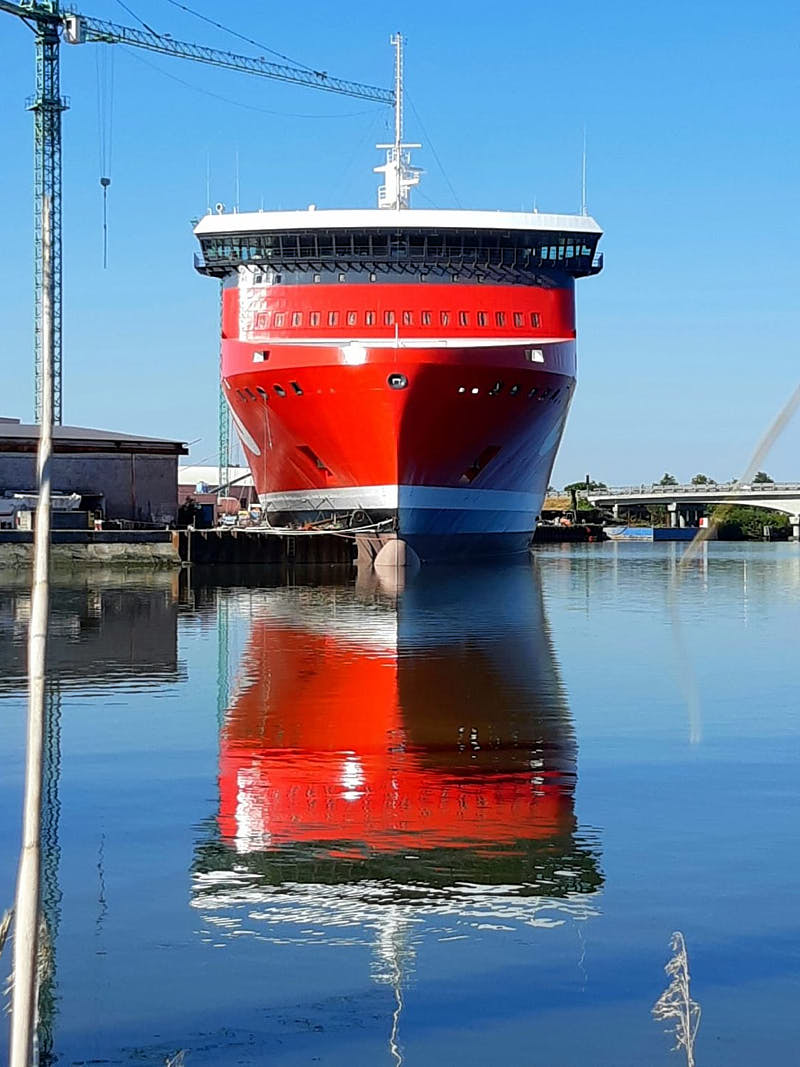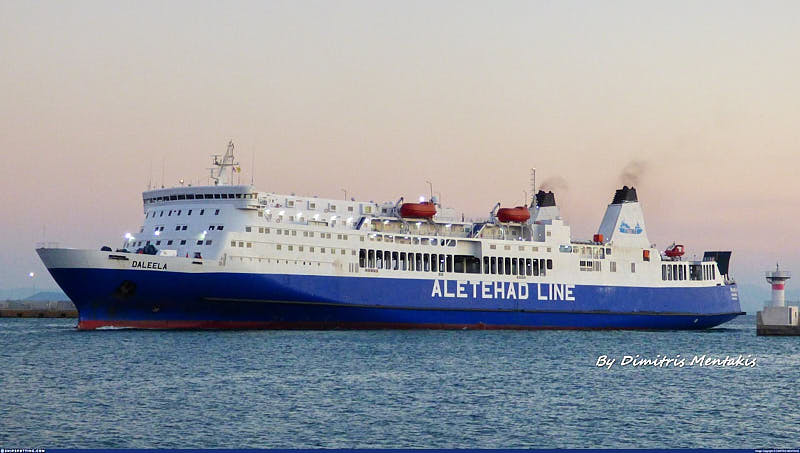
After 14 months of layup at the Perama Repair Zone, the Italian-built EXPRESS PEGASUS of Hellenic Seaways is probably being prepared to go. The ship is out of service since August 2020. Her branding has already been removed.
SUPERSTAR (former SUPERFERRY II) is getting prepared for her fourth career in Greece, this time with SeaJets. The ship is already sporting her new livery. It is expected 100 extra beds will be added in order to offer night service in South or North Aegean routes.
The ports of Stockholm, Helsinki and Tallinn have invested simultaneously in onshore power with the same standards.
All of the ferries operating on Stockholm – Helsinki and Stockholm – Tallinn, already connect to shore power. Now the final part of the puzzle is in place to make it possible for the ferries operating on the Helsinki – Tallinn route to connect to shore power.
Due to increasing demand on the UK, CLdN Ro-Ro will be introducing a 7th sailing on the Zeebrugge –Killingholme service.
As from week 45 the service will run daily (Mon-Sun), offering an overnight connection between the port of Zeebrugge and Killingholme.
Since Brexit , CLdN experiences a growing and ongoing demand for unaccompanied transport between the UK and the Continent.
The modal shift towards unaccompanied transports underlines the need for more efficient transport in view of an ongoing lack of truck-drivers in the Uk and on the continent.
CLdN writes on LinkedIn that it is a top performer for CO2 emissions per tonne of freight carried. This statement is based on public MRV data for pure freight ro-ro vessels, as published on EMSA/Thetis-MRV.
CLdN RoRo says that, with a weighted average emission for its fleet of 36 g CO2/tonne-km ( or 67 g CO2/tonne-nm) in 2020, CLdN RoRo emitted 17% less greenhouse gas per tonne of cargo carried than their second best competitor.
Typical emissions of other modes of freight transport:
Plane: 1036 g CO2/tonne-km
Truck: 137 g CO2/tonne-km
Train: 24 g CO2/tonne-km
CLdN RoRo vessel HERMINE: 21g CO2/tonne-km.
This means HERMINE emits less carbon than a train, concludes CLdN RoRo.
CLdN’s ambition is to further reduce its carbon footprint and to maintain its position as greenest ro-ro operator by:
- Slow steaming
- Innovative propulsion
- Operational efficiency
CLdN asked PwC to run an independent check and the report can now be downloaded via below link (click on page to go to https://www.cldnroro.com/downloads and then go to “Cases”).
April 2022 will see the start of a new ferry connection between Port of Kristiansand (Norway) and Eemshaven (The Netherlands).
- Name of company: Holland Norway Lines (HNL)
- HNL’s CEO: Bart Cunnen – CFO: Patrick America
- Terminal in Eemshaven: 6-8 ha, a special roro-quay will be constructed.
- Ship: ROMANTIKA, 3-year (+1y+1y) bareboat charter from Tallink.
- Frequency: 3 return trips per week
- Departure 3:00 PM – Arrival 9:00 AM
- The initiative Holland Norway Lines is realized with the support of Groningen Seaports, the Northern Development Agency (NOM), the province of Groningen and the municipality Hogeland.
- Holland Norway Lines was founded in 2020.
The contract for chartering ROMANTIKA is the sixth charter contract for Tallink Grupp in the space of the last six months, with SILJA EUROPA and ROMANTIKA both recently being chartered out short-term to provide accommodation at COP26 in Glasgow
The Riga-Stockholm route which is due to re-open in spring 2022, will be operated by Tallink’s vessel ISABELLE.


Boreal is the fourth largest public transport operator in Norway. It has been owned by several funds:
2011-2018 Cube Infrastructure Fund (Luxemburg)
2018-2021 Everbright Overseas Infrastructure Investment Fund (China)
2022 (no later than end of January): Vauban Infrastructure Partners (France) will acquire Boreal Holding AS.
Vauban is a company affiliated with Natixis Investment Managers, and has a long-term strategy for sustainable infrastructure investments.
Vauban manages around € 6 billion and has invested in over 60 companies in mobility, energy conversion and social and digital infrastructure across 10 different areas.
Boreal continues the work on the green shift with full force, and currently has 10 emission-free vessels and 55 emission-free buses under construction.
Vauban will help Boreal to achieve its ambition for further growth in the mobility sector.

“It is the first ray of light we have seen after a period where we have made a net loss of more than EUR 151 million in roughly a year and a half,” says Tallink Grupp’s CEO Paavo Nõgene. “We have unfortunately just reached the low season and the high COVID rates in Estonia and Latvia, in addition to the challenging employment market and high fuel prices, are all indicating it will be yet another tough winter ahead.”
Q3 Results
- Unaudited net profit EUR 5.5 million (net loss of EUR 23.9 million in Q3 2020)
- EBITDA EUR 35.1 million (EUR 5.7 million in Q3 2020)
- +18.6% Unaudited revenue EUR 170.5 million (EUR 143.7 million in Q3 2020).
- The biggest contributors to the revenue increase: onboard restaurant and shop sales, ticket revenue and charter revenue
During the third quarter of 2021, the company strengthened its liquidity position by taking out the loan from the Nordic Investment Bank and carrying out an additional shares emission of the company’s stock in early September. This has enabled the company to secure new capital, creating a strong liquidity buffer for the challenging low season ahead. The total liquidity buffer as at 30 September 2021 amounted to EUR 252.5 million (EUR 115.0 million at 30 September 2020).
Q1+Q2+Q3
- In the first 9 months, the Group’s unaudited revenue decreased by 14.7% and amounted to EUR 310.3 million.
Unaudited EBITDA for the first 9 months was EUR 33.2 million (EUR 6.9 million

Q3
- Revenue EUR 97.5 million (EUR 56.6 million)
- Operating income EUR 26.0 million (EUR -7.8 million)
- Q3 results were characterized by a steady increase in demand in the passenger segment and continued stable demand for cargo transport.
Q1+Q2+Q3
- Revenue EUR 169.0 million (EUR 154.2 million)
- Operating income EUR 30.5 million (EUR -35.2 million)
- Income before taxes EUR 27.1 million (EUR -38.3 million)
- Income after taxes EUR 22.7 million (EUR -30.8 million)
The outlook for the financial year 2021 is unchanged compared to the Half-Year Report as of June 30, 2021, which means positive operating income for the full-year 2021.
An Extraordinary General Meeting, to be held on November 22, will decide to issue new shares to strengthen the capital structure as well as the financial and liquidity position.
The goal is to raise 50 million in equity.
The subscription price would indicatively be EUR 8.00 per share and shareholders of the Company would be entitled to subscribe for 3 new shares for each five 5 shares held by such shareholder.

- Port of Dublin says in its Q3 report that core freight and container volumes from Britain declined by 21.2% to 537,680 units between January and September this year (Holyhead, Liverpool and Heysham).
- In contrast, volumes on continental European, direct routes increased by 36% to 522,765 units. (Mainly Rotterdam, Zeebrugge, Antwerp and Cherbourg).
- Containers and trailers in the RoRo and LoLo modes – the largest part of Dublin Port’s business – declined by just -0.5% to 1,060,445 units but with very different trends between the two modes:
RoRo -6.6% (707,212 units)
LoLo +14.4% (353,233 units)
- Behind the different trends in Ro-Ro and Lo-Lo, there has also been a large and consistent change in the geographical mix of Dublin Port’s trade since the introduction of Brexit border controls in January 2021.
- As a result, unitised volumes on routes to Great Britain now account for just over one half (51%) of all unitised trade where, before Brexit, they accounted for approaching two-thirds (64%).
- Allied to this, the proportion of RoRo units which are driver accompanied (181,605 after nine months) has fallen from 32% to 26%.
- Dublin currently has two shipping lines looking to commence services. They cannot be accommodated. Dublin has a short-term and a long-term plan.