Ferry-Borne Freight Grows at Ports of Stockholm

By 2026 Newsletter week 35

Ferry-borne freight volumes at Ports of Stockholm increased by 3.4% during the first half of 2026, reaching approximately 3.1 million tonnes.

All cargo segments recorded growth compared with H1 2025. Container traffic increased by 14%, bulk cargo by 6% and the number of rail wagons by 17% to almost 3,400, although the latest quarter’s rail data had not yet been included.

Ports of Stockholm said the positive development in RoRo and container traffic underlines shipping’s importance in supplying the Stockholm region.

Read the full release:

Canada Invests $32 Million in Souris Ferry Terminal

By 2026 Newsletter week 35

Transport Canada has awarded a CAD 32 million contract to Dexter Construction to replace the movable transfer bridge at the Souris ferry terminal on Prince Edward Island.

Souris is the mainland terminal for CTMA’s year-round service to Cap-aux-Meules in the Magdalen Islands. The route carries approximately 135,000 passengers and 59,000 vehicles annually.

Design work will begin immediately, with construction starting later in 2026 and completion expected by summer 2028. A fixed transfer bridge has already been installed to maintain ferry operations during the works.

https://www.canada.ca/en/transport-canada/news/2026/08/government-of-canada-invests-32-million-in-eastern-canada-ferry-infrastructure-to-support-connectivity.html

Rolf Nielsen Appointed CEO of Molslinjen

By 2026 Newsletter week 35

Rolf Nielsen has been appointed CEO of Molslinjen and will take up the position on 1 January 2027.

The 48-year-old joins from Hanseatic Global Terminals in Rotterdam, where he is COO. He previously served as Vice President, Head of Hub Terminals at APM Terminals and held several senior positions at Mærsk.

Nielsen succeeds Kristian Durhuus, who stepped down in February. Carsten Jensen, CEO of parent company Nordic Ferry Infrastructure, will continue as interim CEO until Nielsen takes office.

A key priority will be Molslinjen’s transition to electric operations, including the introduction of three large battery-powered high-speed ferries on the Kattegat.

Peter Hove Hildebrandt Appointed CEO of Go Nordic Cruiseline

By 2026 Newsletter week 35

Go Nordic Cruiseline has appointed Peter Hove Hildebrandt as its new CEO, effective 1 September 2026. He succeeds Kim Heiberg, who led the company through its transition from DFDS ownership to Gotlandsbolaget.

Hildebrandt brings more than 20 years of international shipping and logistics experience. Between 1999 and 2020, he held several senior positions at Maersk, including roles in revenue management, optimisation and transformation.

His priorities will include increasing passenger numbers and revenue on the direct Copenhagen–Oslo route, operated by NORDIC CROWN and NORDIC PEARL.

Go Nordic Cruiseline carried 711,700 passengers in 2025, its first full year under Gotlandsbolaget ownership.

DFDS Drops Acquisition of Armas’ Ceuta Route

By 2026 Newsletter week 35

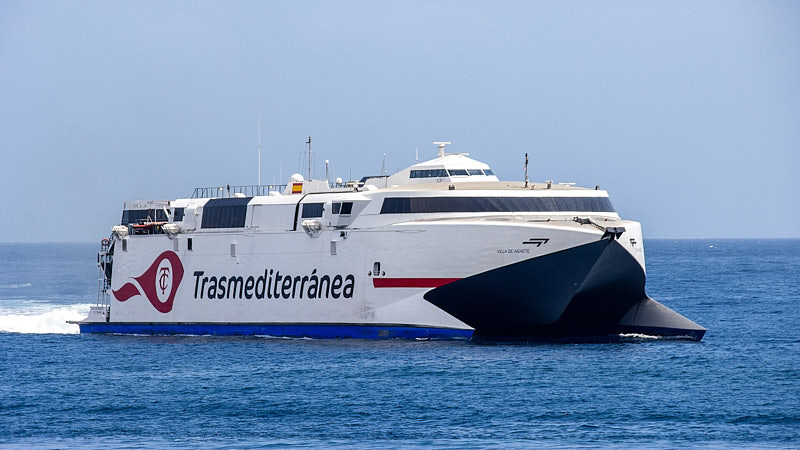
DFDS will no longer acquire Armas’ Algeciras–Ceuta route or the fast ferry VILLA DE AGAETE, as the conditions imposed by the Spanish competition authorities were unacceptable to DFDS.

Negotiations are now underway to sell the route to another operator.

The acquisition of RoPax VOLCÁN DE TAMASITE and Armas’ Tanger Med operating licence by DFDS will proceed.

Source: https://ferrybalear.com/dfds-rechaza-quedarse-con-los-activos-de-trasmediterranea-de-la-linea-algeciras-ceuta-incluido-el-agaete

Photo Mike Peel (www.mikepeel.net). – Own work, CC BY-SA 4.0, https://commons.wikimedia.org/w/index.php?curid=103472730

Dutch Seafarer Pay Claim Could Affect Ferry Operators

By 2026 Newsletter week 35

A Dutch foundation is preparing a collective legal claim on behalf of approximately 23,000 Filipino seafarers who allegedly received significantly lower wages than Dutch and German colleagues performing comparable work aboard Dutch ships.

The wage differences are based on the country-of-residence principle, under which salaries reflect living costs in the seafarer’s home country. In 2025, the Netherlands Institute for Human Rights concluded in two individual cases that differences based on a seafarer’s country of residence constituted discrimination.

The claim reportedly targets both Dutch shipowners and the Dutch State and could seek back pay dating to 2016. The case may have consequences for ferry and RoRo operators sailing under the Dutch flag if they employ non-European seafarers under similar arrangements. Possible effects include substantially higher crewing costs, retrospective claims and changes to crewing or flag strategies.

However, the legal proceedings are still at an early stage. Their wider impact will depend on whether the claim is admitted, the eventual judgment and which employment arrangements and collective agreements fall within its scope.

Industry representatives warn that abolishing the existing system in the Netherlands without international coordination could weaken the competitiveness of the Dutch fleet. The case will therefore be important to follow for Dutch-flagged ferry and RoRo operators.

Source (in Dutch):