Interview with Scandlines CEO Eric Grégoire
Ferry Shipping News – Mike Louagie
Ferry Shipping News – Mike Louagie
FSN: The sea trials of FUTURA, the first fully electric freight ferry, have begun. When do you expect her to enter service?
EG: We anticipate starting commercial operations around 1 June. It is crucial for us to deploy the vessel before the high season. FUTURA will replace KRONPRINS FREDERIK, which is currently used for freight and dangerous goods. By shifting freight to FUTURA, we free up capacity on our four sister ferries on the Rødby-Puttgarden route, allowing us to accommodate more passengers during peak periods.
FSN: Will FUTURA have the same turnaround time as your existing ferries?
EG: Yes, FUTURA will operate with a 12-minute turnaround time, just like the other ferries. While we can technically turn them in eight minutes, 12 minutes is optimal for ensuring smooth freight operations.
FSN: What will happen to KRONPRINS FREDERIK once FUTURA is in service?
EG: For now, we are keeping KRONPRINS FREDERIK as a backup vessel, mainly for dangerous goods. However, it is an old and fuel-intensive ship. We will assess her future once FUTURA is fully integrated.
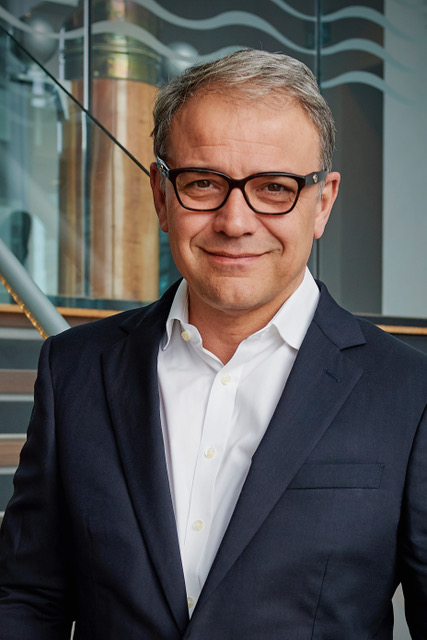
Eric Grégoire – Photo © Patrick Kirkby -Scandlines
Electrification and Charging Infrastructure
FSN: Scandlines has been a pioneer in electrification. What is driving this strategy?
EG: We are committed to being protectors of the Baltic Sea. Our goal is to minimise environmental impact—whether it’s noise, carbon emissions, or waste. Electrification is not just an environmental decision but also an economic one. With modern battery technology, we are saving money while reducing emissions.
FSN: How will FUTURA be charged?
EG: We have already installed a charging tower in Rødby and will add a charging tower in Puttgarden. The plan is to charge at full capacity in both ports, ensuring FUTURA operates efficiently throughout the day.
FSN: Was preparing the ports for electrification a challenge?
EG: We had strong collaboration with utility companies, which helped us install the necessary infrastructure. One key benefit is that we now have a high-capacity power line, allowing us to introduce fast-charging stations for electric trucks in the future.
Port Efficiency and Customer Experience
FSN: Scandlines is known for seamless check-in and boarding. How will this be improved further?
EG: We are implementing license plate recognition, thermal cameras, and automated check-in. This will make the process even smoother. Our turnaround time of eight minutes is unmatched.
FSN: What about passenger car traffic? Do you have many frequent travellers?
EG: Surprisingly, the average leisure customer only takes our ferry 1.2 to 1.3 times per year. Most of our traffic is seasonal, with families travelling during the summer. Business travellers often prefer the Great Belt Bridge for convenience.
Competition with the Fehmarn Belt Tunnel
FSN: Once the Fehmarn Belt Tunnel is operational, how will Scandlines compete?
EG: We are not competing on speed—the tunnel will be faster. Instead, we will focus on the experience. Customers will still need to take a break, so we plan to brand ourselves as “the moving stop”—a place where travellers can eat, relax, shop, and charge their electric vehicles.
FSN: Will freight customers also benefit?
EG: Absolutely, and this is an important point. Truck drivers are required by law to take rest breaks. If they drive off the ferry and immediately continue their journey to find a safe parking area, that segment is still counted as “driving time.” However, if they move their truck from the ferry directly to a charging station within the port area, it is legally considered part of their rest break.
This means drivers can take a proper one-hour break while their truck charges, without using up their driving hours. This is a major advantage over the tunnel, where they would need to stop later at a rest area, cutting into their driving time.
Future Strategy and Fleet Development
FSN: What is your long-term vision for Scandlines?
EG: We will evolve into two distinct segments:
We are also investing in port services, such as truck charging stations and resting areas.
FSN: How is Scandlines preparing for upcoming environmental regulations like ETS and FuelEU?
EG: The ETS (Emissions Trading System) has been accepted by most customers since they pass costs on to end users. However, FuelEU is the real challenge, as it forces efficiency improvements beyond just carbon pricing. Fortunately, Scandlines has been working towards this for years, unlike some operators who may struggle.
Technology and Artificial Intelligence
FSN: How can AI improve ferry operations?
EG: We are using machine learning and AI for autopilot optimisation. AI analyses wind, currents, and fuel consumption to find the most efficient route, rather than simply following a straight line.
AI-driven improvements might only increase efficiency by 1%, but electrification changes efficiency by tens of percent—that is where the real impact lies.
Final Thoughts
FSN: What can we expect from Scandlines post-2030?
EG: A fully modernised fleet with:
By splitting freight and passenger operations, we can offer the best service for both.
Scandlines will remain competitive, sustainable, and customer-focused, even in the post-tunnel era.
Ferry Shipping News thanks Eric Grégoire for this insightful discussion. Scandlines is clearly shaping the future of ferry transportation with bold investments in electrification, efficiency, and customer experience.